October 23, 1988
Drove to Broderbund early in the morning, let myself into the building and worked for ten hours straight. Like in the old days. I’m starting to see code patterns floating in my brain as I drift off to sleep at night… and, disturbingly, when I wake up in the morning.
The game and the editor are now integrated on a single disk. Very slick.
Five months of this and I really will be done by March.
November 11, 1988
“I like games where you can shoot things. Your game has no rewards except getting to the next level. It’s all survival and no triumph.” –Tomi
She’s right about POP. It’s empty and lifeless. I don’t know if even the shadow man and swordfighting will change that.
On the other hand, I put in a new door which looks pretty good.
Oh, God. I want this game to be a hit. Like Karateka.
Maybe this whole modular-design approach is wrong. Maybe the thing to do is put in a whole bunch of hard-wired enemies, one after another, and forget the whole free-floating, random-access, 24-screens-per-level idea.
24 screens, if they’re linked sequentially, could give a playing experience as satisfying as a whole level of Karateka. But they should be in the form of obstacles to be overcome one after another. For example:
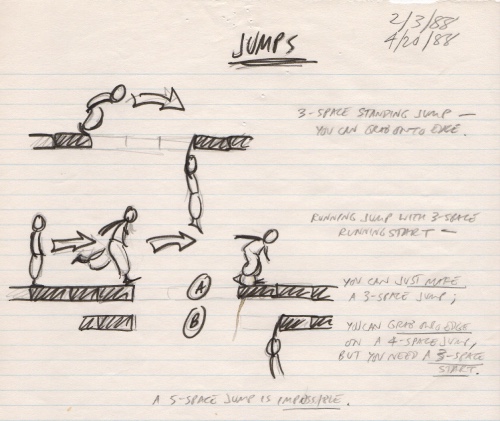
- A chasm that has to be jumped
- A gate that has to be raised
- A guard that has to be killed
The way it is now, you’re plunged into a huge arena with no overall idea of what you’re trying to accomplish except “get out.” It’s too perplexing, especially at first.
Maybe after the first 10 or 15 levels, I could start introducing some real Lode Runner/Dr. Creep “puzzle” type game play. But in the beginning, it should be pretty much left-to-right (like Karateka) with a little bit of up-and-down. So the player can get his bearings.
YEAH!
November 12, 1988
Still not enough.
What’s the point in running, running to get to the exit, if all it gets you is more of the same?
The princess waiting at the end is a reward only in the story. We need rewards in the game – like beating a guard in Karateka. What makes a game fun? Tension/release, tension/release. Prince of Persia has neither. It’s like going on a 25-mile hike. Every now and then, you get to step over a log or cross a stream. Big deal.
Running, jumping, and climbing, no matter how beautifully animated, hold your attention for maybe the first three screens. Then you start to wonder: when is something going to happen? Like: a guard to fight. An airplane to shoot down. Something.
There need to be sub-goals. Places where you can say: “Whew! Did it! That was a tough one!…What’s next?”
Like:
- clearing a screen in Asteroids or Pac-Man
- beating a guard in Karateka
- solving a level in Lode Runner
Right now, solving a level in Prince of Persia has none of the feeling of accomplishment of any of these. It’s more like “Oh… so that’s the end. Oh.”
What elements do All of the Above share?
1. You can tell at any moment, by glancing at the screen, how close you are to finishing, how much is left.
2. There are setbacks and successes on the road to ultimate success. You get a smaller version of the “Whew! Did it!” when, say, you clear a difficult area (Pac-Man), or drive a guard back with a series of blows (Karateka), or retrieve a hard-to-get sack (Lode Runner). Conversely, you get the “Oh, shit…” reaction when you accidentally split up a bunch of bigger asteroids into more smaller, faster ones; or when you finish a pattern and see that you’ve missed one dot; etc. Some setbacks are fatal, some are just irritating. But when they happen, you feel they’re your own fault.
3. You can hold off on the next task, waiting for the right moment, before saying “OK… Now” and going for it… plunging into a period of higher tension, higher chance of either a setback or success.
Persia has none of these features at present.
If the sub-goal is “solving the level,” you need a consistent visual indicator of how close you are. You don’t just stumble onto the exit and say “Oh—guess I’m done.” Or stumble onto a sack of gold and say “Oh—here’s another one.” That’s why collect-the-dots games like Lode Runner and Pac-Man always show the entire screen at once. That’s key.
But POP doesn’t show the entire screen at once. That’s a problem.
November 13, 1988
How can I be so up on screenplay story structure, and so blind when it comes to my own game?
A story doesn’t move forward until a character wants something. So – a game doesn’t move forward until the player wants something. Five seconds after you press start, you’d better know the answer to the question: “What do I want to happen?”
There always has to be a range of possible outcomes, some better than others, so you’re constantly thinking: “Good… Bad… Terrible.” Every event has to move you closer or further away from your goal, or it’s not an event, it’s just window dressing.
The overall goal of POP is to get the girl. But that’s not a strong enough magnet to pull the player through all that distance. It needs sub-goals.
Beating a guard in Karateka buys you time to gain distance. You want to get closer to the palace because the princess is there; every guard you beat brings you closer. It’s simple, but it works. In psychological terms, it even follows the classic addictive pattern of diminishing rewards: each subsequent guard is harder to kill, and gives you a smaller reward for your pains, until you reach the intermediate goal (the end of the level), at which point there’s a bigger reward, and things get easier again…. for a while.
Getting through a dungeon in Prince of Persia doesn’t give that satisfying feeling of getting closer to the goal. Partly because it all looks pretty much the same. That, I can fix.
But there’s another key element in story stucture that also applies to games, and is missing from this one: The Opponent. Someone competing for the same goal as the hero, or trying to stop him from attaining it. The more human, the better. (The days of Asteroids and Pinball are over.)
In this case (we’re short on time, so let’s use the opponent we’ve already got), it’s Shadow Man.
Some games boast a whole series of different opponents. (According to Truby, this is characteristic of Myth, and it weakens the story.) We’ll make the shadow man your opponent for the entire game. You’re competing for hit points. Each blow you deal him weakens him. Each power dot you eat makes you stronger. But if he gets there first and he eats it, he gets stronger. So when you face each other with crossed swords, the balance of power is not predetermined (as in Karateka), but is the result of your own actions thus far in the game.
It links the combat with the running-around. It’s brilliant. I love it!
(Forget the boring damn keys.)
November 14, 1988
Spent the morning talking to Eric about the game. Conclusion: My next step should be to implement the fighting. Until I do, it’s too difficult to imagine in the abstract what the game will feel like to play.
November 17, 1988
Showed POP to the Tribunal – Gary, Gene, Brian, Sophie K. (of Marketing), and Ann Kronen.
Ann and Sophie, who hadn’t seen it before, gasped over the animation. Gene grudgingly admitted it might be pretty good, “if it ever becomes a game.” Gary liked the puzzle angle, didn’t mind the two disks, liked the level editor, didn’t think it needed all that much combat, thought it had big conversion and coin-op potential and I shouldn’t limit it on account of the Apple II’s shortcomings.
I’ve got to learn to get more pumped up for these things. I was so blasé, I really brought the energy down in the room. I think they’d have been more excited if I hadn’t been there to demo it.