This is an archive of old blog articles from 2008-2013. Read the latest news from Jordan.
Old notebooks
I started keeping a journal my freshman year in college, and kept the habit for years afterward. I'm still not sure whether it was a good habit or a bad one. A few months ago, when I sat down to write an afterword for the Prince of Persia graphic novel, I pulled out those old notebooks and started to browse through them, figuring it might help me wrap my mind around Prince of Persia's 20-year history.
It's all there. The story of how Prince of Persia came to be, and almost didn't. It occurred to me that as a case history, a time-capsule view of the videogame industry as it was in the 1980s, this was a story others might find interesting too.
So even though the last thing I need is another hobby — especially one that involves spending more time at the keyboard — I've begun posting those old journal entries, a kind of blog from the past, starting in 1985. Check out the "Old Journals" and let me know what you think. If enough people are interested, I'll keep posting — ideally, at least through the end of 1989, when... well, you'll find out.
The entries are selected and abridged — most of what I had on my mind at age 21, you don't want to hear about — but on principle, I've let things stand as I wrote them, and avoided the temptation to revise with hindsight.
Comments (...)
My first day on Prince of Persia set
Here's a page I started on the midnight flight from Casablanca to Ouarzazate and finished the next morning when I arrived on set.

What the drawing doesn't show is that it reached 125 degrees that day (52 Celsius).
Comments (...)
I can't believe you didn't take me!
great drawing ! we want to see more !
(and nice website)
did you finish my sketchbook ?
I was just in Ouarzazate! Back in June. And it was already incredibly HOT back then!
http://www.facebook.com/friends/?ref=tn#/album.php?aid=94911&id=1031301342
Alex — I did finish, and I started a new one! Moleskine again, of course.
Writing a video game
The Sands of Time: Crafting A Video Game Story, an essay I wrote a couple of years ago for MIT Press, is now available online. If you're curious about the nuts and bolts of video game writing — and how it's different from screenwriting — check it out.
Comments (...)
This was a fascinating article, thanks. I've wondered about how to develop stories for videogames, but I'm not that much of a gamer — at least not with the current crop. Do you feel that's a hinderance?
Jordan -
That was a great piece. I've been telling stories cinematically for about five years, and as a gamer have had several ideas that leaned into gaming territory. While I've been met with the usual "it's too hard to break in" blather, I've found very little real information about the process. I'll be following your blog closely from now on.
Thanks again!
hello mr jordan if you read this message i want that you know that it's my dream to speak to you face to face and perhaps make the 5th prince of percia together .....i hope ^^
thanks
Hi Jordan, I would love to read this article you refer to, but I believe the link is broken. If you have time, can you shoot me an email with the correct link?
Thanks!
Susan
Hi Susan,
Thanks for bringing our attention to this. The link is now fixed.
Sketchbooks

As a kid I was pretty good at drawing... until I got my first Apple II computer. After that, I did the occasional scribble-sketch, but my level of skill basically remained frozen for the next 30 years. When you stop drawing, you get rusty very fast.
Over three decades of writing, programming, and other left-brain activities, I pretty much forgot that I'd ever known how to draw.
Until ten months ago. It was in Paris, a city where unexpected things often happen to me. The first day after flying in from California is always a bit surreal anyway; you force yourself to stay up and walk around in the bright daylight, even though your body wants to be asleep and dreaming. On that day, to stay awake I went to the Jewish Museum in the Marais. They had an exhibit called "From Superman to The Rabbi's Cat" about the history of comics.
As I prowled the museum, it gradually became intolerable to me that I had gotten to a point in my life where I could no longer express myself through drawing. I don't know if it was the comics or the Holocaust memorabilia that tore it, but the next morning I bought a sketchbook and a pen and started drawing people in the street, in cafés, at train stations. That was last December. I've gone through three notebooks since then.
Now, I'm addicted. These days, when I'm in an airport and my flight is delayed, I hardly mind, because it's a chance to draw. I love drawing even when the drawings don't come out right. It's a trance state, like playing music or skiing: Even when it's bad, it's good.
Comments (...)
Drawing was the first thing that put me into that artist "trance state" too. But I was mostly drawing the faces of Ryan Gosling and Christian Bale. And then hanging them around my room. And kind of scaring my mom.
I found you through John August's blog and am a PoP fan from way back as a bonus.
I am forwarding your post to my wife who has packed away her sketch pad for far too long and needs a reminder to pick it up again.
Keep up the great work!
It is an addiction. It will eat you! It will suck and crunch yer bones; it'll masticate you and munch you up and you'll feel all the better for it. And you already know I love yer drawings. Lovely site, matie; look forward to visiting on a regular basis.
Prince of Persia and Persia
Reader Masoud Shoushtarian asks about the Prince of Persia movie:
- do know about persian culture and persian civilization?
- why do you make this movie without iranian actor or actress?
- why don't you make this movie in iran?
The story and screenplay for Prince of Persia were inspired by many sources, especially the tales of the 1001 Nights and Ferdowsi's Shahnameh (Book of Kings). In doing the research I read pretty widely, including the lives and writings of Omar Khayyam, Rumi, and Ibn Battuta, and modern histories such as Frye's The Golden Age of Persia, but my goal was to create an entertaining fantasy in the spirit of the 1001 Nights.
In my afterword for the Prince of Persia graphic novel (which was written by an Iranian author, A.B. Sina) I talk a bit more about the origins of Prince of Persia and its connection to Iranian history and legend. The graphic novel site also has an interview with A.B. offering some of his thoughts on the subject.
The movie casting and location decisions weren't mine to make, but the choice to shoot in Morocco and the UK was certainly based on practical considerations including availability of locations and production facilities. For similar reasons, Kingdom of Heaven, Black Hawk Down, and Asterix and Obelix Meet Cleopatra were also shot in Morocco, although those stories take place in Jerusalem, Somalia and Egypt respectively.
Comments (...)
Hello Jordan,
You've said you didn't make the casting decisions, but can you tell us:
Is it true that David Zandi was once seriously considered for the title role?
How do you feel about the film's white stars?
If it were your choice, would you have chosen any differently?
Thanks!
My studio friends say David Zandi was considered, but passed on because he is a homosexual.
Old journals, continued
Just posted a new batch of old journal entries, bringing us up to September 1986.
Many thanks to all the readers who have written in to comment on the old journals. The October 1985 animation reference video seems to be especially popular.
So OK, the die is cast... I'll continue this "blog from the past" so you can follow the development of Apple II POP (and related matters) in all its gory details. True diehards can subscribe to the old-journals RSS feed here. And yes, there will be more videos to come!
Comments (...)
OMG! These old journals rock!
I'm really, really, really looking forward to more old journals!
Just wanted to say that :)
I want to read them forwards. How do I access the first entry rather than having to click back from the last entry?
Alex — link added; see above.
These journals are fascinating — I'm amazed that you kept such a detailed record of the design process at the time! I encourage you to keep posting them. I find the little videos awe-inspiring too — it's fun to see how they compare and contrast to the final element.
I'm very pleased with the trend of writers, game designers, filmmakers, etc. cataloging their design process — the little stories of history, told as they were formed (and not idealized), are beautiful.
An Albanian motorway

This tunnel is part of a highway being built through a mountainous region of northern Albania, connecting the Adriatic port of Durres to southern Kosovo.
I showed my sketch to a Turkish engineer who'd been watching me draw. He studied it briefly, then shook his head and handed it back to me with one comment: "You drew that pipe crooked, but in reality, it is straight."
I couldn't help thinking it would have been a great setting for an episode of Ops.
Comments (...)
Great sketch!
Little Big Planet
...is beyond amazing. It warps my mind to even begin to imagine some of the things people are going to do with this.
I did spend a good hour last night playing a strange new form of Tetris. It's even more fun with two players.
Comments (...)
I too had a go at it this weekend and was baffled by the sheer size of it. It is the sort of game that makes me want to be, once again, a 14 year-old with nothing to do in the long summer vacation. Well, maybe I'll keep the game safely stored so that I can enjoy it later: either in between jobs or in the golden years of retirement!
That looks like a really interesting game! I love the physics of it! Really good animation! Is it PlayStation only, or is it available on PC too?
Really old journals
My college classmate Alex Epstein tipped me off that someone has been posting Samuel Pepys' diary, 343 years later to the day. So my old journals aren't so old.
Comments (...)
Union Square

Comments (...)
i like this a lot.
now we are blog friends
I didn't know you were drawing Jordan! this is actually really good! you are better than I am for live sketches!
Love the simple shading technique you've used. It gives a lot of depth to the picture.
Down the rabbit hole
One of my most hopeful daydreams as a kid was to discover a secret compartment in our house, perhaps in a wall or under the floorboards, containing a cache of old papers that would set me on the trail of a long-hidden secret. (Since the house was built in 1970 and we were the first occupants, this was about as likely as finding a dinosaur fossil in one of the metamorphic rocks in the woods around our house; but it took me a long time to give up on that search, too.)
A few months ago, my friend Barry Isaacson actually did find a cache of old papers hidden in a secret compartment in his house. The real-life horror story they revealed is enough to give any child, or parent, nightmares.
Here's Barry's story as he wrote it for the LA Weekly.
Comments (...)
I've watched my share of thrillers and horror movies. I've never felt so frightened as when I watched a recent documentary (http://www.imdb.com/title/tt0762111/) about Jonestown. I had read about it, but actually seeing the testemonies of people who survived the tragic incident left quite an impression.
Great article, thank you for sharing.
Thanks for reading the article Bruno; I'm glad you liked it. I guess we all think it couldn't happen to us, but this is "us".
Ouarzazate

Sometimes I add sepia ink wash to my sketches afterward. I'm always nervous that I'll ruin a perfectly good line drawing, but it's amazing what a difference even a touch of color can make.
Comments (...)
Hi Jordan,
Really enjoy your sketches. What type and size sketch book have you been using lately? It looks like it's got one of those elastic things that come on the moleskin notebooks.
cheers,
Peter
P.S. Big fan of your Prince of Persia videogame — looking forward to seeing your adaptation on the bigscreen!
Moleskine 5x8. They're almost too trendy, but they really are good quality, and the elastic band and the pocket in the back are useful.
Thanks Jordan!
Forgot to ask, what do you use to sketch? Pen, pencil and what type? Thanks!
I agree — I tend to keep a crayon with my journal for similar reasons. (I like crayons because they give a similar depth, but can be kept in my pocket.)
Hi Jordan! Your sketches are great! And the prince of persia is simply top (along with another world). One question: what do you use for line drawing?
Postscript
Designating a particular moment as the end of the story is basically arbitrary, because life just keeps going on (I think that's what David Chase was getting at with the Sopranos finale)… but January 1993 seems like as good a point as any to stop.
From here on, my old journals are increasingly taken up with the saga of Smoking Car Productions and The Last Express. Which is a good story too, but for another time.
My thanks to all the readers who've followed the seven-and-a-half-year tale of how Prince of Persia came to be. It's been fun for me, revisiting those days. I'll leave all the old journal entries up on the site, and will continue to welcome your comments and questions as always.
— Los Angeles, November 2009
Comments (...)
Thanks for sharing these journal entries Jordan, it was great to read about the journey of this fantastic classic.
I never knew (before this) that you were planning to release a 4th game by '96. I've been want closure on the ending of Prince 2 since '94.. :(
I hope that some day you will revisit your ideas for Prince 3 and have Gameloft (Ubi) produce a XBLA/PSN version. I guarantee that it will hugely surpass the sales of Prince of Persia Classic.
Best wishes, and thanks again!
Thanks so much for putting up your journals! I had no idea that the core of one of the few games that started my love affair with computer games (mac Prince) was created mostly by a single programmer. I believe it was on the mac demo disk that came with my Mac Performa 600 (a 68030).
Besides that, the journals were a long read, but they were great. It had parallels with what I'm trying to do in web software, and the way I do my work. It echoed my wanderlust and my restlessness. And, it gave me a lot of things to think about. They made me realize simultaneously that success requires the help of other people, and also that I may be stuck in a rut. Again, thank you!
Mr. Mechner, thanks for sharing this awesome story with us. You and Mr. Suzuki are my inspiration to continue my game developer career. I hope we can meet each other someday.
Keep up the good work, life just goes on.
Dear Jordan,
For a very long period of time I thought of you as of the creator of "Prince of Persia" saga. However, getting acquainted with "Last Express" less than year ago made me change my mind. Now, I consider that "Last Express" is your gratest archivment - as well as the absolute best game I ever played.
I know that it was a huge commercial disaster and it may be that you have many negative recollections related to market fate. However, I would be the gratest pleasure for hundreds of thousands of your fans to learn the true history of "Last Express". So, if its possible, please, continue publishing of your diary.
Thank you very much for all the games you worked on and sorry for my English.
Please, please, post The Last Express entries when you have time. I will wait for them. To me the game is very precious. Thank you.
Thanks very much for posting your old journals! They've been fascinating to read. I would have liked to reach the point where Prince 2 was actually shipped and reviewed, considering what a let-down the Prince 1 launch was. I can see why you stopped here, if your journal entries don't actually go into that much.
Prince 2 blew me away. I took pride in showing the game to people, and watching them gasp because it had actual speech. The art, story, and levels were all amazing.
Basically, anything you post I will read with great interest. Congrats on all your successes.
Thank you so much for these journals, Jordan!
I found it through the Wikipedia article about the original Prince of Persia and spent much of today reading my way through the whole thing. Aside from being excellent procrastination-fodder, it was also incredibly inspiring to read about your troubles and the ways in which you handled them.
You actually inspired me to start using my own website more effectively for my own use. Hoping that writing about what I do will help me do what I set out to, especially since I'd have to explain to myself and the five people who read my blog why I haven't done anything some days.
Also, this whole thing got me jazzed up about playing POP again. I actually never finished it way back when.
I want to say thank you for the hard work in putting these on-line. I have enjoyed visiting here everyday to read some wonderful stuff.
Prince of Persia blew me away when I first played it on the Amiga. It remains one of my all time top 5 games.
What a riveting tale! I was both dismayed and gratified when your server went down earlier today; I could actually get some work done. Very inspirational, I'm looking forward to more. Reminds me that I should be keeping a journal.
Thank you so much! I went through the whole journal... it's 6:12am right now. Truly, truly inspiring. Thank you.
I've stolen an hour here or there every day for the past week to finish reading your journals. I feel like you could take a small cut of them and publish them as a wired article on "the insides of game publishing". Its a wonderful thing to follow through with a project that you love, though it seems it rarely feels that way when you're nearing the 99% completion mark.
I hope life has found you well, I'm sure I could check up on your current happenings, but for now I'm going to think of you as a 25 year old game developer figuring out life, business and passions. (And of course consider your journal a reflection of myself.)
Thank you for sharing.
What an amazing ride... This was a joy to read! Thank you for sharing. This really could be a movie some day. It would be really cool if our paths crossed in the future and I got to shake your hand. I am a huge fan of your games starting with Karateka. Cheers.
Brilliant. I love reading about the infancy of the gaming industry and the pioneers behind it.
Hola señor Jordan.
Espero que aun practique su español, quiero comentarle que soy de Mexico, tengo 25 años y me encuentro creando una empresa de desarrollo de video juegos junto con cuatro amigos, y me encuentro muy deprimido por el poco apoyo que encuentro en mi pais, sin embargo al estar leyendo su diario, me he llenado de animo para continuar.
Espero algun dia pueda estar frente a frente con usted y no solo saludarlo sino mostrarle mis videojuegos.
¡Hasta luego!
PS:It Will be a pleasure to follow your steps, and above all I hope that my games are worthy challengers of yours.
Such a fantastic read, Jordan. I spent the last few days reading this in-between working and found it inspiring and a great record of the time. Do you think it's time to write your memoirs for real now?
Thank you, sir. I'll continue to enjoy your POP games for years to come, I hope and pray! The work that you've done to ensure that this story is alive and available for the fans is much appreciated! I enjoyed it all so much and look forward to viewing more of your site as I can. Thanks!
Thanks for sharing these great journal entries, it was a pleasure reading it, even back then you were already a great human being!
I devoured this journal a month ago, cutting and pasting snippets of text that really struck a chord with me. I printed them out and taped them up; I'm so suprised how much they've kept me focused and "up" for life, surviving this Hell that's been 2009. As I make an inventory of '09 I wanted to thank those words for being so positively affecting and for coming so unexpectedly:
"You dumb shit. You've dug your way deep into an active gold mine and are holding off from digging the last two feet because you're too dumb to appreciate what you've got and too lazy to finish what you've started."
It's true: People like you better if you stand up for yourself. There's no percentage in being self-effacing and making them think they can walk all over you.
Everyone has their own particular form of self-destruction. Mine, I'm starting to think, is standing outside myself, watching myself live my life, turning my face so as to give the cameras a better angle, and thus missing the whole thing.
The more experiences I have, the more I realize that working with people you like and respect is more important than anything else.
"You know, there's a lot of poverty and injustice here… only a few people are really living, the others are just struggling for survival."
I know myself well enough to know that whatever happens, it won't be my excesses I'll regret, it'll be the things I held myself back from doing. In all my life I've never yet given a present so lavish, or made a gesture so expansive, or indulged a pleasure so recklessly that I regretted it later. Whereas there are so many things I look back on now and think: That was one of the high points, that moment will never come again, why did I hold back?
I know it's possible to err in the other direction too, to screw up your life by not thinking of the future. I just don't think I'm nearly there yet…
thanks again! between Book of Eli and the PoP movie, here's to oh-10 ushering in the DECADE OF THE NERDS!
This was a fantastic read, and very inspiring even though I'm not a game designer, film director or anything analogous to what you are doing.
I'm off to do some things I've been procrastinating on for far too long. Maybe this time around the sense of carpe diem that's been built up through experiencing these slices of your life will stay embedded in this dilapidated cathedral of potential.
Best of luck to you with your new movie and game,
Lars
It's 5:02 am; I just spent a good 3-4 hours reading through this. Though I did skim a few entries (maybe more than a few) this was as gripping a read as any I've had in a good while. It scares me to think how much time it took you to type all this up, though.
Just wanted to add to the chorus of approval. Inspiring, enlightening stuff.
and sorry for the crappy English in my previous comment :D
What can I say? Thank you for sharing. Thank you for the opportunity of reading a fascinating piece history. Thank you for making me see that I'm not the only one asking the questions I ask, facing the decisions I face. Tank you for the proof that one can succeed.
And thank you for a great game. Even if it's older than me and I didn't get to play it.
You're great! Hope you'll read this comment (and all the others), and maybe you'll smile for a second. I sure know I did when I finished reading your journal :)
Wow I just spent 3 days reading these when I should have been doing other stuff.
Great stuff.
Dear Mr. Mechner,
This journal may be the best screenplay you ever wrote !
I found myself picturing various scenes and characters....
( read the whole thing in 4 hours)
Truly amazing story !
Regards
T
Oh I forgot to add that i spend countless hours and days playing PoP back in 92'
Well that's several hours of my life spent reading these. I loved reading your exploits, trials and tribulations of getting Prince out there. I didn't actually play PoP till quite late in the grand sceme of things but I do remember advising a girl at school what to try. Appraently I gave great advice, didn't help me with flirting with her though.
Thanks for sharing, that was an inspiring read.
Yes! So many great snippets that inspire me to invigorate my own life!
(And yet great procrastination fodder too, as someone else wrote! Took me hours, glorious hours to get through the whole thing!)
The best thing I've read in ages.
Thanks so much for KEEPING a journal, and once again for SHARING it with us all.
I'm just starting my own game development business, all on my own, a dream I've had since I was about 6, in 1984, playing King's Quest, Digger, Alley Cat, and later Prince of Persia which really blew me away.
This is a real inspiration, and a great time for me to reflect on where I'm at, and have a good look at what I have planned for the coming year as I release my first game, and onwards!
As a musician, filmmaker and game designer (who's doing the art, code, sound and design all by himself), this journal resonated so deeply with me. It's a very special thing!
THANK YOU JORDAN, and all the very best!
Murray
www . muzboz . com
Thanks for putting up your diaries. It was all a fascinating story. I read it because I loved the Prince of Persia 1 (pirated, sorry, we were to far away and too poor to pay; I'll donate $5 to the local ASPCA to make up for it) and still have a fond spot for it in my heart. And this is coming from a girl geek. :)
Wow. I started reading this journal last night and and throughout today and now I'm finished tonight. A very interesting read, which keep me wanting more.
Reminded me of the great Diary of a Game magazine articles back in the day but the insights to a computer company in the 80's really added to it. I'm glad it all worked out for you.
Definitely a good read. Not a "reach out for your dreams" piece that is meant to inspire you to do what you always wanted, but a "look at what you already have". So many times, early in the story (later parts just drove it home), I was thinking "Why, WHY, Jordan, do you pursue the screen writing like some golden fleece? Everything screen writing could bring you, you've gotten from game design! Why do you not see this yet??"
When you were puzzled over what possible use you could have for a pair of Apple IIs, I was too, a bit. Until I remembered multitasking was a crazy future-man thing. It felt like archaeology reading the early stuff. As a child, Prince of Persia (among others) made me want to design games for a living - never mind that my parents and teachers all drubbed that out of me, and my IT teacher crushed my passion to program, the point is PoP, and games like it (not in style but in quality and execution) were some of the first things I appreciated. Not long after, I started reading, too (three or four years old), and books joined them, but games are the first love of my life :D
I'd just like to say, and I'm sure I speak for all of your fans when I say this, thankyou for the entertainment you've brought us all. For some of us, it's childhood memories, for some, it's their adolescence, or they discovered games as adults, but the sentiment is all he same. Thankyou, also, for taking the time to transcribe all these journal entries. I never even had the patience to KEEP a journal, let alone one like this.
WOW! Read all 67 pages, how not to love this history of winning and good code? I've played your games and always though you to be such a gifted man. Almost cried when I saw your name in the prince of persia movie. But I couldn't imagine an history like that. May God bless you and I hope someday I can make something as big as you, to be remembered as someone who gave so much happiness to the world :D
Greetings from Brazil!
The most inspiring, thank you very much.
Twenty years ago your game blew my mind and that was fine, but tonight, reading your story has given me a whole new outlook on my own life, you have no idea. Thank you!
You bastard.
I was about to go to sleep, when I found a link on wired.com about the source code for PoP beeing 'rescued'.
A bit of reading and clicking I found this.
The hope of 8 hours of sleep before work is now, at best, 4 hours.
This has been the best read on the Internets in a long, long time. I applaud you, sir!
Thank you!
/M
Thank you for publishing this. It was quite a journey (I read it almost non-stop, just taking a few breaks to eat something and take me and my dog for a walk).
I still remember the first time I see Prince (DOS version, back in the early nineties, I think). This older kid showed it off to me and my brother. He was kind of a jerk and didn't let us play it.
Some years later I spent countless hours on it on my mom's Classic.
The most curious thing is that since then I lost almost all my hearing but I still clearly remember the sound the tiles made when you stepped on them and that of the doors and the amazing splat. I can recall it better that most of the music I loved in my teenage years, and the voices of people I loved and hated it. And that's something.
Drawing from life

This life drawing workshop was a cool way to spend a Monday evening. I got a lot of inspiration seeing the other artists work. Some of them were really good.
I did this page during the breaks and actually like it better than my drawings of the model. It's more interesting to draw people who are doing something, than a model who's holding completely still.
Comments (...)
Game to movie to graphic novel
This month's Game Informer magazine has an opinion piece I wrote about the creative process of adapting a property across different media. You can also read it here.

Comments (...)
This article makes me want to read the graphic novel more. I ordered it, and it should arrive somewhere next week. :)
That was real good article. Thank you for bringing light on it. I was wondering how would Prince of Persia be adapted for a musical or theater production in your opinion?
I just wanted to say I really enjoy your website so far. With writings like these plus your old journals, you give off a very relaxed insightfulness, instead of the opinionated yelling of many blogs on the internet. Plus, the journals are great to read for someone who's somewhat young and trying to put together their own life path.
Hi Jordan,
When will we see the first bit of marketing from The Sands of Time movie? I heard that the poster will be seen in "Confessions of a Shopaholic". I thought one would be released online as well, but so far... nothing.
I seem to be the only person really looking forward to this movie - can't find any active forums/message boards either. It's so frustrating!
I need my PoP fix! :)
nicely written jordaninsitful and succinct.
I meant "insightful and succinct"
Hang in there Rohit... that train will leave the station pretty soon!
awesome information. I am happy I found this blog.
Thank you for this informative blog. A graphic novel is a book made up of comics content. Although the word "novel" normally refers to long fictional works, the term "graphic novel" is applied broadly, and includes fiction, non-fiction, and anthologized work. It is distinguished from the term "comic book", which is used for comics periodicals.
The Last Express remembered
Gamasutra posted a great interview with Mark Moran and Mark Netter about the making of The Last Express.
I'm writing this from London, where the Prince of Persia movie is shooting now. The Pinewood studios, originally built in the 1930's, still feel very much of that era, at least to my L.A.-accustomed eyes. The contrast between the dilapidated physical infrastructure, and the state-of-the-art technology being used inside the stages, is striking.
Whereas the state-of-the-art technology we used to make The Last Express is now as quaint and dated as the 1914-era steam locomotives that were still in service when the Pinewood stages were built.
Pinewood is in an industrial park west of London. To get there, you take the A40 highway, which was originally a Roman road. It was already old in the sixth century, when Prince of Persia is set.
Jet lag makes me think about stuff like this.
Comments (...)
Heck this game needs a MOVIE made out of it. Or something! I wonder, do you still have the original film shoot of it?
Does anyone know what type of locomotive the steam engine is in the game?
Hi Jordan,
A group from my school which included myself visited the pinewood studios on the 1st of december and got a tour of the surroundings. We were fortunate to meet you there and to see the brains behind it all.I hope that the film will be a great success for you and the production crew,all the best. We throughly enjoyed meeting you.
From Adam Guinness, The Academy of Saint Francis of Assisi.
This game needs a re-release. Would that happen to be in the cards?
Man I wish I could find a copy of The Last Express for OSX. A Scanner Darklys rotoscoping techniques really inspired my current digital drawing style, and I'd really like to go back to the source of their inspiration. It's like how my love of Frazzetta led me to Bridgeman [or my fathers love of Eisner also led him to Bridgeman].
Also, Mr. Mechner; when are you going to post your thoughts on Ubisoft's new take on your character? I haven't had a chance to play it yet, but Its visual style has kept me very excited about it.
Hi Jordan,
I love your work, especially Prince of Persia, including the original 2D versions.
Related to The Last Express though, I am hard of hearing and most of the game does not subtitle the English dialog. I would greatly appreciate if you could share a script of all the dialog so hard of hearing players won't be lost (as I am now) when playing The Last Express? It's difficult to finish without hearing everything but I would love to one of these days.
Regards.
Thank you for keeping us up to date on your ventures.
Great suggestion, Reid. How would you want the script indexed? How would you be able to find the page that corresponds to what you're seeing on-screen? Even if Jordan can't supply such a script, I would think there'd be some agency somewhere (for the hearing-impaired) that would be willing/able to get the job done somehow. It would be worth it, because Last Express is such a beautiful game, my favorite of them all.
A French video game school
Congratulations to this year's graduating class at ENJMIN — the graduate school for video games established by France's CNAM (Conservatoire National des Arts et Metiers) in Angouleme, near Bordeaux. I've had the honor and the pleasure of being their parrain (mentor) for the last year. At last week's graduation ceremony, I passed the baton to Ubisoft's Serge Hascoët, as Eric Viennot passed it to me a year ago. It was a great experience getting to know the students and faculty at ENJMIN, and I have no doubt that the games industry will benefit from their ideas, energy and talent.
Comments (...)
Chavez Ravine now on Amazon

Chavez Ravine: A Los Angeles Story — a short documentary I wrote and directed in 2003 about the Mexican-American village in the heart of L.A. that got replaced by Dodger Stadium — is finally available on DVD from Amazon.com at the reasonably consumer-friendly price point of $12.95.
For educational and institutional buyers, the DVD can still be purchased directly from Bullfrog Films at the original price of $195.00, if you feel that is more appropriate to your situation.
Comments (...)
Already Out of stock ? :(
By the way, Hi from France!
a RSS follower
Yesterday I finally bought this book after having it on my wish list for ages...and was wondering how I came upon the story of Chavez Ravine...
Today I ordered Jordan's book, The Making of Prince of Persia, came here and realised it was Jordan who first drew my attention to this story!
A trickster prince
Though the Prince of Persia has managed to survive for 20 years as a videogame hero without any character ever mentioning his name, this wasn't a realistic option when it came to writing the movie. He needed a name.
I found it in this passage from Ferdowsi's Shahnameh (the Persian Book of Kings):
[The Simorgh] went to the youth and said, "O brave young man, until today I have brought you up as if I were your nurse, and I have taught you speech and the ways of virtue. Now it is time for you to return to your own birthplace. Your father has come searching for you. I have named you Dastan (The Trickster) and from now on you will be known by this name."
Despite what the Simorgh says, the new name doesn't stick; everyone goes back to calling him by his real name, Zal. But Dastan seemed like the perfect name for my prince (especially since Zal wasn't using it). So I borrowed it.
The Trickster has been a popular heroic archetype for thousands of years (Joseph Campbell called him the "Hero with a Thousand Faces"). From his first incarnation as an Apple II sprite, the prince has run, jumped and scrambled firmly in the footsteps of other well-known Tricksters like Robin Hood, Zorro, Han Solo, Indiana Jones, and (of course) the Man with No Name.
As it turns out, the word dastan has shadings I wasn't aware of — shadings that make it an even more appropriate name for the prince than I realized.
First, several people (including Jake Gyllenhaal the first day we met) have pointed out to me that Dastan is also a Persian word meaning "story." And so it is, although the vowel is pronounced differently. According to wikipedia, a Dastan is a type of Central Asian oral history "centered on one individual who protects his tribe or his people from an outside invader/enemy." Hey, just like every video game.
Then, I came across this fascinating article by Dick Davis (the translator of the English edition of the Shahnameh I quoted above). He's discussing the qualities of the Trickster Hero as they pertain to Rostam, Persia's greatest epic hero (think Hercules, Siegfried, etc), who is way more famous than Zal or Dastan. It's a great example of the kind of nuances that get lost in translation:
There is also the curious nature of his name to be taken into account. He is often referred to as "Rostam-e Dastan," which can have two different meanings. One, "Rostam the son of Dastan," is the meaning the poem foregrounds, and his father, Zal, is seen as having somewhere along the line acquired a second name, Dastan. But the phrase can also mean "Rostam who possesses the quality of dastan", and the word "dastan" means "trickery." This, I believe, was the original meaning of the phrase "Rostam-e Dastan" (probably long before the Shahnameh was written, while the stories of Rostam still had a solely oral existence), i.e. "Rostam the trickster", the equivalent of Homer's "Odysseus of many wiles", and only later did the word dastan come to be identified as the name of his father (after all, his father already had a name, Zal).
The prince in Sands of Time (the video game) at one point wishes aloud that he had the strength of Rostam so that he could smash through a certain wall. I figured a seventh-century Persian prince would have grown up hearing those tales and would use them as a point of reference.
Now he's got a name of his own.
Comments (...)
Ooh, I didn't know that! Is that persian?
And Dastan is a beautiful name too, I like the way you choose it :-).
Wow, I didn't know anyone remembered that! Shazdeh isn't a name, though; it just means Prince.
Ohw come on.. i wished atleast the female character would be more like in the game.. ATLEAST.. but you guys threw that out too.. and changed her name to Farah!! So that PoP fans can accept Gemma Artenton as the princess coz its a different name.. ? I love that game so much but.. yea.. well.. its not ur fault.. u probably wrote great script and some casting director screw'd up his part of the job..
Nooooo, Jordan!!!! The Prince's name is already Shazdeh! In the demo-version of Prince of Persia 2: The Shadow the Flame is the Prince called Shazdeh, in the last part of the demo!
I can't believe it!
Definitely an interesting background story.
This makes the Prince in the film the only Prince to have a name, although I suppose the Sands of Time video game is sort of the same character.
I'll have to see the film to get a better idea about that of course, see how much of the overall story as well as the character is the same.
I really should try and get my hands on the Arabian Nights and Shahnameh stories.
(I did buy and enjoy the Prince of Persia Graphic Novel.)
lol its not a good name i hate my name =(
I'll have to see the film to get a better idea about that of course, see how much of the overall story as well as the character is the same.
While I like the name, for all of it's variations in meaning, I have to ask - WHY? Why wasn't it a realistic option to keep him nameless when writing the movie? Look at Postal... ok... maybe not a good comparrison (Uwe Boll and all...), but still.
Also, I'm curious - Where is Farah in the movie? Was she renamed to Tamina, and if so, why? Did the studio required the change for whatever reason, or did you wanted to rename her (and why)?
Having a nameless hero as a literary device only works if it doesn't call attention to itself. It worked in the games because (a) the prince was onscreen in pretty much every scene and (b) he was a stranger arriving in a new place where no one knew him. (Same with the Clint Eastwood spaghetti westerns.)
In the movie, the prince has a family, and there are scenes where people talk about him when he's not there. For them to never refer to him by name would have felt really forced and contrived, and broken the reality of the world. (Try it with someone you know well and you'll see how weird it feels.)
As for Tamina, yes, she is based on Farah. I chose the new name in homage to one of my favorite operas, Mozart's The Magic Flute, which has a princess Pamina and Prince Tamino. One reason I changed her name was so that game fans wouldn't expect her character to exactly match the portrayal of Farah in the game.
Interesting. Didn't thought about it in that way.
Oddly enough though, there have been many people whom I've known long and don't know their names. If they have a title (like "the math teacher", "the land lady"), I use that. If they don't, I use a descriptive nickname (a replacement title if you will), like "the foreigner" or "the red hair". In this case, "the price" would suffice, unless perhaps its his family that talk about him when he's not there. Though in that case, "our son/nephew/whatever" is also good (and in fact I've often seen this in movies where the character does have a name).
What's harder indeed is to speak *with* people I've known for long times without knowing their name. In most such cases, simply using "you" as a replacement for the name is sufficient, but it can indeed look forced at times. And it's especially weird with long distant relatives.
As a fan, I don't know which would be worse - not having Farah, or not having a good Farah... I guess I'll have to wait for the movie to find that out, but then again, who am I kidding. I've liked all POP games (except maybe POP3D), and I'm not so critical to the movies I watch (even the mentioned Uwe Boll, who's a synonym for a bad game based movie makes movies that are better than the worst I've seen). The combination of those two means I'll like the movie even if the "critics" don't (which I doubt).
It would still feel odd to watch Tamina when I known she portrays Farah though. Dastan would be much easier to swallow since he didn't had a previous name to stick with.
Hopefully, she'll end up looking and behaving more like the Farah you have originally imagined, Jordan. Good luck!
Hail to Jordan
I'm Persian and Honestly i must say the Prince of Persia (all versions)
were the only Adventure Games that i played in all of my life just because its name have my Country name . i offer you a point ,could you use the original base stories that wrote in the Shahnameh for writing your epical stories ,its gonna be great because i can seriously tell you and promise you that its absolutely want to rules the world .
as you well know the Shahnameh has the most of great epical stories on itself , please let the world enjoy from the sweet spells of Persian epic
thank you Jordan for everything and we all love in Iran (Persia).
Hi everyone,
I saw someone in IMDB was complaining that "dastan" means "story" and not "trickster", as I can't post messages there I think I should clarify this here, the name is "dastaan" (and again, not a plural for "hand"), like in this poem by Hafez.
dardam az yaar asto darmaan niz ham, del fadayeh oo shodo jaan niz ham
inke migoyand aaan khoshtar ze hosn, yaare maa in daarado aan niz ham
yaad baad aanke be ghade khoone maa, ahd raa beshkast o peymaan niz ham
doostan dar parde migoyam sokhan, gofte khaahad shod be "dastaan" niz ham
chon sar aamad dolate shabhaaye vasl, bogzarad ayaame hejraan niz ham
har do aalam yek forooghe rooye oost, goftamat peyda o penhan niz ham
etemadi nist bar kaare jahaan, balke bar gardoone gardan niz ham
aashegh az ghazi matarsad mey biar, balke az yarghoye divan niz ham
mohtaseb danad ke hafez aashegh ast, aasefe molke soleyman niz ham
Sorry for the complete poem, though it's pity to write a line and leave the rest, it's one of my favourites, well :)
That line Hafez says "Friends, I'm saying this privately, but tricksters will hear it too [soon]"
For more info check Dehkhoda lexicon.
Again, sorry for such a long comment with a poem rarely anyone here can read :)
Jordan, your a wonderfull writer,
it's also lovely to see you keep in touch with the fans of the game
this only means the dedication and carefull thoughts writing the script.
I have no doubt this movie will be a blockbuster and fans will enjoy it I can't wait and keep up the good work :-)
greetings from the Netherlands.
Thanks!
I like it
very useful!
AT the same time though, having a nameless hero also manages to keep a sort of mystery to the character. You mentioned family, but in the games does that Prince not have King Sharaman and Queen Nameicantrememberbutisawinbattles? Also, The Forgotten Sands (which is before Sharaman's ultimate death, and possiby Queen Whatsername's) has him visiting a brother's kingdom, or so I've read. Along with that, the Prince (in The Two Thrones) is referred to as "Prince" even by the Old Man, who certainly knows his name. He is also called this by Sharaman (who had BETTER know his name), the Vizier (who I refer to as Zurvan, the name he took in TT [but you know that]) and Farah, among others. If the King is King Sharaman, certainly the Prince would have to be Prince Something. However, isn't Dastan a different Prince than the videogame Prince?
Since there's an okay chance I'll never post anything on this site ever again (I'm not much for forums) I must add that Prince of Persia is far and away my favorite fictional universe, and I own every single Prince of Persia videogame. And I've preordered Forgotten Sands from Gamestop. Then again, 90% of everyone else on this site probably has too. I should probably stop writing... I have to figure out how to run POP3D on a Windows XP computer. D_mned technology....
I disagree. The idea of a nameless prince has always been better for me, ever since I played POP1 online a number of years ago as a promotional tool for the Sands of Time (And a good one at that, I went out and bought SOT a few weeks later, and now I've collected every other game including Battles, Fallen King, and Forgotten Sands through Gamestop pre-order.). I find that giving the Prince a name would ruin the illusion for many like me. For the movie I have no problem with it, as it is in my understanding that Dastan and the videogame hero are not the same character. The game Prince, however, should remain nameless. After all,if he has a name, which he obviously does, it would've been used by now. You mentioned family, but does this Prince not have a family as well? There is King Sharaman, Queen Whatsername (It's been a while since I was there in Battles) and Forgotten Sands, if my memory serves me right, has the Prince visiting an older brother. You also mentioned that he was a 'stranger arriving in a new place', but in The Two Thrones/Rival Swords, he is in his home of Babylon and yet the Old Man, every citizen, Princess Farah, and even Empress Kaileena refer to him as 'The Prince' or simply 'Prince'.
By the way, to anyone that noticed, use of the phrases 'Whatsername' and 'If my memory serves me right' were indeed references to the Green Day song "Whatsername". For anyone reading this who caught 'whatsername' but not the other, listen closely at the "Remember, whatever, etc." part.
I'm really excited about this movie. I kept telling all of my family and friends about it since you announced you're going to make a movie. I even lent one of my friends (who only played the earlier version of the game in 1989) the trilogy games to download and play until the movie comes out, so she can have a good idea about the story Lol
Regarding the name, I'm fine with it, but I'm a bit disappointed about the casting. I love Jake Gyllynhaal and been an avid fan of him for years, but I don't know about him acting as the Prince. I know he's a great actor, but I wanted to see a new comer for the role of the Prince instead of a famous one. I know this can be hard, but that was my hope.
And unfortunately, from the few minutes of the trailer that we all saw, I couldn't stand Tamina. yeah she's based on Farah's character, but god I hated her! I don't know why though! she's pretty but so bossy. Farah though was a tough girl but she was very likable too. Her relationship with the Prince was one of the many reasons why I loved the game. When he used to pass out and she called him my love, that was when I thought to myself: "man she's lovely". I hope I grow to like Tamina later as the movie progresses, but right now I don't.
sorry for my VERY long comment lol I just wanted to say that I absolutely appreciate all of your hard work and hope the movie will be a great success and expect other sequels (I'm looking forward to Warrior Within and the The Two Thrones).
i think he has a brother dustin in milwaukee his bday is march 3
What is the meaning of DASTAN in Persian?
thank u..
And a couple more questions of Jordan:
You were personally acquainted with Stuart Chatwood, the former lead singer of Canadian rock band The Tea Party, who wrote the music for Prince of Persia: The Sands of Time?
If so, send one's best and thank you for such a great soundtrack)
I'm very bad translator.
Now I understand that the name of Prince Dastan.
And his full name?
Well, as Leonardo da Vinci and his full name is Leonardo di ser Piero da Vinci.
And the Prince?
Full name of Prince Rostam-e Dastan? or just Dastan?
I'm from Russia and poorly know English. Therefore not quite understand...
Sorry, i don't know if you have already asked this question,
the name Dastan, applies only to the Prince of the film, or at the Prince in all his apparitions, from 1987 to present day?
Fathom

It's official: I'm writing a film adaptation of Fathom, the comic book series created by the late, great Michael Turner. Megan Fox is attached to star.
The first time I read the book about ten years ago, my immediate reaction was "I wish I'd thought of that!" (It's about a young girl who discovers that she belongs to an ocean-dwelling race that has existed secretly alongside humans for thousands of years.)
At that time, the film rights were with James Cameron's company, they already had a writer, and Ubisoft and I were in early discussions about the project that would become Prince of Persia: The Sands of Time. So I put Fathom out of my mind... for ten years.
Last October, out of the blue, I got a call from Fox Atomic saying they were starting over with Fathom and would I be interested in writing the screenplay? Were they kidding? I pitched my take to Fox execs Zak Kadison and Eric Lieb and producers Peter Safran, Steve Bessen, Brian Austin Green, and Frank Mastromauro. They liked it, so I got to pitch it again to a slightly larger group including Megan and studio head Debbie Liebling. (If that sounds like an intimidating roomful of people, it kind of is.)
Now the news is out, and I'm incredibly stoked. Megan is a Michael Turner fan from way back and was instrumental in making this project happen. She's perfectly cast as Aspen Matthews.
Watch this space for updates. It may take a while till the next one, though. I need to go write now.
Comments (...)
It's really gratifying to know that dream projects have a way of finding us, even when they seem to already be taken.
Congrats and have fun!
This combination of individual aspects came completely out of the blue to me, but good news.
Congratulations, Jordan!
Nice! Succes with writing and I'm looking forward to updates.
Congratulations, that's awesome! Love to see more scriptwriting. Graphic novels to the big screen are very exciting.
Congratulation Jordan.
A new amazing project on your way. Give us some news as often as possible !
Bye,
Mickaël (of ENJMIN)
Sounds like a full shift to screen writer.
I hope you come back to gaming every now and then. Maybe take PoP back, or perhaps show something from the Karateka project you started rumors about?
Also, this means I need to start reading Fathom. I can't believe I call myself a geek, but have never heard of Fathom before this.
So what happened the the Fathom film adaptation project? Any word?
The Last Express Remixed
A couple of years ago, for a fun weekend project, I captured a dozen hours of gameplay footage from my 1997 adventure game The Last Express and edited it down into a single, 75-minute linear narrative.
Other than a walk down memory lane, I'm not sure what it's good for. It doesn't work as a movie — the demands of game vs. film storytelling are too different — and the low-res, dissolve-between-still-frames animation looks awfully clunky now. But for anyone who's interested, here it is (in eight 10-minute segments).
Spoiler alert: If you haven't played the game, Part 8 gives away the ending.
Parts 2-8 are available here.
Comments (...)
That's great... Everything concerning The Last Express is welcome!
Excellent! :) I'll have to watch this once I get some free time. Thanks Jordan.
Oh wow, this edit is so great, it brings me many fond memories! Thanks!
From an art design standpoint alone, this is brilliant. That it was an actual game (which I purchased and played) is astounding. This game fulfilled the promise that Myst and others of it ilk advertised but didn't quite pull off. Way ahead of its time.
Oh, that brings back memories. Unfortunately I lost my copy of the game.
Who owns the right to this game? It would be great if it was available again. There are lots of digital distribution services that would find a new (and of couse old) audience for this game.
I am especially fond of "good old games" (www.gog.com), who try to pick up and legally release really old (but good) games, making them run on XP/Vista without any DRM. They would certainly be interested in adding this game to their catalogue, and I would certainly be interested in buying and experiencing it again.
Thank you for posting this. The Last Express is a game that meant more to me than games probably should. I replayed it with friends and family, espousing its merit as true entertainment as good as any book or film out there. Sure, I was a teen at the time, but it really was something special.
Finding these clips (through Offworld.com) has been my happiest moment this week... which, I realize, is probably sad :-p
While I'd heard about the game many years ago, I'd never had the privilege of playing it- the artwork was astounding, I imagine it must have been great working on them!
The videos of them kept me riveted all the way through, Makes me want to try and find a copy and play through myself. Thanks so much for posting them online!
I replayed it with friends and family, espousing its merit as true entertainment as good as any book or film out there. Sure, I was a teen at the time, but it really was something special. Thanks!
Thanks for this video! It sums up the the key sequences and the atmosphere of the game. It means a lot to me personally, and I know a lot of fans who share my opinion.
I believe they used a rotoscoping technique, after photographing every shot in the game. Pretty cool stuff.
"During a 22-day long live-action video shoot, every action by every character in the game was photographed by actors wearing distinctive makeup and costumes against a bluescreen on 16mm film and digitized. From this, a limited number of frames were selected and put through a patented process developed in house, where the frames first had all colour removed. Then, a powerful computer program created black-and-white line drawings of the frames, which were then coloured in by hand. The finished product has 40,000 frames in total."
Jordan,
thanks for taking the time and trouble to edit and post the footage. I loved the Last Express dearly - it's one of the few games I took time to review on Mobygames - and to see that memories brought back today was great fun.
Best, Bjoern
This is was a great game, something about the Mystique of the Orient Express is intangible. I hope you are some day able to make a live action-motion picture based on this game, just as you are doing with Prince of Persia.
Thanks for this wonderful video, how I wish a sequel for this fantastic game ;_; but i know that maybe it is not possible anymore...
Oh god, the animation reminds me of Tom Goes to the Mayor.
Did they use Photoshop to create the cel-shaded effect?
I too bought a copy of this game when it came out.
I loved it dearly. Without fail I always seem to mention this game in discussions regarding computer games. It was a gleaming example of what's possible with the medium. The game stands toe-to-toe with some of my favorite novels, songs, and films. I always cherish the time I spent with it.
But alas, my copy was lost as well. I passed it on to my grandfather to play and when he passed on I think it just got lost in the shuffle. A shame. I would really like to play it again!
Thanks Jordan, and all those involved in its production, for making such a great game.
This is the best (!!!!) game I have ever played. The first time I played it I was twelve; now, at nearly 20, I still find myself wondering what else there is for me to do on that train. Even at 12, I could appreciate what effort went into the making of it. I'm really excited that I found my copy again just in time for summer break. :) Thank you for posting these videos and bringing on the nostalgia!
How about, ummmm, releasing the game on GOG, huh? I would buy it in an instant.
I already own the game and I'd buy it again on GOG in an instant, if only to not have to worry about swapping and losing disks. =)
This game was such a memorable experience and I absolutely share j_king's experience that it comes up very often in conversation. I would really love to see this game remade in 3D. Though the core of the game - dynamic storytelling, immersion and visual style - remains compelling, the control scheme was always tricky and is really dated. It's hard to play this game, but not for good reasons. The 90 degree increments in turning around in a rail car means you often don't know which way you're facing.
Are there any plans to revisit this IP, and if not - what would you think of a fan-made re-creation using modern 3D technologies?
I have heard rumors that you are working on a film based on this game. I sincerely hope this is true; it would be a true delight.
For anyone interested, the game is for sale at bigfishgames.com
The birth of Indiana Jones
John August and Mystery Man have already posted about this priceless document: a 125-page typed transcript of a series of 1978 meetings between producer George Lucas, director Steven Spielberg, and screenwriter Lawrence Kasdan in which they figure out the story line of their next movie, about an archaeologist hero named "Indiana Smith," so that Kasdan can go off and write it.
Discovering this transcript has made my week (and it's only Monday). I recommend it not just to screenwriters but to anyone interested in the process that goes into creating an iconic hero. Reading it, witnessing the characters, scenes and plot points of a familiar masterpiece emerge in real time from the mass of alternative possibilities, gave me chills. I couldn't help thinking of Michelangelo's apocryphal advice to "take a block of marble and chip away everything that doesn't look like a Pieta."
The classic Well of Souls snakepit scene, for example, is first envisioned as a flood, and evolves from there:
G [Lucas] — And then all the water rushes through?
S [Spielberg] — And he swims out with the water. It's a waterfall.
G — The only problem with the water is it's going to be hard to do, and it's going to be hard to rationalize it. We can't. We can call it the temple of life and establish that it has a lot of water in it. But, at the same time, it's like the sand. Plus it's such a classic thing.
S — What about snakes? All these snakes come out.
G — People hate snakes. Possibly when he gets down there in the first place.
L [Kasdan] — Asps? They're too small.
S — It's like hundreds of thousands of snakes.
As they discuss "the girl," it's fascinating to see what could have been a stock character take shape into one that sets the bar, not only for all later Indiana Jones movies, but pretty much for action-adventure blockbusters in general for the next thirty years. Some of Marion's best scenes arise from their struggle to logically justify her presence (or absence) in certain setpieces:
G — We have to figure out a reason for them to take the girl at this point. Before I had it because she was a double agent.
L — Maybe here is where we can save the other thing. The Frenchman wants her, even though she's not receptive to it. We can do that in a scene when he comes in to question her. Say he's the Claude Rains character, it makes sense that he's attracted to Barbara Stanwyck. The German says it's time to get rid of her, the French guy says no.
G — The big thing with these movies is the damsel is going to get screwed by the bad guy. What we do is, in the interrogation scene the Frenchman is in love with her, coming on to her. The German torture guy could care less: "Get out of my way." When they push her down into the snake pit, it's the German guy who does it, and the Frenchman is very upset about it. "The girl was mine." "She's a waste of time, and we don't need her."
Then there are moments like this:
L — How do you see this guy?
G — Someone like Harrison Ford, Paul LeMat. A young Steve McQueen. It would be ideal if we could find some stunt man who could act.
S — Burt Reynolds. Baryshnikov.
For great commentary and more excerpts, check out Mystery Man's and John's posts. MM's comments section offers various possible links to the full transcript in .pdf and html.
I have no idea how this got on the internet, and I hope Lucas, Spielberg et al don't mind... but I'm really glad.
I saw Raiders of the Lost Ark for the first time the summer I graduated from high school, on a giant screen in Leicester Square in London. I still remember the excitement of that packed theater. To state the obvious, Raiders was the inspiration and template for Prince of Persia... the original 1989 Apple II game, as well as what came after.
Comments (...)
Great find, Mr. Mechner!
Sorry Jordan! But this really shows Kasdan's talent for bringing all these elements together into a coherent script.
One other thing I just realized, the whole idea of riding out the water in the Well of Souls...got used in the opening of MUMMY 2!
Great, thanks!
I've shared the news with lots of people thru our net film mag.
Makes me wonder what the story conference for CRYSTAL SKULL looked like. If there even was one.
Here I was all happy and you had to go and burst my bubble.
Beautiful pages, thanks for the share
Thanks for posting this! :) Raiders was always one of those movies I wanted to see, but didn't (though I saw Temple of Doom and Lost Crusade plenty of times). But about 5-6 years they re-showed it in a theater in my city. I took the opportunity to see it for the very first time, on the big screen nonetheless. A fantastic experience.
Thanks for the heads up; I'll go and read that document... :)
Prince of Persia movie sketchbook
Here are some sketches I made on the Prince of Persia set in Morocco.
India is the assistant script supervisor. The straw hat on the director's chair is Mike Newell's.

Comments (...)
Dear Jordan,
thank you very much for your "The Last Express". I finished playing it two weaks ago and think that will retun to this brilliant game in the future. As I live in Odessa and Russian is my native tongue, it was quite pleasant to hear very authentic Russian of the beginning of the 20-th century (the modern pronounciation changed for a little).
Besides that "Prince of Persia" was my very first game on PC (it was 1992). I walked though the entire game only in 2003.
I wish you all the success with all your projects and can't wait to see "POP - the movie".
That's lovely, Jordan. Do you regularly scan/backup your moleskine?
I love that camel. :-)
I just use the low-tech approach of trying not to forget it somewhere.
Happy Persian New Year!
Today is the first day of spring and the Persian New Year. Aideh shoma mobarak!
Comments (...)
Thanks!
Eide shoma ham mobarak! :-)
Eide shoma ham mobarak!!
Hi Dear jordan
Thank you for this post...I am Pesian and it made me Happy.
By the way, I just read your Biograohy on Wikipedia...you have had a reall great wonderfull life so far and I am sure that you have still morev masterpices to creat.
All te bests and Blesses
Hooman Safizadeh
Hotel California

Comments (...)
An ultimate classic. Never dies. I find myself singing it, or playing it, whenever on a car trip.
In transit

Comments (...)
Where are you headed?
In Roissy, waiting for Air France flight to LA.
This sketch is in the past. It's not actually happening right now at this moment.
hey Jordan, I really like that one!
great composition and colors
More camels

Comments (...)
These are great, Jordan.
Oooh \Ö/ Like it!
I usually do not comment on blog posts but I found this quite interesting, so here goes. Thanks!
These are great, Jordan. You should write a piece illustrated with the best of these for The New Yorker and submit it in time for the release of the movie.
More scans!
Is it Benoît Sokal' blog?! :D
Nice sketches, Jordan.
Leonard Cohen in LA

Comments (...)
wow! it's beautiful!
Still more camels

This was day 30 of the Prince of Persia movie shoot. A spectacular setup with about 350 extras, horses, camels and goats lined up on a ridge. That afternoon a sandstorm rose up suddenly, prompting the decision to wrap early.
A huge exodus of cars, trucks, animals and extras ensued. I had the bright idea of walking the five minutes back to base camp along with the extras, instead of getting a ride, so I could take pictures of the exodus. This was how I found out that (a) a five-minute walk in a full-on sandstorm takes a lot longer than five minutes, and (b) it only takes about thirty seconds for a camera to get so full of sand that its moving parts won't move any more.
When I got to the air-conditioned sanctuary of Mike Stenson's trailer, he remarked: "You're a different color than when I saw you last."
Then it rained.
Comments (...)
Really nice. I can "smell" an adventure game in the air. :)
Paris in springtime

I've been experimenting with those watercolor pencils. You pencil in the color and then go over it with a wet brush and it turns to watercolors. Still not fully sold on it.
Comments (...)
Funny, just last month I discovered a tin of watercolor crayons in my classroom art supplies. My preschoolers LOVED using them. They could draw detailed pictures (we were doing flowers) and then wash over their drawing or parts of it with a brush and water. They loved the effect.
Prince of Persia released
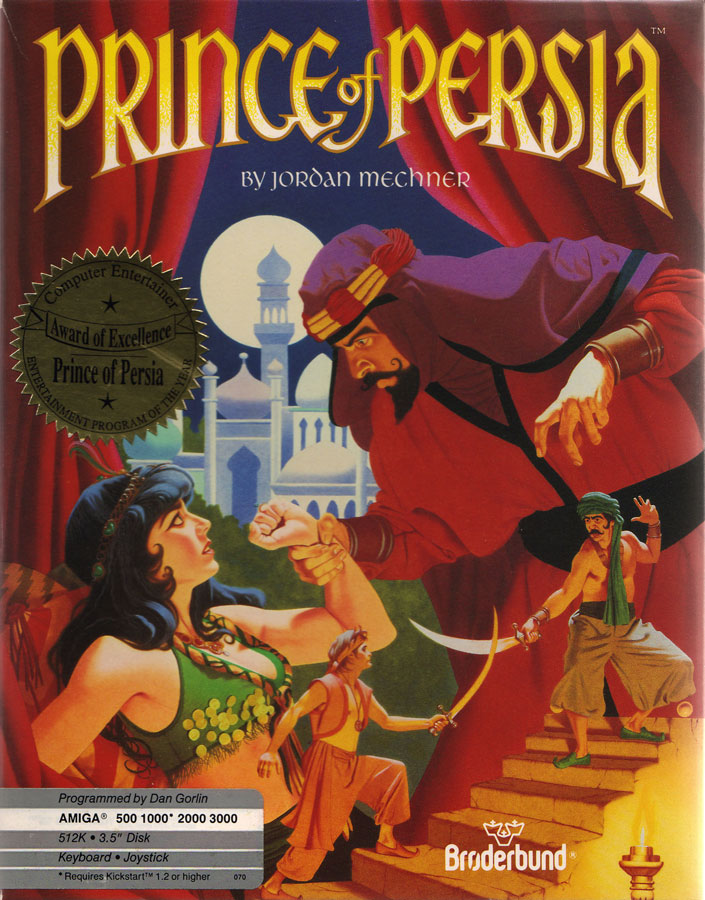
Many thanks to the readers who've been following and commenting on my old journals. Originally, I'd planned to end the feature here — in October 1989, with the release of Apple II Prince of Persia, four years in the making.
Now that we've reached that milestone, though, I realize that no self-respecting storyteller would end at such a critical moment, with my worst fears about the game's commercial prospects soon to be horribly confirmed. So I'll let my 20-years-younger self keep on blogging from the past a while longer.
Meanwhile, here are answers to some nostalgia-oriented readers' questions — this one from Ugur Mengilli:
In which programming language was PoP written?
From Nabil Nawaz:
What language did you program Karateka in? How long did it take to code the game?
I coded both Karateka and POP in 6502 assembly language. Looks like this:
CLRMEM  LDA #$00        ;Set up zero value
        TAY             ;Initialize index pointer
CLRM1   STA (TOPNT),Y   ;Clear memory location
        INY             ;Advance index pointer
        DEX             ;Decrement counter
        BNE CLRM1       ;Not zero, continue checking
        RTS             ;Return
Karateka took me about two years and POP four. Both were significantly slowed down by other things I was attempting at the same time (like finishing college, and writing my first screenplay), as the old journals show.
For true die-hards (thanks, Maurice Kaltofen, for tipping me off to the existence of this site), and anyone who's interested, I've posted the POP source code documentation here.
From Sam Assenberg:
I am Sam and I still play the original Prince of Persia almost every day. I'm a big fan of you and Prince of Persia!
Soon, Prince of Persia exists 20 year and we, my uncle and I, are planning a Prince of Persia anniversary! He played it during a few years after it had been released and I started to play when I was about seven years old, almost nine years ago. We love it very much.
We've searched all over the web for the exact release date of PoP (we need that for the anniversary), but we couldn't find it. And that's our question for you: when has PoP been released exactly?
I had to check the old journals myself to find the answer. The first Apple II version was published in the U.S. on October 3, 1989. So, still six months away. Thanks, Sam and your uncle, for reminding me!
If you'd like to read the old journals from the beginning, they start here.
Comments (...)
While I think the programming and art pipeline work of the original PoP would be almost trivial these days, I did notice from the journal that the game's design did take a long time to take shape.. how long would you think the project would take nowadays? Four to six months?
I'm really glad that you've decided to extend your old journals blog life, I've been following it pretty actively.
Although the posts are mostly POP oriented, I really enjoy the personal, introspective part of it. I'm 26 years old now so I find myself identifying a lot with the personal feelings, philosophies and views you had back then. It's been very enjoying to read this great story of our hero's journey, with all his ups and downs, his human fears and flaws.
I bet that it must be great for you going back, realizing how much (or how less) you've changed, what have you learned (or sadly forget) since then, it's like getting to be your younger self's shrink. Reading it makes me want to start writing my own journal. Keep 'em coming! :)
First, thanks for the game Jordan. I remember when I got PoP for my Apple IIGS on my 15th birthday, and the first night of playing it was completely magical. And so were the 1000s that have since followed!
I just pointed out your old PoP journal to an Apple II friend (a guy who has written the majority of Apple II game FAQs at gamefaqs.com) for reasons Fred_PJ has mentioned above in this blog. I found it to be an inspiring read, combining Apple II history and ancedotes with empirical stuff about game development at the time, and just your growing up and 'trying to work out some wisdom' experiences. I'm in my early thirties now.
Funnily enough, what made me think of PoP tonight was thinking of its box art, which I always loved. The reason I was thinking of the box art was that I had just spent an evening trying to chase up box art for another old Apple II game, 'Fortress of the Witch King', which also has a brunette beauty on its cover. So obviously I was chuffed to read all this stuff in your journal about the battle over PoP game's cover image, etc.
I have one question if you feel like answering it. At the time you wrote the journal, you felt the PC version of PoP would be the whizbang, hi-tech one. I remember when I first played the PC version at a friend's house, not long after it came out, I didn't like it much at all, visually. Now I know I was a kid and I was gorged on the first one, but years later, I still perceive that the Apple version has a kind of incredible liquidity in the animation that no ports ever reproduced. As soon as anyone drew an outline around the characters, that quality seemed to evaporate. My own assessment of it is that it's the fact that the prince is nearly all one colour in the Apple, and has no outline. I feel like it has something to do with perception and persistence, etc., but it just looks so creepily fluid on the Apple. Have you felt anything like that in the years that have since passed, or did you always feel that the first PC version looked better?
I agree, the Apple II animation was the most fluid. For that matter, I always felt the original, rough rotoscoped animations, before I did any cleanup on them, had an uncannily lifelike quality:
/old-journals/1986/10/october-31-1986/
Glad you're enjoying the old journals!
@Sol_HSA - I have to wonder what you are asking.
Of course digitizing the video is trivial now and we have far better tools for editing the images. A game engine that was difficult to produce on the Apple due to memory, storage, graphic, and tool constraints is now, yes, trivial to produce.
Using modern tools, you can create a POP clone in a couple of weeks. Or less.
But that's not the point. How long does it take for you to come up with an original game play idea? Push the boundaries of what people think is possible from a game? Create something that is iconic, loved by many, and still remembered 20 years later?
And remember this is a one-man team without a lot of pressure on him, so you have to factor in 4-6 months just for playing WoW or, more likely, Left 4 Dead.
@Michael: I am, by no means, belittling the achievement that PoP is (not was - is), and to recreate it, as is, would probably only take a couple weeks. But that's because the design is already done =)
What I'm pondering is, if all the work that took a long time was taken away, and only the design work remained, how long would it have taken.. Of course, you can't compress several years' worth random ponderings while waiting for lights to turn green, discussions at lunch and late nights staring at the ceiling into a few weeks of "concentrated" design effort.
Send Jordan a private message offering to do the transfer. Hope to get this rolling soon.
Most often it makes me want to go back and slap my younger self silly and point out the screamingly obvious opportunities right in front of me. Glad you're enjoying it.
I can understand that... In the meantime I'm making good progress anyway.
What's the status of this? Did Jordan reply?
I'm in the middle of reverse-engineering the code of the Apple II version myself, and would appreciate a look at the source to confirm some of the assumptions I made.
I really enjoyed reading your journal. Wish it kept on going. Would love to see what happened to some of those people. Do you own the source code to the Apple II version POP? or just the name/story? If you own the source code, it would be very educational for others to get a look at it.
Don
I do have the Apple II source code — but it's on 5 1/4" disks in ProDos/Merlin assembler format.
If any readers have an old Apple II with the necessary hardware, and would like to volunteer to figure out how to to transfer the source code to text files, I'd be grateful and would gladly post the result. I'd be curious to see that code again myself, after almost 20 years. Feel free to pass this on.
Nothing yet. We're still waiting for Jordan to become less busy... :-)
That should be "Sent"
Ah, if only I had asked this a year ago.
At that time, I had the necessary hardware and converted all of my old disks into image files so that I could see them again.
I will ask around to see if I can find someone to do the same here.
It would be wonderful to see the code.
While I think of it - there's a program called Disk2FDI. It can convert Apple II disks to image files with no need for special hardware. All it needs is an IBM-compatible PC with a standard 5.25" drive and a standard 3.5" drive connnected. Of course, that is rare now, but it's still better than trying to find a CatWeasel card.
I'm volunteering. I have all the necessary hardware and will figure out how to transfer the Merlin source code files to text files.
Don
I am really happy that you've decided to extend the blogs as well. I've been keeping up with them for the past few months. I have really enjoyed them.
I was wondering did you do a journal for your other games like The Last Express and Prince of Persia 2: The Shadow and the Flame?
Thank you for sharing your journals! Also do you have anything in mind for the 20th anniversary of the original PoP?
how i can find it i want play it :)
Hi Jordan,
We're all still waiting for the game (DOS and Apple versions) to be open-sourced, just as others like Doom etc. have been.
Any ETA on this?
hello, I've been playing PoP 1 since 1990/91 on PC, I don't need to tell you what a revolution it was when it came out, I was a kid back then, it was shocking, in a good way, the game trapped me for hours and hours... I had a no-hard drive old PC and I used to dream about "when I get my first hard disk, a 40 mb one, that should be enough for life!, I'm going to have the c:\games\prince directory and no more abuse on the poor floppy disks!!!", hahaha, I had a green monochromatic monitor back then, CGA graphics card, 640kb of ram, it was a 10mhz processor, only pc speaker, no sound blaster, and the game was awesome. when I got a color monitor it looked funny..... the colors were not right..... like purple..... it was supposed to be like that, I know, the CGA pallettes are awful. I swear the game looked better on the green mono monitor than on the color cga one!!, hahaha.
anyway, thank you for creating the game, congratulations for making history, and........ I'm still waiting for the real prince of persia 3 :) I want to know the answers to the unresolved stuff from the shadow and the flame!!.
Getting Adults to Draw
This NPR interview with Mo Willems really struck a chord with me. He points out that while all kids draw, almost no adults do, and questions why:
"People stop when they decide they're not good at it. Nobody stops playing basketball when they realize they're not going to become a professional. The same thing should apply to cartooning."
About a year and a half ago I started carrying around a notebook and sketching what I saw. Aside from the pure fun of it, my new hobby has enriched my life in more ways than I ever expected. Willems has some great things to say in favor of picking up the pen, and I can't endorse his message enough.
Comments (...)
What's even worse is that often times, people actively DISCOURAGE adults who like to draw for fun from drawing for fun because they "suck." I happen to enjoy drawing comics and post them on my website, and pretty much everywhere I go, whenever people see my comics they go out of their way to tell me how much they suck. It's pretty discouraging, except that I get enough positive comments to keep going.
I wonder where along the line people decided that you should only do things that you're really good at.
Sketching in the desert, continued
Of all the things there are to draw in the world, for me the most fascinating, compelling, and damnably difficult is sketching people I know.
It's way more pressure than clandestinely sketching complete strangers in a café or an airport. When you draw someone you know, you've got nowhere to hide.
This little scribble (lower left) of 2nd AD Rich Goodwin standing between takes on the POP set in Ouarzazate was one of the few times I felt I got a recognizable likeness, even though you can't see his face. (Whereas the one of John Seale looks nothing like him.)

Comments (...)
A visit to Aspen
Went down to the Aspen MLT offices to catch up on all things Fathom and see the work the artists are doing for the upcoming season.
Frank Mastromauro and Peter Steigerwald showed me a stack of Mike Turner's original Fathom pencil art, including the very first appearance of Aspen Matthews.
There's something uncanny about a physical drawing, pencil on paper. It's as close as we can come to touching one of those fleeting moments when you imagine something new for the first time. Something that might change your life, and other people's.
It was sobering to realize that the stack is finite.

Comments (...)
Prince of Persia sketchbooks
Did these on set in Ouarzazate, added the sepia ink wash later when I got back to the hotel.


Comments (...)
My goodness, hey wasup Mr Mechner my name is Obothlale (aka ob)...from South Africa. I wana say thank you very very much for your POP you have done an amazing job...truely a HUGE fan. I can't wait to watch the movie =)...finished all the games..from the traps the wall climbing and solving of mysteries in the POP and its super gooood story line. You have inspired me and many other artists with you incredible imagination...keep it up Mr Mechner i hope I work with people like you one day...one day. =) peace
Hi Jordan,
I am a very big fan of "Prince of Persia" since from my age of 12. I have played all the versions of "Prince of Persia" atleast 15 times. The way, I played the games, My friends used to call me as "NamasThePrince". Thanks a lot for giving a life to prince of persia. The Concept art of "Sands of Time" is still in my memory and also the dialogues. Thank you once again Jordan. I am eagerly waiting for your(our) upcoming movie "Prince of Persia: Sands of Time".
OK, here's a translation. Jeez!
The Director's Tent Invaded by Mongols on their Lunch Break
Mike, Jake & Gemma are shooting with 2nd unit today while 1st unit has a rest day. But, a lot of 1st unit crew are here anyway.
Extras waiting in the shade.
I can surprisingly read it without problems, cool :-)
Hasn't the filming of the PoP movie supposed to have been finished ages ago?
Or are you just posting these sketches late?
I'm posting them late. The shoot wrapped in December.
The tyranny of the epic
I found this Gamasutra editorial by Chris Remo interesting (and not just because he mentions POP). He dares to ask: Why do today's video games (and the movies based on them) tend so relentlessly toward the epic, at the expense of other kinds of stories?
Is it because games are often played as power fantasies? Is it because, when the default progression mechanic in most games is combat, grand conflict and badassery just make the most sense?
It's a good question. I saw Star Trek last week at the Arclight Hollywood with friends whose movie tastes run more towards art-house fare. (I loved it, they didn't.) After the first three trailers (Transformers, Terminator, and GI Joe), my friend leaned over to me in some perplexity and said: "I feel like I've just seen the same trailer three times in a row."
Coincidentally, Terry Gilliam made much the same remark in today's LA Times:
Terry Gilliam went to the movies the other night, and this is what he saw. "Trailers from 'Transformers,' ' G.I. Joe,' ' Harry Potter'; they all had the same explosions, the same sound mix, the same rhythms, it was all the same film," the director says, still not quite believing it. " Hollywood's been doing this for 20 years. When's it going to end?"
[Small world: Gilliam's new film, The Imaginarium of Dr. Parnassus, was edited by Mick Audsley, who is also one of the editors of the POP movie.]
Kurosawa once said that he made movies for people in their twenties. For me, that's the key. Epics are the kind of movies I loved most when I was in my teens and early twenties. I liked other kinds of movies too, but I lived for epics. Movies (and video games) mattered more to me at that time in my life than they ever have since. This being a business, it's fair to note that I spent a far greater proportion of my time and disposable income consuming them than I do now. So in a way, I'm still making movies and games for my 20-year-old self.
These days, when I go to the movies (or the Xbox), be it Star Trek, Bioshock or whatever, what holds my interest most are the small, quirky, human moments that somehow transcend the familiar epic framework, make it come alive one more time. They're getting harder to find.
Comments (...)
I think the issue isn't that there's too much epic content though, more that everyone is making the SAME epic content. Harry Potter and GI Joe and so on are all the same kind of epic story and none of them are especially new in their formatting. Epic isn't a genre in itself; it's a recognition of scope. Nowadays everyone is making the same kind of epic action and fantasy films, so it's rare to see epic coming of age films like Bicentennial Man or epic love stories, like What Dreams May Come. And yes, it's probably coincidence that they both star Robin Williams.
To me though, that's only a surface issue. The real problem is that as media plays an increasingly influential and prevalent role in society it becomes harder and harder for people to find unique perspectives or influences when creating projects of the kind of scope that films and commercial games ten to be. Everyone ends up citing the same tired references in comedy (Python, Milligan, Morecombe and Wise) while everyone in action does the same.
Don't get me wrong, there are unique artists out there and there always will be - but as media becomes more prevalent then the market is swamped and it gets harder for people to stand out. That's the real issue; not that everything tends towards the epic, but that there's too much out there and that everyone has a very samey-idea of what an epic can be.
I have the same problem with the ancient Sumerians, Homer, Wu Cheng'en, Milton and bunch of other hacks. It's always Epic this and Epic that.
Yeah. They say Aeschylus wrote some great kitchen-sink comedies modeled on his mother-in-law's family, but they got lost when the library burned down in Alexandria.
Good post!
I wonder, however, about your own PoP film. The one man i associate witht he trends you describe is Jerry Bruckheimer - your producer, I think? Will PoP be a human film - and will it break free of the blockbuster formulas?
On the subject of "sameness", I have to say that art-house can be as guilty as any type of movie. I'll be happy if I never see another story about heroin addiction again.
And while I think it's incredibly narrow-minded to claim two movies are the "same" because they both feature giant robots, this is a great send-up of two would-be summer tent-poles:
"They used to just shoot at us, now they turn into sweet cars..."
Over on the "why epic" note, my guess it's a deep fantasy of ours to be masters of the world. We would all like to be the alpha male, so when a movie shows you a small number against a bigger one, you're left wanting to live that.
(epic is pretty much large scale in which you must unbalance the good side to make the exploit look more impressive, it's lost most of it's tragicness nowdays).
In games, it's different, I would ask you, which one is the most epic game you played ? I'm not sure but I'd bet Diablo 2 would take the lead, because you had the land in your palm and could crush everything. And even if you were not allowed to do anything in town, you knew that you could kill everyone if you wanted. So there's something to think about in my opinion about what makes games special : they don't leave you wanting to do the same thing as in your game, why, because you just did ! You accomplished what happened on the screen.
So as most game designers leave us with dull stories and mechanics, they have to rely on other things to make us play games, that's the epic part.
Being the alpha male is reason enough, in and out of itself, you barely need a story to tell you why you're crushing the world. Epic is a good way to not have to write a complex story. And tell me what you want, Diablo 2 had a pretty linear and dull storyline (although, for no apparent reason, I love it).
Very intriguing post and something I have considered often. I agree that the younger population consumes more media in general so the media mostly appeals to them. And when you are 13 or 14, the romance, the excitement of rapidly approaching adulthood, the promise of exposed mysteries, and risk that comes from being an adult and being able to start defining yourself dovetail easily into the giant action stories along with the overwhelming physical sensation of sitting in a theater with a 120 foot screen and surround sound.
But it does all seem the same to me now as well. I think it's a byproduct of getting older that the focus changes a bit. I'm not saying it's for the better, but what you want to consume, what you need to nourish you changes.
This is such a great post you have shared. I really like reading post like this because its fruitful and helpful by many people like me. I know its not that easy to make a great post but once you've get use to it, you'll be able to make it easier and more qualified. I'm noting it for future reference. I wish to read more of your ideas soon. Please put me in your list, so that I will be inform of your new post.
Just in case your not earning money with your blog, there's a good ebook you must have to learn how to maximize your earning potential through blogging. I can see your blog needs a little improvement, I highly recommend that you take time on reading Darren's book, its full of secret information of how you can earn more money out of a blog. I recommend that you visit this site called ez-dollar-income (you can find it on google - its top in the search engine) - a friend recommend it to me and indeed had help me a lot on making money on my blog. Be sure to subscribe so that you'll be notified for new blog money opportunities. I now made 30-50$ per day, its not that enough but will soon make more.
You take care and hope to read more post when I come back.
Old Journals update

The first five years of Old Journals have now been posted, covering the development and first release of Prince of Persia. As of June 1990 — nineteen years ago — POP is struggling for life on two formats, Apple II and IBM.
I really appreciate the interest readers are showing in these journals, both on this site and on Twitter. I'll continue posting one new old journal entry a day. Thanks for following!
Comments (...)
Thanks for posting those journals! I was barely walking when you were writing Prince of Persia, but it's fascinating learning about game development back then.
Thank you so much sharing them... It really makes me appreciate all the hard work even more looking at the game as programmer and a video game fan through out the years.
Fantastic, Jordan! Thanks! We were all so excited about the game back then...I was even able to finish within 20 minutes :-) I was a kid back then and POP surely encouraged me to do more programming.
I was blown away by the aptness of the following (May 9 1989):
"The unlimited potential has been replaced by the concrete reality of what I programmed today." Oh how precisely this describes my feelings about the "necessary simplifications" I'm forced to do now and then because of deadlines... :-)
And a bold question - I've seen that you made the docs PDF available, any chance of seeing more? The source code, perhaps? There are still people able to read assembler...and perhaps the PC conversion code? That would be coool...But I know copyright issues might still prevent you from doing that.
It's been absolutely fantastic reading these Jordan. Prince of Persia is my most cherished game, and I've always wondered about its development and the man behind it. These are a truly fascinating read and I'm very glad you've decided to keep posting them!
I'd love to post the source code, the problem is I haven't been able to locate it! My first round of digging into the boxes in my garage, and hitting up old Broderbund pals on Facebook, turned up some cool stuff, but not that. If I find it, I'll definitely make it available.
House of Game
Had fun checking out some of this year's E3 titles (without actually going to E3) at House of Game, a "vernissage" organized by the Hollywood gamers who started Nerd Poker.
Among the cool-looking upcoming titles: Tim Schafer's Brutal Legend, Pandemic's The Saboteur, Quantic Dream's Heavy Rain, and, of course, Uncharted 2.
I especially enjoyed seeing some of the indie games: A USC student project called The Misadventures of P.B. Winterbottom. And Shadow Physics, a very cool mechanic in search of a game. Maybe because they're works in progress, or just because they're underdogs; but three hours later, I find myself thinking about them more than about the big studio fare.
Comments (...)
I wonder if the creators of Nerd Poker got this new title for their latest game from David Mamet's "House of Games".
Now, that would be a pleasure to experiment with, wouldn't it? A single-player game where you play as a master con man, with Joe Mantegna as a voice talent?
Obama's speech in Cairo
Okay, this speech has been heard by probably a billion people worldwide; he doesn't need me to plug it... but I'm just so happy to have a President who says things like this:
All of us share this world for but a brief moment in time. The question is whether we spend that time focused on what pushes us apart, or whether we commit ourselves to an effort - a sustained effort - to find common ground, to focus on the future we seek for our children, and to respect the dignity of all human beings.
It is easier to start wars than to end them. It is easier to blame others than to look inward; to see what is different about someone than to find the things we share. But we should choose the right path, not just the easy path.
Can we?
Comments (...)
I love this particular quote from his speech!
I was particularly surprised to hear the President declare his hope for the creation of a Palestinian state. Not since Clinton has the country's Commander-in-Chief showed this much empathy towards the other side.
I can't help but think about Robert Frost when the President speaks of taking "the right path". It will not be an easy road to travel by, but it just might make all the difference.
Attracted to watercolor
I bought a Moleskine watercolor sketchbook and a travel-size watercolor set and took them to my neighborhood life drawing workshop. I still have no idea what I'm doing and no control over how it comes out, but I'm starting to realize that's actually part of why watercolor is fun.


Comments (...)
I like these pictures. They're classical in that Art Noveau tradition. If only watercolor was a more popular artistic pastime these days...
It's the Los Feliz Life Drawing Workshop on Kingswell Ave.
thanks
Where is the life drawing session? I'm alway son the look out for drawing sessions in LA
thanks
I love how, when you don't control things they happen to be incredibly beautiful drawings, and when I don't... Well it's a bunch of lines on a paper, damped by a myriad of colors eating one another.
Late-night drawing salon
My friend Justin Thompson sent me to this cabaret-themed drawing salon put on by the Gallery Girls. First time I'd been. I'd been working really hard all week, finishing up the first draft of Fathom, and it was a fun change of pace to decompress by spending an evening drawing people in crazy costumes with live music and a bar.
A lot of the artists there were pros and some had pretty mad skills. The guy sitting next to me, Joey Mason, amazed me with his dead-on caricatures that in a few lines somehow managed to look "more like" the model than the classic/academic, accurately shaded drawings other artists were doing (which amazed me too).


Comments (...)
Wow! Hey Jordan. my wife came across this searching for info about the drawing salon. Thanks for the mention! :)
Nice.
Looks like these artists specialized in capturing that 1940's Dick Tracy sort of atmosphere. It's always a pleasure to see stuff like that. Where was the salon located?
And , again, nice sketches! Dig the color choices on the bottom left most. (and being able to get down that song is a nice touch) Next one's this Friday!
A visit to Lucasfilm

Just gave a talk to Lucasfilm at their Presidio campus. The invitation included spending a night at the Skywalker Ranch — the stuff of dreams, for me.
I'd been to the ranch once before, in 1987. I was two years out of college, stalled halfway through the first Apple II version of Prince of Persia, and torn between pursuing a career in computer games or screenwriting. In fact, the old Broderbund Software building where I programmed POP is just down the road from the Skywalker Ranch (a long, winding, scenic road, often foggy and frequented by deer). So being invited back to tell Lucasfilm staff the story of POP's 20-year journey — from 8-bit computer game to summer movie — felt pretty cosmic.
Especially considering that it all goes back to the first ten minutes of Raiders of the Lost Ark.
Both the Skywalker Ranch and the Presidio campus are seriously nice places — in idyllic natural settings, with a level of luxury and attention to detail rarely found in movie or videogame studios. And filled with sacred artifacts like the Original Millenium Falcon.
I got a tour and a sneak peek at some of the cool stuff the LucasArts guys have been working on, at least one of which I'm pretty sure I can mention without violating the NDA I signed along with the retinal scan.
Thanks, Lucasfilm, for a great and memorable visit.
Comments (...)
It was a great talk. Thanks for sharing with us.
from the look of the sketch, the ranch seems really peaceful. even though i'm not a big star wars fan, i'd love to visit there one day. did anything there inspire you for any new prince of persia ideas? i'd love to hear some new stuff about prince of persia (gamewise)
I envy you! Skywalker Ranch is one of those places I can't wait to visit.
Just out of curiosity, was George Lucas himself there? I know that he's focused most of his attention on producing lately, but I think he should start directing again. Have you ever seen his 1971 film "THX-1138", with Robert Duvall? I just watched it and cherished every minute. It's proof that despite that "Star Wars" mania, Lucas is truly an artist.
Sketchcrawling in LA
My friend Alex Puvilland tipped me off to the 23rd International Sketchcrawl happening today in many cities around the world, including L.A. Basically, the idea is for a bunch of people to get together and spend the day sketching what they see, and post the results.
So I made my way down to Echo Park to brave the summer heat with a dozen or so like-minded souls. I'm looking forward to seeing their sketches. Here are some of mine:
View from Angelus Temple steps:

Fellow sketchcrawlers:

Not too surprisingly, most everyone I met today is planning to attend San Diego Comic-Con in two weeks.
Comments (...)
i really like the sketches. they're so simple, yet pretty elaborate. if you draw something REALLY badass, you have to put it up for all the people who visit your site to see.
Thanks. I'm probably going to start going to the zoo every so often let me know if you want to join sometime. I like that you used the warm tones with the ink for shading.
keep drawing!
I missed the skethcrawl! Dang. But I really love your sketches. Very loose and nice. See you next time.
Prince of Persia panel at Comic-Con

I'll be in San Diego next Friday for an 11:30 am Q&A panel about the Prince of Persia: The Sands of Time graphic novel anthology I'm writing for Disney, with artists Todd McFarlane, Cameron Stewart, Bernard Chang, Tommy Lee Edwards, Josh Middleton, and Niko Henrichon, many of whom will be on the panel as well. (Check the Comic-Con schedule for updated details.)
It's been a very cool project and one I've had a lot of fun doing. The book is a prequel to the movie (I use the word "prequel" advisedly, for those who think time is like a river that flows swift and sure in one direction), with each chapter drawn by a different artist in a different style. It'll be published next April as part of the Prince of Persia movie pre-launch.
This is the second Prince of Persia graphic novel I've been involved with — the first, written by A.B. Sina and illustrated by LeUyen Pham and Alex Puvilland, was published last year by First Second Books — and they're very different projects. Whereas the First Second book is deliberately separate from the games and movie — linked thematically, rather than through plot and characters — the Disney book is firmly in the universe of the movie. It offered a chance to establish, and expand on, the characters' world and back stories beyond what's in the film.
Most enjoyably, it's given me an opportunity to revisit the story and characters of the original game for the first time in two decades — though in a way that's kind of hard to explain, until you read the book.
Hope to see you next Friday, those of you who can make it!
Comments (...)
i just saw the new prince posters, oh man they look beautiful. i'm a little confused as to why the prince is wearing the armor from warrior within, but i guess it's because it looks better. nonetheless, the posters are amazing, tamina looks beautiful, the prince looks powerful, it's just wonderful. =]
Since I have a few days off before my vacation, I'll pick up the first graphics novel. It should be a good read while relaxing. Can't wait for the new one as well.
As for ComicCon, I'd like to attend one someday.
Excellent. Can't wait to read it- it will definately be a great way to prepare for the movie.
I hope, that the movie as also the Graphic Novel will be splendid. However, I look forward to the movie.
wow, this is awesome, i'm so glad to hear info about a second graphic novel, i've only been hearing rumors. i really wish i could go to comic-con to see the POP stuff, but i got school and no tickets to get in :( oh well, any info on a teaser trailer for the prince of persia movie?
I had no idea there would be a graphic novel for the film as well. The tie in to the original game sounds interesting. I don't really know anything about new the universe and characters yet, so perhaps I missed some rumours, but I'll enjoy it more if I don't get any spoilers. :)
Seemly on the armor you can see some snake designs that resemble the sigils on the ruin levels (that I believe that are Prince home? When I played the game I did not knew english, and I do not had time to play it over again) that are on the game PoP2 (not warrior within... in fact I disliked all PoP after Sands of Time, they are too much God of War + Tomb Raider than PoP...), also on PoP2 the sigil shows-up on a witch forehead...
In my opinion the movies should follow the progression Sands of Time, PoP1, The Shadow and the Flame, and then finish (you know, PoP2 ended in a half-cliffhanger, and PoP3D well... :/)
This is so cool!!! I am really happy to see another Prince of Persia Graphic Novel. I really enjoyed the first one! I really wish I could go to San Diego for Comic Con. I've never been to it. Best of luck with the new graphic novel. I am wondering if are you going to come to NYC in the near future to advertise the Prince of Persia Sands of Time Graphic?
What's the release date for the graphic novel? It looks like the movie's out in 2010 (summer)? I enjoyed reading the Star Trek prequels in iPhone format this spring/summer..... really cool formatting for that platform.
i can't wait to see what secret games Capcom are going to annouce today at comic con
First POP movie poster comps

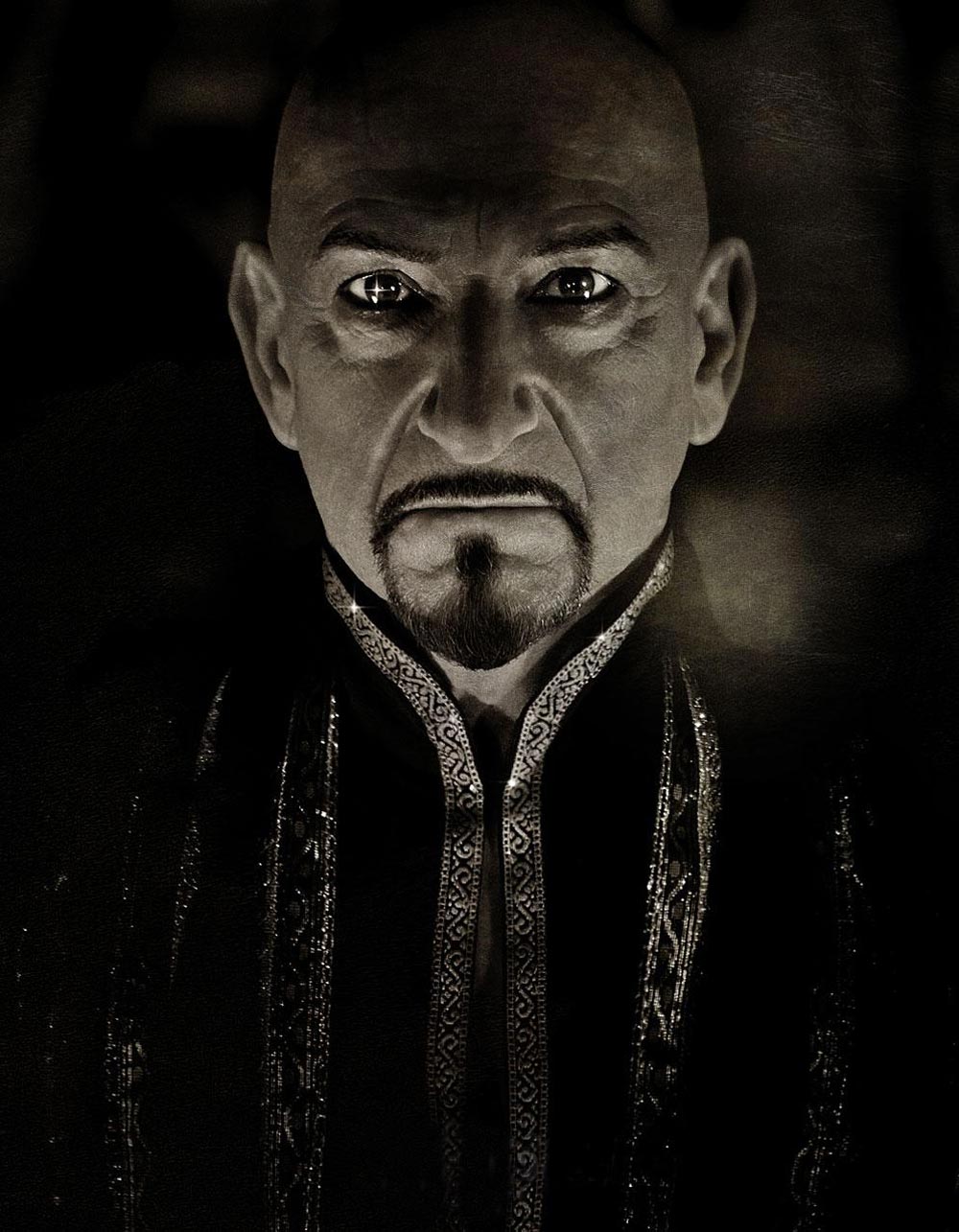
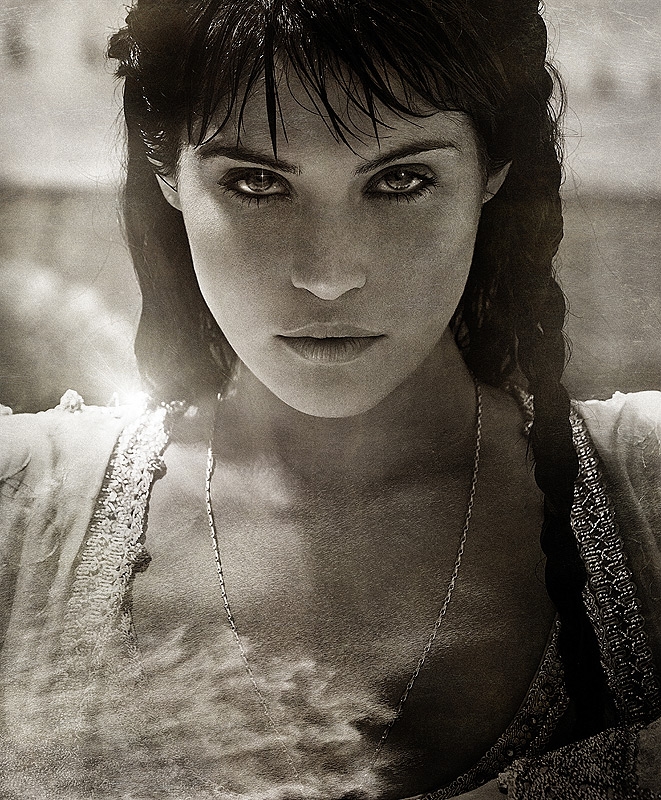
(Updated with latest versions.)
Comments (...)
The images are cool and iconic, but what's with the completely personality-less font? Seems entirely un-POP.
Am I reading too much into things when I notice the little snake designs on the Prince's chestplate look like ye olde family sigil from Shadow & the Flame?
Answer: probably.
Oooh... very nice. I'll be seeing this for sure. :)
Based on the commentary on kotaku, people are guessing the font choices etc. are so that it doesn't come out as a "video game movie"..
Still, the blocky sans serif type does seem a bit out of place (too "modern"), and the walt disney logo sticks out like a sore thumb.
Nice grayscale+red trickery though.
Love the tagline. Jake looks iconic. Shouldn't one of those swords have a sand tank?
"What the font!?" was my first reaction, though.
The font sucks. Totally out of place.
Really cool pics, and Jake Gyllenhall (sp) actually looks pretty good as the Prince.. I think that font (and composition of text) would be more suited to a modern corporate website however, it looks really out of place and is unfortunately the first thing that I noticed.
Gyllenhaal does look pretty awesome. In that picture he has all the charisma of a young Omar Sharif.
Kingsley looks a little bit like Peter Sellers in Blake Edwards's "The Party" (1968), no?
Great pictures, Jordan.
i'm still wondering why you chose to have the prince wear the armor from warrior within, and i still guess it's because it simply looks better. i'm hoping for a teaser trailer soon, c'mon jordan, tease us a little more. maybe a little taste of the effects of the sands of time, not just the prince :D
This may also be of interest: =)
http://kotaku.com/5319873/ben-kingsley-in-persia-persia-looks-like-this
Comic-Con sketchbook

Comments (...)
It was great hearing you talk and meeting you at comic-con!
Hi Jordan. I've enjoyed flipping through your sketches - very simple, subtle, and evocative. (Especially your watercolor)
After 20 years of computer games and reading, I'm finally going back to illustration and sketching... your work has been inspiring. What kind of pens/brushes do you use when you sketch, out of curiosity?
Many thanks,
- Chris
Thanks, Chris! Your question inspired a blog post — see the main blog page for answer.
The wilderness of childhood
This essay by Michael Chabon is so true, I just had to link to it.
Comments (...)
Chabon is a genius, isn't he? It only took him seven months to write "Wonder Boys", which of course was a fantastic story- and resulted in the excellent 2000 Curtis Hanson film with Michael Douglas.
Reading this new essay of his, I couldn't help but nod my head when he talks about how the outside adventures of young boys will eventually be replaced by places with boundaries like Chuck E. Cheese. Of course.
It happens to all of us. In our young ages, it's as if we're exploring our manhood- which is then stripped away from us sometime around our preteen ages when we have to learn how to conform. Then we become adults, and we have to go find our manhood all over again.
He's right, too, that parents are more overly cautious these days. Roger Ebert wrote a similar article in his own blog just last month:
http://blogs.suntimes.com/ebert/2009/06/raising_free-range_kids.html
Funny... Ebert shares the exact same opinion! There must have been a recent nationwide event that got Chabon and Ebert putting their thinking caps on all of a sudden. Wonder what it was?
thanks a million...
Aw, this was a really nice post. In idea I would like to put in writing like this additionally — taking time and actual effort to make a very good article… but what can I say… I procrastinate alot and by no means seem to get something done....
Unfinished Last Express Prequel
Browsing through my storage room in an attempt to avoid working on my current project, I stumbled across this printout of an unfinished screenplay (PDF) I'd started, then abandoned, back in 2002.
Entitled "Red Serpent," and set in 1904 Paris, ten years before the events of The Last Express, it would have been an early adventure of Robert Cath (still in medical school) and his best/worst friend Tyler Whitney (upgraded in this version to Cath's half-brother — a change I don't think I'd make today).
The plot bears a more-than-slight resemblance to The Da Vinci Code, which would be published the following year. No plagiarism was involved. I'd guess that Dan Brown and I had been reading the same pseudo-historical "research," including Holy Blood, Holy Grail by Baigent and Leigh (who did, in fact, sue Brown for plagiarism, and lost). Whereas Brown treated their theory seriously, my approach was more tongue-in-cheek.
I've posted it here (PDF) in case it interests anyone — as a glimpse into the early, rough-first-draft stages of the creative process. Mostly, the stories we read are ones that survive all the way to completion. This one, for many reasons, didn't.

Rereading the screenplay fragment today, I can see why I abandoned it. There are things in it that I like, but it's not really of a piece with The Last Express. It's more fluffy and lightweight. It can't quite decide whether it wants to be a movie in the Indiana Jones/Da Vinci Code spirit, or a spoof of that kind of movie. And, while I enjoyed the two main characters, I can't quite see them growing up to be Cath and Tyler as Tomi Pierce and I originally conceived them.
Also, in 2002, Prince of Persia: The Sands of Time (the game) was gearing up production at Ubisoft Montreal, and my excitement for that project was growing while my sense of conviction on this one was dwindling. Ultimately, I dropped "Red Serpent" to give me more time for POP. It was the right decision.
Comments (...)
I really enjoyed reading it. Thank you for sharing it with everyone.
I remember enjoying The Last Express a great deal. Come to think of it, I wish I could find my copy of it, so I could at least attempt to play it again. (I suspect OS issues and such would throw a wrench into the works.)
Any chance we might see The Last Express show up on GOG.com or the like?
i am looking forward to reading it. thanks for being so open.
It's not bad at all. Also interesting to know you were thinking of a prequel. I personally had imagined the next chapter would be what happened to Cath (and Anna?) during WW1 or in the 1920s and probably set in the Middle East.
While reading the draft, I thought for a moment that Pandora might be the girl on the motorbike who helps Cath reach the train at the start of The Last Express... but I guess that's part of a different story...
Talking of sequels and prequels, I can't help thinking that (commercially successfu)games such as Uncharted: Drake's Fortune and Assassins Creed are heavily influenced by TLE. And I am equally confident that an updated and expended version of TLE would be a massive hit on the PS3.
This is so thrilling to be able to see what you were working on at the same time of Prince of Persia: SOT. I'm sure you give yourself too little credit. I can't wait to read it.
For me, there's never such a thing as a worthless Last Express story. Thanks a bunch for providing this for us, Jordan. I already have a feeling that I'm going to eat it all up (even if it IS more of a satire than an adventure drama).
Just finished reading the script (when I should be studying for my first year medical school classes!)...as you said, rough in spots, but a nice piece of work. I managed to find a copy of TLE, and I'm looking forward to playing it when I get the time (having grown up on Karateka and POP). Thanks so much for sharing!
Wow! Thanks so much for it, I will read it as soon as I can.
Sounds pretty darn cool. I'll have to read through it. I'm intrigued. :)
I remember writing a rough plot for a sequel to The Last Express set in 1915, Ethiopia. Robert Caith's business in Jerusalem (whatever that was about) has lead him to Ethiopia, so he arrives in French Somaliland and gets a ride on the Djibouti-Dire Dawa railway. Unknown to him, a disguised Iyasu V is also travelling back to Addis Adaba after mysterious activites in Djibouti. The politics had to do with Iyasu V wanting to join the Central Powers and drive the Italians out of northern Ethiopia (today's Eritiea), agents of the allies wanting Ethiopia to remain neutral, and the remains of the legendary Bronze Serpent of Moses. So yeah, it was pretty much the Last Express all over again but on a pathetic and bankrupt rail line instead of a luxurious one. Actually there is a lot of crazy politics behind the railway, including British and French colonial rivalries, and even Russia trying to get a piece of Africa (seriously).
I had never thought of a prequel before, I was too busy writing fan fictions on what happened next.
Hmmmm... "KickStarter"(?) ;o)
It certainly wasn't a bad script, but I think you made the right decision. The Last Express stands as a glimpse into a much larger world of adventures that is constantly, but unobtrusively, hinted at (PS: Still angry about Cuba).
I think neither a prequel or sequel would add anything to the original game because somehow, thanks to all the questions unanswered, it feels like all those adventures exist somewhere, even if they don't even exist in the writer's mind. Showing would be ruining the magic of The Last Express.
PS: Thanks for making my favorite video game.
Gamasutra analyzes Last Express
A thoughtful article by Tom Cross on Gamasutra about The Last Express and immersive game worlds:
Read the article at Gamasutra.com
Comments (...)
A very thoughtful and insightful analysis. I still love this game, Jordan.
With this, Cross has by far written the best essay around on The Last Express. That part where he praised the film's realistic amount of space kind of reminded me of what you, Jordan, said in the "Making Of" documentary for the game- on how the whole thing is set within an enclosed space and is, therefore, the perfect atmosphere for a computer game.
One thing Cross pointed out that I confess I never thought of before was how brilliant of an idea it was to plunge gamers into the game without much introduction to Cath or the rest of the characters. We know next to nothing about Cath upon his illegal boarding of the train (unless we've read the Instruction Booklet!), and we learn very little about him even as the story progresses.
But then again, Cath's past history- the shootout in Ireland, Tyler Whitney's revolutions in Cuba/Mexico- it's all a "MacGuffin", as Hitchcock might have put it. We're led to believe that it's important... but it really isn't. Even after Cath finds out how Tyler died, it's about as helpful as finding out exactly what Charles Foster Kane's "Rosebud" was. It explains nothing, and everything.
So Jordan, that script you started, you should do something with that:)
Speaking at GDC China
I'll be giving a keynote at the Game Developers Conference in Shanghai. The date is October 12, I think. If you happen to be in Shanghai and are interested in attending, the official GDC website has details. Looking forward to it!
Comments (...)
I will definitely spread the news around. I wish I was in China, but I am sure Jordan Mechner fans will love it! Thank you for sharing this exciting news. Also is it possible to post a transcript of the speeh?
The gear I use
About two years ago, I started carrying a notebook around with me so I could sketch when the urge struck. My friend Alex Puvilland gave me my notebook number two, a Moleskine sketchbook, which is the kind I've used ever since. I've filled seven of them.
Moleskines are kind of the iPhone of sketchbooks: They're ubiquitous, pricey, and their marketing is so blatantly geared toward making you feel like possessing one will make you a cooler person that I feel a vague sense of embarrassment at having succumbed. But I keep on using them anyway, because they're just so well designed.
Nifty features: The pocket in the back is just right for holding airplane boarding passes and scraps of paper you don't want to lose. The binding doesn't fall apart no matter how much you kick it around. And there's a ribbon to mark your place.
The paper is really thick. At first, I found it almost intimidating (as if it required a worthier drawing than just a casual scribble), but I got over that. It's thick enough that I can draw on both sides without it showing through, which makes the book last twice as long.
It's not good for watercolor; the paper is so smooth that the water just beads up and rolls off the surface. It will accept an India ink wash, like this sketch I did in Union Square. Watercolor pencils also seem to work OK.
Moleskine does make a watercolor notebook; I used one for these watercolor sketches, but I haven't really gotten comfortable with it.
The pen I use most often is a Staedtler pigment liner, black, 0.3 nib. It's not perfect, but it's waterproof, and cheap enough that I can buy them by the dozen and always have an extra handy when I lose one (or when the cap gets lost, which happens a lot, as it tends to fall off when I stick it on the back end). I'm still looking for the perfect pen. I'd also love to find a brush pen that uses indelible India ink cartridges, but can't seem to find one. Suggestions welcome.
Comments (...)
Oh my god I totally agree with you about the Moleskines. Especially because the specific kind of coolness they advertise involves literary self-importance and a kind of Barnes&Nobel-level engagement with famous writers and artists of the past. It's like aspiration marketing that in no way speaks to my aspirations.
But oh, how they feel in your hands!
I have been going through pens looking for the best myself. I have tried them all and the one that I have been using for the past few years is copic sp multiliner. Works on all different types of note/sketchbooks papers
You are quite a talented artist. I love the one of Union Square. As far as pens go, I don't have much experience myself but a how-to guide for drawing comics I own recommends a Rotring technical pen (they only give one consistent line however. But on the other hand I don't think you are looking for a dipping pen for your sketches). :)
Many thanks for the detailed description of your tools - I was surprised by the 0.3 pigment liner - some of your sketching has a lighter, thicker look to the lines — almost like you were painting with watered-down ink of some kind.
I've been using a Moleskin notebook (awfully pretentious little thing isn't it) for a few years ago for note-taking script/game ideas/thoughts, but the paper is not really suitable for sketching.. I'll check out their sketchbook next time I'm at the book store.
Thanks again Jordan,
- Chris
I like that approach you have on Moleskin :) Me on the other hand make peace with using brands so I'm trashing it any way possible :) Even teared a piece of paper out of it once.
But I'm more on the pens subject. I'm having the same problem but recently I came across with this guy, Dustin Nguen. Wonderful comics covers artist, specializing on watercolors mostly and here's his travel tools kit: http://duss005.deviantart.com/journal/24610344/
Hope you'll find it useful.
Just a quick update - I picked up a set of Faber-Castell "PITT" artist pens - they are fantastic. The Brush nib in particular is great for sketching with.
Yeah, I like those too — I think the watercolor you mentioned was done with the brush pen. My only complaint is they don't last that long, especially the brush pen which runs out of ink pretty fast. But the ink quality is nice.
Absolutely agree on the embarrassment front. I still find it hard to get over that initial intimidation factor when starting a new Moleskine. Which is ridiculous, really, because it's just a bunch of uppity paper, and I'm pretty sure I could take it in a fight. Regardless, the Union Square sketch is lovely - so much so that I needed to be a pain and reply on a post from two weeks ago. :)
Prince of Persia movie pitch trailer
In my GDC China keynote about Prince of Persia's 20-year journey from game to film, I showed a 2-minute trailer I made six years ago to pitch the movie to Jerry Bruckheimer and Disney execs. I'm posting it here for those who are interested.
Why did I cut a new trailer, instead of using one of the existing game trailers Ubisoft had already produced to market the Sands of Time game? Because the game marketing trailers were very specific about certain story points that weren't in the movie (freeze, fast-forward, sand monsters, visions). Co-producer John August and I didn't want to confuse the execs by showing them a different story from the one we were pitching.
It took me a week to cut on Final Cut Express, in late 2003. Assembling a trailer from existing PS2 game footage was an editing challenge, because key scenes, locations and characters from the movie didn't exist. So rather than attempt to explicitly tell the story of the movie in the trailer, I set out to convey the kind of movie it would be. (Don't worry, there are no spoilers — the trailer reveals nothing about the plot of the movie beyond what's in the game.)
The sound mix is rough — I didn't have the proper elements or the time to do a professional-quality mix — but it served its purpose of selling the pitch. Hope you enjoy it.
Comments (...)
For me, this game-based trailer is better and much more exciting than the film trailer — partly because (weirdly) it feels much more real and believable. Much more like the real world, and so much more seductive.
Looks Awesome! Waiting for the movie ^^
Wow. That is actually really good. You had me hooked. Did it get you the movie deal?
WOW, I can't wait, looks and feels exciting... I aways enjoyed the game. back when it came out,I was hooked! Now I will be again... what fun! Go Jordan, keep the fun coming!
I always forget how powerful the music is.
wow, really, i missed that music. i haven't played sands of time in a while, i just had a nostalgic moment. really good pitch trailer, i hope one day, when i pitch my future game(s) i can have such strong music as sands of time did. please, if it's not too late or haven't done it already, put music from the game into the movie, it's freaking great. hope to see the official movie trailer soon =]
This trailer just reminds me how much I love the game.
Nicely done trailer Jordan, Ubisoft could have even used this same trailer for the game if they wanted to. Watching it just makes me want to go out and play SoT again.
on a side note -
I happen to have read the movie's script, and interestingly, after reading all of Jordan's and John August's (on his blog) comments on what the pitch and trailer were supposed to convey, I still don't get the feel of the movie's story at all, still reminds me completely of the game.
Great, thank you.
that was absolutely perfect!!you made the game look so exciting.I can see why Disney agreed on making the movie.
Honestly I'm a lil disapointed in the film with out even watching it. Its not politically correct. There isn't one single person on the cast that is Persian or has persian decent. If any one knows there history, they know that persia today is now Saudi arabia. I don't see not one arab actor in the whole film.
Persia - Iran -> technically caucasian = no big deal.
Defending the Sands of Time
After I spoke at GDC in Shanghai yesterday morning, Gamasutra posted a summary of my keynote. Their report was very good and accurate, but I want to clarify a comment that set off alarms with some Sands of Time game fans:
Film and games, though they have similarities, have important differences as well, says Mechner. "There's no button on the controller for sit down with someone and have a nice conversation... The game story was just an excuse for getting the player to get from point A to point B and kill everybody he meets." It is not, in his words, "this epic, romantic action movie that [the film version of] Prince of Persia was setting out to be."
This sounds like I'm saying the Sands of Time game story is somehow less ambitious or less fully realized than the film story. That definitely wasn't my intention.
Just because a game story is designed to support and enhance a particular game play mechanic (which, in the case of Sands of Time, does indeed consist largely of getting from point A to point B in various challenging, acrobatic ways, while killing sand monsters along the way) does not mean that it can't be every bit as sophisticated and nuanced in terms of dialog, character development, emotional and thematic resonance, literary qualities, etc., as a movie story. Indeed, the Sands of Time video game achieves some narrative effects that are beyond the scope of film, or at least beyond the scope of a 110-minute action-adventure movie: for example, the counterpoint, sometimes emotional, sometimes ironic, between the voice-over narration, the onscreen banter between the Prince and Farah, and the Prince's actions under the player's control.
The 2003 Sands of Time game doesn't need me to defend it, but I hope this post helps clear up any misunderstanding.
Comments (...)
if people don't appreciate prince of persia, that's their thing.
sands of time was the inspiration for my career choice, it's a very inspirational game, not just 'cause of the unique gameplay, but the dialogue, storyline, and love elements all tie in perfectly. it's harmony in the form of a video game really. i'm sure many people are ready to back up prince of persia at any moment, including myself.
i often spend a couple minutes at a time wondering what a true sequel to sands of time would've been like (since warrior within wasn't really your intention of the sequel)
Jordan, please, make a sequel to sands of time, the way YOU wanted it, i would love that.
Don't worry, I've been there. But I think it's only natural to accidentally reduce the quality of video games when comparing them to film. After all, when we first think of games, well... we DON'T immediately think about plot. Now, of course, "The Last Express" was an exception, since you and Tomi Pierce literally constructed 75% of the game with dialogue. "Prince of Persia" is obviously at a disadvantage in that regard, since the action sequences (and the body count) are much higher. Yet it most certainly has a wonderful story- not to mention characters who are both likable and who even make sense!
Still, video games are at a slow and steady pace in being accepted as a serious artistic medium. This may explain Roger Ebert's refusal to accept video games as art; he assumes that because it's the audience manipulating the form instead of the artist, it defeats its own purpose, Jake LaMotta-steak style. However, you could have made the same argument that film ruins the imagery in literature that ought to be left up to the imagination of the reader.
Though videogames have steadily become more cinematic over the years their intrinsic purpose is still to allow for player interaction, and to effectively do this they often need to employ different narrative techniques.
I don't think this cheapens them in any way, they're just serving a different purpose. Some games work better with fleshed out stories, and some don't.
The Sands of Time was beautifully constructed, and I always thought it stood strongly as a standalone title.
It's funny how vehemently the video game community rallied around its genre before by talking about how the experience of gameplay is paramount to a good story, and when someone says something that supports such a theory (as per your comments), it gets interpreted as insulting to the medium.
Hi, I am a great fan of you and played both 3d and 2d versions of the game... but I was disappointed with the names you put in the 3D version of the game. Persia is different and India is different, "Maharajah" describes "Great King" in Hindi/Sanskrit. But in Persia he will be called as Badshah or Sehenshah. So this disappointed me.
Conversation with Eric Chahi

I've met Eric Chahi (creator of Another World) twice: in Paris in 1992, and a couple of years later in San Francisco, where the Smoking Car team and I were toiling away on The Last Express, while Eric and his Amazing Studios were deep in the throes of finishing Heart of Darkness — both passion projects that had gone over schedule and budget, an ocean apart, exacting a psychic and financial toll for which the experiences of making Prince of Persia and Another World had only partly prepared us.
I remember looking at Eric's tired face and thinking: He looks the way I feel.
Recently, Mark Siegel, my editor at First Second Books, asked me if by chance I had Eric's contact info. I hadn't spoken to Eric in a dozen years (though the original Another World poster he signed for me is hanging in my office), so I asked my friend Eric Viennot.
That email sparked Eric to suggest a joint interview, which, after much patience and persistence on his part, he's now posted on his blog. Here it is, for those who read French.
Update: An English translation (non-Babelfish) has been posted on Gamasutra.
Comments (...)
I remember playing Another World (aka. Out of this World) on my old Sega Genesis. It was one of the most unique games of it's time, and one of my favorite memories from my childhood.
I never played Another World, but Heart of Darkness was an amazing game - it terrified me as a kid.
The interview can be read in english quite well if you use Babel Fish translation. Not the same as the original but it gets you there. Eric Viennot did a great job, once again. He is the best.
Mr Jordan, there has been one question that troubled my mind for years as a game player and researcher. According to Eric Chahi's statement in his "Another World Anniversary Edition" making of feature, he was not aware of Prince of Persia when he created Another World. When you met him, did you ask about this? Can this be true?
Thank you.
Hey, this is great! I'd love to translate it, though I'm afraid I might mangle your meanings in the anglais-français-anglais hokey-pokey — Eric Viennot noted on Twitter that you originally answered in English.
According to Eric Viennot, on its twitter, the interview will be published on Gamasutra (in english).
It will indeed :) We're working on the translation now.
very cool.
looking forward to english translation.
Thanks for the link. Enjoying (very slowly!) reading the interview, although I'm missing a lot of the subtler language.. if only it came with illustrations like Tintin.
I see no mention of the new Karateka game. Is that project still active or has it been set back or abandoned entirely?
Excellent read all-round. You two are expert craftsmen.
It's worth the price of entry: http://www.anotherworld.fr/
Indeed, I discover Prince of persia on PC, in the middle of Another World developpement (end 1990). I was really impressed, the true influence of Jordan works came from Karateka on Apple II, it has always been a reference for it animation and the dramatic tension.
That's very cool to know! Merci, Eric!
Eric, hi
did you have a twitter account?
And also have you ever think about making a movie "Another World" like Jordan did with "Prince of Persia"?
As Jordan allredy has relations with Jerry Brukhimer so would be interesting in such idea? ;)
Shanghai sketchbook
From my last day in Shanghai:

This is my new favorite skyscraper, the Jin Mao Tower. (The one that looks like a bottle opener is the Shanghai World Financial Center.)

I did this sketch from the top of the tower. It was growing dark and the city was fast disappearing in the haze, so I only had a few minutes. I actually like it better than the more "done" sketch I did in the park.
Comments (...)
hey Jordan I love that one. it conveys everything without really getting into complicated details.
The Making of Prince of Persia

Update: The Making of Prince of Persia journals are now available as an ebook. You can buy it here.
For the past year, I've been posting daily entries from the old journals I kept while I was programming Prince of Persia on the Apple II, 20 years ago.
This "blog from the past" covers roughly seven and a half years from May 1985 to January 1993 — from Prince of Persia's conception through the development of its sequel, Prince of Persia 2: The Shadow and the Flame.
In a coincidence I couldn't have planned, this month marks both the 20th anniversary of the original game's release, and the release of the first trailer for Disney's Prince of Persia movie. Time is an ocean in a storm.
If you're curious to know how the Prince's journey began, back in those halcyon days when computers looked like this, it's all in the Old Journals. Some highlights include: the day my kid brother modeled the prince's moves; the day Prince of Persia got its title; and the first rotoscoped animation test.
You can read the whole story from the beginning starting here.
Comments (...)
Wow, what a nostalgic feeling! I was around 10 when my dad bought Karateka for our Apple II. It was so amazing, the beautiful animation, the music! I remember I was so scared of the big samurai at the end! :D
I just found your website today and it's great being able to know all the little details behind the making of those games! Seeing how much attention to detail you've put into them, and the early testings of animations and all the work you've done to optimize things. Such romantic times when a lone programmer could create an awesome game all by himself. And you were so young!
Guys like you were my heroes back then, as I typed the listings off the issues of Nibble magazine, and dreamt of becoming a programmer myself, and I see you're still a role model for the new generation of programmers. So it's a pleasure being able to somehow "talk" to you after all these years and thank you for the great games and inspiration you've provided!
haha sorry for the rant :) I wish you much success with the forthcoming games and the movie (which looks great btw), hoping you stay in the business for many years to come!
Best regards, and greetings from Brazil!
Henrique
Jordan, any chance of a .pdf or other single-page rendition of your whole journal? It makes for absolutely fascinating reading.
I just want to ask you that, how on earth you created this character, really awesome, I always wanted to create this type of Game, starting with a good story.
Thanks for posting these Jordan, it's great reading them. POP starting my fascination with games on PC back when I was 10 years old, and it's great to see the legacy continuing on to this day. It's really inspiring reading all the ups and downs throughout your journey. You should maybe publish these journals in a book or something, I'd buy it.
Your great work is now a significant part of my childhood memory and even now, a 23 year-old man still remembers the moments he was playing POP frequently whenever he recalls the past years. Even I've dreamed about playing as the prince character in a real game several times! Well, as a matter of fact, I'm really Persian=Iranian;)
Now that I've found your website, I hope the best wishes and success for the developer of my nostalgic feelings.
Woo... Thanks to internet, I can find the orginal writer of Prince of Persia here : ) I am playing the old games (1992 SFC ver. Konami), and have no match for the shadow prince in the LV 15, I loss my HP as once I hit him; and I also can't jump over the bridge when the wizard turn it down : (
My dear uncle jordan, do you mind to told me how to pass it? ^^
wow loved that game :) I played it first when I was about 10 years old.
This just came to my mind: What about an iPhone version?
Wow man, I loved that game too, I played it for a long timeee !! Jaffar haha ! I always remember the sound effects when I fall into the traps hehe ! Thanks for making this awesome game and our childhood even better =) greetings from Brasil !
I played it first when I was about 8 years old. hehe :)
Eeee. I wasnt even born when jordan sir started creating POP, and could have been hardly one year old when the first POP released. And now here i am a die hard fan of it. Every time a version releases i almost say yippee in my heart. Kudos to jordan sir. And, as strange it may see, i would request jordan sir to create games more frequently. Lol, have i got addicted to it or better even gone mad at POP...
Your prince of persia game series is very good games thank you so much
Did you know that your game inspired "Prince of GOSPLAN" novel by russian writer Victor Pelevin? It's about how games turns into lifes of people who playing them. http://www.amazon.com/Prints-Gosplana-Gosplan-Viktor-Pelevin/dp/5699486917/ref=sr_1_1?s=books&ie=UTF8&qid=1334724809&sr=1-1 http://radio.javaranch.com/map/2005/06/28/1119942710220.html
Prince of Persia movie trailer
The first official trailer for the Prince of Persia movie (opening in theaters May 28, 2010) is now online.
There are some bootleg low-res versions bouncing around the net, despite the best-laid plans of Mouse and men. Accept no substitutes. The hi-def version looks better.
I got to see the trailer in a movie theater for the first time last week in San Francisco and L.A., when producer Jerry Bruckheimer and I did Q&As with journalists. It was quite a thrill seeing it on a big screen with a theater full of people.
There's actually one line of dialog in the movie trailer that's also in the homemade game-footage trailer John August and I used to pitch the project to Jerry and Disney six years ago. Which is funny, because the line's not actually in the movie (at least I don't think it is). No prize for spotting it.
Comments (...)
The Trailer looks great and even though it has already been said I really liked seeing the tie-ins to the other games in the series like the daggertail at 45 seconds. Anyways great job to you, Jerry, and disney.
Jordan,
congratulations for such a high profile movie release of Prince of Persia. It seems it will be one of the few vg-based movies that do the actual game justice.
Best, Bjoern
Wo-ho!! That looked amazing! And looks like it's gonna do justice to the Trilogy. Cant wait till May. Oh, and there was speculation that Jake wouldn't do well in this role. The trailer totally rubbishes that.
wow this trailer is just amazing. i like how pieces of warrior within and the two thrones are in the movie. the prince's wardrobe mirrors warrior within, and the rewind of the dagger shows what looks like part of the dark prince from the two thrones.
this is really one of the only great video game to movie adaptations i've ever seen.
I'm really happy that you managed to reach your dream after all these years, a big Hollywood movie! The fact that you built it up from your hobby makes for a fantastic story.
However, I hope once this is all done, you'll take a sabbatical and write a game the proper way again - by yourself, in a room with a computer. Karateka and Prince of Persia weren't only good for their storytelling and technology, they were real both rare gems of game design. I know it will never happen, but I wish you would take a year and make another single-authored game.
I enjoyed the newer Price of Persia games, and I loved The Last Express, but these games with large teams of designers never quite have the clarity of vision that single-authored games (or novels, or songs) have.
Wow, I'm really impressed, I have been a fan of Prince for such a long time and the trailer shows that the movie does capture the dynamics of the charaters and the story which I was afraid wouldn't come across. I guess with you being the screenwiter, I shouldn't have been worried! Thank you for the story, the games, and now the movie. May is such a long way away.
I'm with Bennett, please write more.
so excited!
The movie seems very wonderful ...
i hope from ubisoft and from you
to make a new game from Prince Of Persia Like (the sands of time) or continue it
or make game collaborate between the three old game (SOT,WW,T2T)
and called this game (Prince Of Persia Legacy)
actuallly we need a game have a wonderfull graphic,gameplay and story like Warrior Within
but not like Prince Of Persia 2008
Best Regards Mr. Jordan
Hello Jordan
I've a player of almost all your games since I'm 8 y/o when I first saw Prince Of Persia for DOS (the 1) and the PoP2 WaF--- I've been always thrilled on the way the history develops to make the way until the end and win the game.
What I'm wondering right now is, when you began developing POP (the 1st POP); did you ever imagine your game to become the complex world you've created and the movie you're about to publish un May'10?
What's your feelings about that your wonderful idea becoming a major movie?
Did you ever thought about it when you were 15 or 18 y/o?
Johan R, you should read from the Old Journals (linked at the top of the site) to find out what some of his thoughts were at the time.
congratulations for such a high profile movie release of Prince of Persia. It seems it will be one of the few vg-based movies that do the actual game justice.
Hi, i started play POP only after Sands of time in 2003. I played all versions of pop and i love this game. In 2008 I heard that disney is planing a pop movie, since then i waiting this movie.
When i first saw this trailer a few month ego, I was very glad. The movie cg effects are looking great.
Good luck to you Jordan....
Saw the movie and it was great! I'm happy the Sands of Time game got a worthy big-screen translation. Hope you guys do a sequel! Congratulations! :)
At the counter
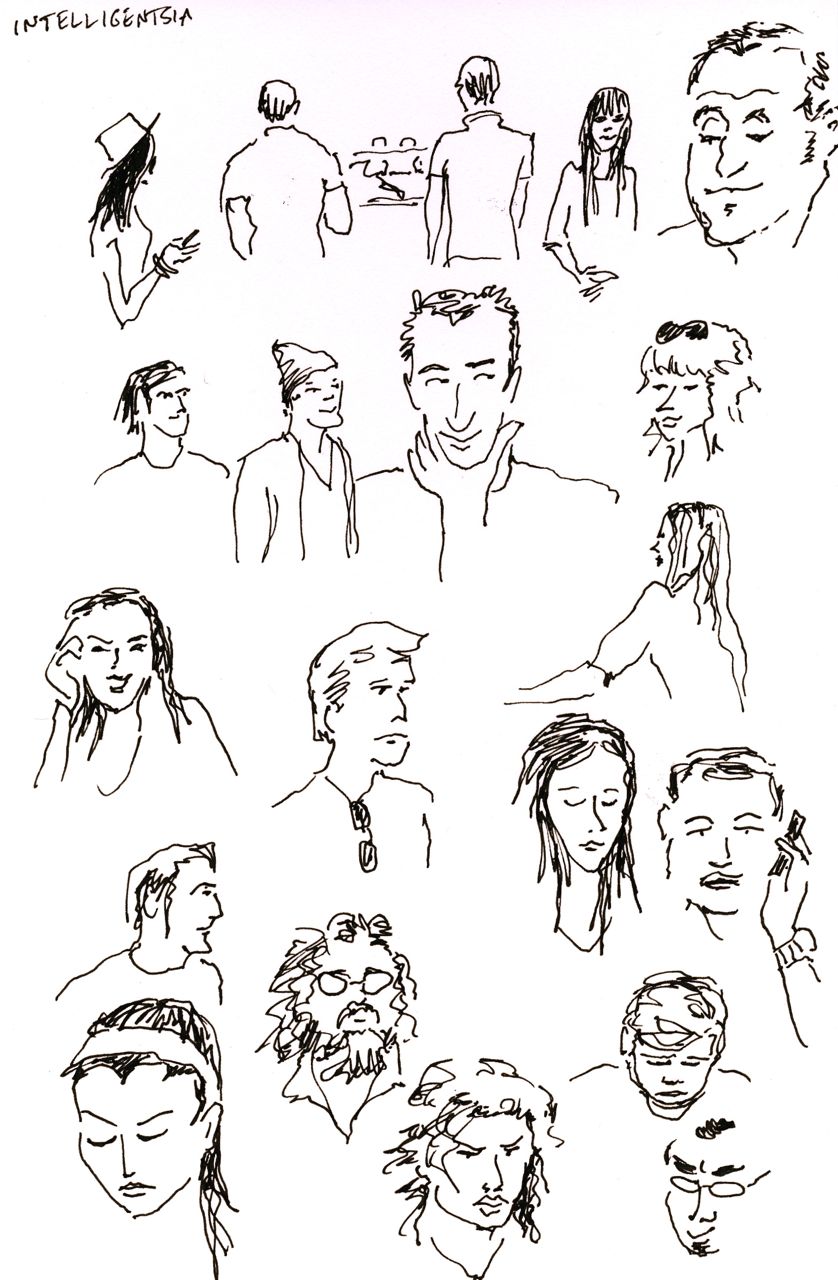
Comments (...)
Fantastic expressions on the faces. I've spent time trying to sketch people's faces on the subway here, but I have a hard time doing it surreptitiously ... I end up getting a bunch of "what're you lookin' at?" looks after about 20 seconds.
I swear the guy in the middle holding his chin is a character from Dr. Katz: Professional Therapist. Wonderful subtlety!
Designing story-based games
Eons ago, in 1996, Next Generation magazine asked me for a list of game design tips for narrative games. Here's what I gave them.
Reading it today, some of it feels dated (like the way I refer to the player throughout as "he"), but a lot is as relevant as ever. I especially like #8 and #9.
- The story is what the player does, not what he watches.
- List the actions the player actually performs in the game and take a cold hard look at it. Does it sound like fun? (Resist the temptation to embellish. If a cinematic shows the player's character sneak into a compound, clobber a guard and put on his uniform, the player's action is "Watch cinematic." Letting the player click to clobber the guard isn't much better.)
- The only significant actions are those that affect the player's ability to perform future actions. Everything else is bells and whistles.
- Design a clear and simple interface. The primary task of the interface is to present the player with a choice of the available actions at each moment and to provide instant feedback when the player makes a choice.
- The player needs a goal at all times, even if it's a mistaken one. If there's nothing specific he wishes to accomplish, he will soon get bored, even if the game is rich with graphics and sound.
- The more the player feels that the events of the game are being caused by his own actions, the better — even when this is an illusion.
- Analyze the events of the story in terms of their effect on the player's goals. For each event, ask: Does this move the player closer to or further away from a goal, or give him a new goal? If not, it's irrelevant to the game.
- The longer the player plays without a break, the more his sense of the reality of the world is built up. Any time he dies or has to restart from a saved game, the spell is broken.
- Alternative paths, recoverable errors, multiple solutions to the same problem, missed opportunities that can be made up later, are all good.
- Don't introduce gratuitous obstacles just to create a puzzle.
- As the player moves through the game, he should have the feeling that he is passing up potentially interesting avenues of exploration. The ideal outcome is for him to win the game having done 95% of what there is to do, but feeling that there might be another 50% he missed.
Comments (...)
This is a great list! I find #11 the most fascinating...do you think that games today still consider this direction? I get the impression that the trend now is more to create actual supplemental avenues of exploration and not just the illusion of them. What do you think?
I've been feeling number 11 playing Dragon Age, I think... definitely a well-designed "sandbox"
I've been working on a Choose Your Own Adventure graphic novel for the past three years and this is priceless information. Thanks so much for reposting!
HellO! I found this website by chance and I'm really surprised with your list. An brief overview is enough to see your point (or get closer, at least :)
I felt nostalgic about games - I used to play compulsively since 10/11 years old. When I was 28, and I felt interested about games again (btw, Me and my English are "Made In Brazil", so I'm sorry if I make weird grammar mistakes).
I start looking for the classics from MSX and Amiga games. I easly found perhaps ALL the games made for these machines, and a "new technology" called "emulators" turned out my PC into an old computer perfectly.
Anyway, to make it short, the nowadays games and it's blockbuster productions just make it worst. I was shameful about playing games that even my two kids could call it "too childish".
So, I decided to start a game from "ground zero"; maybe it was the challenge of been able to make a good game without cliches (or almost no cliches). I googled for "point and click guidelines for dummies" kind of stuff. Thinks like "Examine every location for clues, 'cos developers wouldn't make these things for nothing." I avoid puzzles, magic stones that opens secret places with no connection with the story at all.
I called it "Mature Games" because it's suppose to mean, well, erotic...
Hmm, I'm afraid that the comment have a limit of characters, so I wil finish it on another post (sorry for the size of that, but I think you may understand because it the first website I found that is pretty much about the kind of games I make...
I don't design games but this information was excellent.
How does number 7 apply to the dream sequences in The Last Express? I always thought they never added to the game, but maybe I didn't understand them.
Thank you very much for posting this, it's a fascinating list!
I'm also intrigued by #11, in that it would seem like providing the impression that a percentage of content exists even when it's not so potentially leaves the player with a sense of unfulfilled potential.
For example, Assassin's Creed provided a series of rich environments but very little to do in them, outside of collecting items for which there was no in-game reward. The hub environment of the game was especially guilty of this, in that it was beautifully designed but ultimately served as nothing more than scenery between points. Once the ability to fast-travel between cities is introduced, the player appears to have no significant incentive to return to the hub environment at all.
I can see the benefits of leaving the player with the impression that there's more to do that they haven't seen, as this encourages replay, but if there's the impression of content without actual material to back it up, it strikes me as hollow.
Lisa — Those percentages would be very different for a sandbox game like GTA, but I think the concept still holds true: It's a good feeling if, having finished the game, the player is left with the impression that the unexplored portion is greater than it actually is.
Conversely, if a majority of players finish the game not realizing or even supposing that certain unexplored avenues exist, that means they don't get the benefit of the designers' hard work, even in their imagination.
This list seems very insightful, but I'd point out that the most recent PoP game fails at #1 in a way you might not have envisioned in 1996. When you press 'jump' in that game, the Prince chooses the next appropriate moment for a jump, and executes it when that time comes. Sometimes this can mean that there's a gap of a second or so between your button press and the actual motion.
Just as the illusion of foley sound effects is broken when the effects are out of sync with the action by more than a half-frame, the illusion of agency is broken when the action in a game is out of sync with the input.
The first one is about an decadent lawyer (the player) who had a job offered by a rich businessman from the country-side. His son is the primal suspect for the crime of rape and kill his ex-girlfriend.
It's a snall city and there are three days only to understand the city and have a glimpse about it's mysteries, search for clues, talk with people, make useful friens, do illegal things like looking for drugs (he is an addict), to lie, to be persuasive, black mail people, etc.
There's no way to be stuck on a certain point because you don't know exactly what you need to get through this, so I tried to solve it by giving more than one option to the player at almost every point.
Another thing is when your character evolves in the game and sometimes you find yourself in the middle of something that you feel like taking a nap during a movie or "accidentaly" pick some item or choosing the right answer/question. I find a way to make sure that the player cannot find/solve something by accident.
The 4 day, is the trial. I think it is the best of the game, since I found a way to put pretty much everything from novies, like objections, evidences, testimonies, jury's perfil and the hability to manipulate then, etc.
Oh, like I said, there are no score system - it kinda take away the suspense specially if it's about investigating a game with no predefined "Game Over" or "You Win". I like it because it gives diferent ends based on the player's choices during the game and the personal sense of justice, so the end is different for each personality.
For instance, players can see VICTORY if he wins the case, regardless what he discover during the game. Other may think that find out what really happened is more important than win the case with some doubt. You know, the oposite ideas of professional ethics and moral ethics.
---
Well, that's enough. I'm very sorry, you can delete it if you want. Anyway, the game is free and if interested, you can download it on the company's website: "Beware The Ladybeetle" http://www.beware.co.nr
Thank you and I hope you keep this great website to support the indie developers.
Bruno.
Nice tips. Very useful for my new(old) game project.
Bye,
http://twitter.com/alexnautilus
i get the feeling of missing something after playing sands of time, although i've gone through the game multiple times. i'm planning on majoring in game design, so this is amazing information. thank you for posting this up.
The only significant actions are those that affect the player's ability to perform future actions. Everything else is bells and whistles.
That's why I LOVE all Zelda games!!!
Thanks for this interesting list
Nice tips..
Codswallop. When I play a game the second time (which should be a rule, don't bother if you never want to play it again even once) and expect to experience the 50% I think I've missed, you're damn right I'm pissed off when it takes one tenth of the time I expected.
Jeez, that would be as bad as The Force Unleashed.
You were absolutely right. Deus Ex was a great game, and it's because it followed #6 and 11 better than any game I've ever played.
've been feeling number 11 playing Dragon Age, I think… definitely a well-designed "sandbox"
You were absolutely right. Deus Ex was a great game, and it's because it followed #6 and 11 better than any game I've ever played.
Zelda = FAIL
"because it followed 11"
Are you kidding? #11 is just a cheap trick, and it doesn't improve a game's quality AT ALL.
Do you mind if I repost this over to my blog? I just want to make sure credit is given where it is due. Have a great day!
i don't think this is a "one size fits all players" plan of attack.
One of the more popular ways to approach story-based game design is to offer the player choices. If i choose path A, that eliminates path B. This is one way in which designers hope to make their otherwise linear games replayable.
A lifelong gamer, a father of two, and an entrepreneur who runs his own games studio, the "free" time i have to play games is rapidly declining. i ALREADY don't have enough time to play a game like Mass Effect. i gave it another stab recently, and it absolutely killed me that i was forced to make choices that excluded me from seeing other content in the game. i suppose a gamer with more time just says "i'll have to play through again and choose the other path next time".
As a gamer who fights to find the time to play through even once, i gravitate towards games that i know i can play through without worrying i'm missing anything.
i think what you're saying is better applied to world-building - giving the player the sense that there's a big, wide open world to explore, and many more stories to tell. The best worlds do this (and reap the benefits in sequels and spin-offs!)
- Ryan
All the steps listed here are very good tips indeed. But #11 is kind of a 50-50 shot. It mainly depends on the the story. Example: Final fantasy. Those type of games have super long storys.It is hard enough to get the final level on games like those and then you want them to go back and do it all over again to see "what could have beenn". Probably not. On the the other hand, using step 11 could be a good thing. just look at the geame "Infamous". that game has alternate options to the game and how you beat it. This is just an opinion of mine
yeah i agree with nick, Deus Ex was really a great games. and #6 #10 and #11 will be my take.
The real Dagger of Time
Sketchbook pages from my first day on the Prince of Persia set in Morocco, last summer:

Jake offered to hold the Dagger of Time so I could sketch it. The one drawing you'd figure I could do in my sleep. Naturally, under pressure (we were between takes), I rushed it, and messed up the proportions.
I asked him to hand me the dagger for a moment, thinking I might just turn back time and try that sketch again. Alas, it was empty. He must have used up the sand doing stunt work with 2nd unit.
It felt good to hold it, though. Much more solid and weighty than a PS2 controller.
Comments (...)
i'm looking forward to the movie but i cant help but wonder, will you ever be getting into game design again? sands of time was one of the best games of the last generation and all the others have been pretty disappointing i think (though i did enjoy two thrones quite a bit, it still wasn't as good as sands of time) so another pop designed by you would be pretty good at this point.
The real Dagger of Time... :)
To be honest I figured there would be multiple daggers for the film. A finely detailed one for close-ups, a rubber one for use in fights, a virtual one for special effects, and multiple copies of those in case one of them breaks. Actually I think breaking the Dagger of Time would be catastrophic, so I hope that doesn't happen.
Wow, even if it is disproportionate, it is stunning work. There is something about your art style that is quite captivating. I love it.
i can't begin to imagine the feeling(s) that went through you when you held that dagger in your hands. i know i'd have a variety of emotions going through me.
@Mike Apparently you missed this new story on Kotaku from 1 September: http://kotaku.com/5350351/mcfarlane-does-the-prince-of-persia :)
Still no PoP stuff listed on the McFarlane Toys site, so keep checking: http://www.spawn.com/
When do we get to see a picture of the dagger of time ,and will there be any prop replicas made?
Seeing it in a screen and holding it for real are two very different things. I would keel over and let out several sobs if that were me.
Jordan, did you hiss 'Myyyy Preciousssss' when Jake said he had to take the dagger back from your hands for the next take? :D
seeing it in a screen and holding it for real are two very different things. I would keel over and let out several sobs if that were me.
Me and Robert McKee
I took the Robert McKee 3-day screenwriting course a bunch of years ago because I wanted to learn how to write screenplays. I was blown away. I thought he was the most brilliant and inspiring speaker I'd ever seen, possibly excepting the guy who gave my college commencement speech. (I was a computer programmer; I didn't get out much.)
I was so impressed that a couple of years later, I took it again.
He was word for word the same. That tour-de-force, thirty-minute, apparently extemporaneous example of how to escalate a sequence — the girl jogging through Central Park, or whatever it was? The same. He even paused to take a sip of his coffee at the same places.
I thought: The guy's been giving this speech every weekend, he's had YEARS to make up new examples and try them out on an audience... and he still only has ONE??
I walked out at the break and never came back.
Comments (...)
Good to know. Thanks for the post!
Thanks, Olivier! I'll post about this.
Apparently unrelated, but:
Your "Tips for the game designer" have been put online:
http://diplome.pixylab.com/wordpress/2009/12/16/jordan-mechners-tips-for-game-designers/
(thx to Jérémie Biron)
When I read them in 2004 I was very impressed...
Some years later, would you keep them unchanged (like McKnee lol)?
Any new tips?
Well...when you've got your "performance" down why change it? Everyone buys it. He's more of an actor than a writer anyway.
How close did it match the McKee scene in adaptation? ;)
You're surprised a screenwriting course has a script? =)
More POP set sketches

Comments (...)
Oh, so really the Prince of Persia in this film is an Ostrich. :)
I love your lines, Jordan.They're really expressive.
Also: Is that a Moleskine?
Thanks! Yeah, it's a Moleskine, the one with the thick paper.
yes :)) so it is good.
The lyrical wizard of "Oz"
When I was seven, The Wizard of Oz was my favorite movie.
I watched it every time it came on TV (this was before home video, when an "Oz" broadcast was a special event) until I knew the songs and most of the dialog by heart.
I typed up as much of it as I could remember on my dad's IBM Selectric, in stage-play format, my ultimate plan being to stage it and charge admission. But there were gaps in the song lyrics.
So I took the Manhattan white pages directory from my parents' bedroom and looked up E.Y. Harburg, whose name I'd seen in the credits. Our conversation went something like this:
YH: Hello?
Me: Hello. Is this E.Y. Harburg?
YH: Yes...?
Me: Did you write the lyrics for The Wizard of Oz?
YH: Yes, I did.
Me: Can you tell me the first line of the Cowardly Lion's song, because I didn't understand it.
YH: "It's sad, believe me, Missy / When you're born to be a sissy / Without the vim and verve / But I could show my prowess / Be a lion, not a mowess / If I only had the nerve."
Me: OK. Also, what does the Tin Woodman sing after "I hear a beat, how sweet..."
YH: "Just to register emotion / Jealousy, devotion / And really feel the part / Just because I'm presumin' / That I could be kind of human / If I only had a heart."
I got what I needed, thanked him, and hung up.
In retrospect, from an adult perspective, it does sort of make sense that a Broadway lyricist who'd been blacklisted by Hollywood would, in his 70s, be living in an apartment in Manhattan and answering his own phone in the middle of the afternoon. At the time, being a kid, I just took it for granted. I don't think I even thought the call noteworthy enough to mention to my parents.
Comments (...)
You probably made his day, Jordan. Any of us should be so lucky to have our work so long remembered and cherished.
Hahaha, wonderful.
:o) that is really great (o:
Haha, lovely. I was really shy as a kid, so I don't think I would have thought of something like that.
Nice story! Thanks for sharing it.
hehe good story :)
Prince of Persia Latest News
How do I keep up with all the myriad developments in the world of Prince of Persia? With Google Alerts. That's how I just found out that
Prince of Persia: The Forgotten Sands testament passion the new plot from stylish year's periodical reboot and go back to the humanity of Sands of Quantify, the games on which the upcoming Jerry Bruckheimer flick is supported.
This shouldn't proceed as untold of a earthquake to incessant readers of Game Life, who already bed that serial creator Jordan Mechner said early this month that Ubisoft's City apartment was working on "something that I'm frantic about" and that he due an annunciation soon.
Hot on the heels of the lodging for the Prince of Persia celluloid, Ubisoft has announced that the next Prince of Empire courageous will be usable in May 2010.
Pretty accurate reporting, overall, except I thought what I actually said was "The vodka is good but the meat is rotten."
Comments (...)
Good thing I read about the new Sands of Quantify announcement elsewhere before, because this only confuses me. :) I'm really curious about this new game, so I'll have to watch the Video Game Awards like the PoP game website suggests: http://princeofpersiagame.com/
Looks like your Google Alerts found a copy/paste of a back-and-forth Google Translate of this original blog post at Game|Life:
http://www.wired.com/gamelife/2009/11/next-prince-of-persia-game-hits-may-2010/
Just so you know.
Crazy translation programs occasionally produce pretty funny results, but Sands of Quantify?! That is pure comedy gold, right there.
Actually, this is a linkbait article written for SEO purposes. It's not mistranslated - it's been "Roget'ed" using bad half-synonyms via some crappy automated process. "Time" became "quantify," "based" became "supported," etc.
The madlibs technique allows the sleazy poster to attract a modicum of traffic; if he merely reposted the original article Google would smack him down for being a duplicate.
Prince of Persia at VGA
Tonight's Spike TV Video Game Awards 2009 broadcast will include a couple of Prince of Persia exclusives:
- The first footage from Ubisoft's upcoming game, Prince of Persia: The Forgotten Sands
- Jake Gyllenhaal introducing a new clip from the Prince of Persia movie in which he stars
I'll be there, too. Although with the rain, this would really be a perfect Saturday to stay home, watch TV and play video games.
Comments (...)
i agree with selva, the prince looks way different, i was pleased to see the sands of time arc come back, and the "forgotten sands" part is apparently this huge sand creature thing. but the prince, he doesn't look like the prince from sands of time. my first thought was MAYBE, a son of the prince, OR a new prince. clarification please? :D
also, are you working on the storyline for this game or is it another game that doesn't follow what you wanted like warrior within?
As I've understood it, it's a tie in with the film, which would make it a different Prince and a different Persia. The movie is based sparsely on the game because the two mediums work differently. Likewise, rather than adapt the film's story to the game, they wrote a new tale based within the same universe.
I'll be interested to see how the game turns out. Movie tie ins are (almost without exception) mediocre games, and my faith in Ubisoft ever doing anything right with the Prince of Persia series has pretty much run out - what little is left being crushed further with every new release :(
I wish they could have shown some footage of the actual game, instead of just cutscenes too. Surely with just a few months until release there must be some actual game play footage!
In case anyone missed it, here is a link to the Dastan Online Featurette. Be warned that it shows a bit more about the story, so if you don't like spoilers, don't watch the video.
Also Brickset.com now has images of 4 (of the 5) LEGO sets. These might be spoiler-ish too, I guess.
(Thanks Kotaku for the links.)
It's mainly the irritating emoticons that cause me to 'fight back' on this kind of thing. No other reason. Not sure why they irritate me, they just always have.
One thing I've just noticed, however, is that barely anyone actually sourced the press release, so that's probably part of the reason no-one read that part.
Anyway, we'll see how they deal with it. Supposedly he gets them for becoming a general during Battles of... (I never actually played it, and people on the board have a habit of making things up to suit themselves and their bizarre arguments) so there's a possibility they'll keep that game canon. They may just completely ignore it, leaving it ambiguous. I imagine the sandwhirlwind has something to do with the elemental control that's in this game.
@Beato2106 I admit I usually primarily visit Kotaku and The Escapist, but as a PoP fan I did look around, and the sites I found only mentioned Ubisoft's original description which is ambiguous about the story. Unless the sites I missed somehow had access to more, official information, I'll have to assume they were posting their guess (or interpretation) as fact. A good guess too apparently. :)
http://kotaku.com/5415359/ubisoft-turns-back-time-with-prince-of-persia-the-forgotten-sands
http://www.escapistmagazine.com/news/view/96425-The-Prince-Returns-in-Prince-of-Persia-The-Forgotten-Sands
@selva You're welcome. I actually came here to post the link to another interview I just found. Apparently the Prince has a brother, which was new to me:
http://xbox360.ign.com/articles/105/1054785p1.html
I am curious if they're going to explain the old man in TFS, because it would be a good time.
On the subject of the story, I understand the game Nintendo DS game "Battles of Prince of Persia" (which I haven't played) also takes place in the 7 years between SoT and WW, but no idea if the two games overlap, or if one takes place before the other yet.
omo thanks so much for the link of the interview about TFS. I had no idea the story was set between the SOT and the WW. I had always wondered about what exactly happened to the prince during these years, how did he meet his crew on the ship, who's that gut that died and he felt sad about, why did he change so much from that very young care-free prince to that angry and aggressive man (apart from the Dahaka chase and the whole "your fate is written" thing) and where did he meet the old man? That would be really interesting.
I'm also excited to know that Yuri Lowenthal is back in the voice of the Prince again. I always loved his portrayal.
But still this one tiny little thing: why does the Prince look different? o.O
By 'they', I mean every single (actual) source I have seen on the subject of Forgotten Sands when it was announced. It's not that Ubisoft said it many times but that it's been reiterated everywhere. Gaming blogs, news sites, whatever. Which is why I don't understand how almost everyone completely ignored them and decided it was a movie tie-in. In fact, there are people still insisting that it's a tie-in completely disregarding the interviews that just went up.
Regardless of that, a game-movie game has happened before at least twice. Generally though, it's limited to things like Mortal Kombat. I wonder, though, if the original Sands of Time was exactly the same game but also with a movie back when it came out, would people react the same way they have to Forgotten Sands?
OK, I didn't realize it wasn't a direct movie license. I think it's an easy mistake to make though, there hasn't been a whole lot of info released about it. A game based on a movie based on a game did seem a little ridiculous :P
I figured TFS would depict more or less the same as the SoT film, because that's that games that appear along films usually do. Beato2106, with "they", do you mean Ubisoft? And what about the "many times"? I only remember them giving a few lines of text forming a bit of a vague description, nothing since, except for the recent teaser. Do you have any links to more information, because like you say, on the internet people can say anything. :)
I came here to link to an interview I just found, saying it takes place between the SoT and WW games:
http://www.joystiq.com/2009/12/14/prince-of-persia-the-forgotten-sands-fills-in-gaps-before-warri/
Indeed, I'm just irritated that so many people ignored what they said and jumped on the 'hurr movie cash in' bandwagon.
While I would like a different costume also, I guess they wanted to explain where he got the armour (with its medallion fitting) from in the first place.
The sentence starts: "PoP: TFS will feature many of the fan-favorite elements from the original series as well as new gameplay innovations...", so I believe those elements refer to gameplay elements. The story was mentioned in a different sentence, so I don't believe it's about that.
The sentence before that mentions the SoT storyline, and in this instance I more broadly regarded that as everything SoT-related (trilogy, Battles, I guess the LEGO and toys, as well as the SoT film), although in hindsight that is an assumption on my part, perhaps because of how The Escapist wrote their article (it seems they assumed the same thing). I wouldn't be surprised if I would have assumed just the game trilogy if I found out about TFS through a different article.
The word "return" I read as: return to the SoT storyline after the Corruption storyline.
Not sure why I'm being such an apologist on this; I guess I was curious how my reasoning must've happened at the time. :) By now it's moot, we know when the game takes place, at least more closely.
Good eye on the Prince's tattoos! None in the TFS trailer, and I do see them on the Battles box art. You're right, maybe Battles isn't canon (any more) due to inconsistencies that might be introduced with TFS. We can always consider it and TFS two parallel timelines, both leading up to WW.
It would be nice if TFS explained the medallion, because that seemed strange.
Like Victor Carias, I have to admit I am curious about the extent, if any, of Jordan's involvement with TFS.
Finally, it seems from the trailer there is a big whirlwind of sand forming an enemy presence. Am I the only one reminded of the similar looking enemy seen on some SoT (original game) concept art? :)
I'm sure the "The Forgotten Sand" teaser will be uploaded to the official site sooner or later, but until then check GameTrailers:
http://www.gametrailers.com/video/prince-of-spike-tv/59825?type=flv
Hi Mister Jordan. Thanks so much for always updating your blog ^_^
I saw the trailer of the new game. I love the look of it, but I gotta say this: I hate the new look of the prince T_T;; he looks just like Jake! Not saying it's a bad thing, but since the game is supposed to be back to the SOT storyline, then how come the Prince looks totally different!
Is this game a reboot of the sands story with another Prince of Persia (with no Farah, kaileena, vizier and such?) We don't know any more details except that it will have "many of the fan-favorite elements from the original series as well as new gameplay innovations that gamers have come to expect from the Prince of Persia brand."
Please be kind to all of the fans and tell us more lol
Yeah, my bad. But what do you expect when they go with the WW costume they're using in the film, redesign the prince, and set the release for May.
I'd rather have seen an original costume. It would have set it apart from the film mentally.
I hate the Internet sometimes. One person can insist that something is true, and there's always the chance that it'll snowball into everyone thinking the same.
Forgotten Sands is not a movie tie-in. It's a game set between the Sands of Time and Warrior Within. They've stated many times that it is in the Sands of Time SERIES universe, and there are now interviews about how it is between the two games. Seems to me people're just looking for something to complain about, like usual.
The press release clearly said 'a return to the Sands of Time storyline' and later on, 'Prince of Persia: The Forgotten Sands™ will feature many of the fan-favorite elements from the original series'.
I don't think it possible to return to a storyline that hasn't started yet, nor that a film can have 'fan-favorite elements' when it hasn't accrued any fans. Not that a film is even compatible with a game in the way they're implying.
There's nothing ambiguous about that unless you choose to selectively ignore parts of it.
Besides that, it's likely the game takes place before Battles of... because he supposedly gets his tattoos in that, whereas he doesn't have any in the trailer. That, and it takes place shortly after the Azad event. Of course, the trailer and story are subject to change. Not to mention that we don't exactly know if they'll choose to ignore Battles of...
Morongo Canyon

Used a brush pen for this sketch in the desert outside L.A. I had to work fast cause my hands were freezing.
Comments (...)
Excellent sketch, Jordan. At what time of day did you do it?
B
In the morning. Long shadows!
Tips for game designers
These "20 Tips for Game Designers" were first published in 2004, on the release of Prince of Persia: The Sands of Time.
- Prototype and test key game elements as early as possible.
- Build the game in incremental steps — Don't make big design documents.
- As you go, continue to strengthen what's strong, and cut what's weak.
- Be open to the unexpected — Make the most of emergent properties.
- Be prepared to sell your project at every stage along the way.
- It's harder to sell an original idea than a sequel.
- Bigger teams and budgets mean bigger pressure to stay on schedule.
- Don't invest in an overly grandiose development system.
- Make sure the player always has a goal (and knows what it is).
- Give the player clear and constant feedback as to whether he is getting closer to his goal or further away from it.
- The story should support the game play, not overwhelm it.
- The moment when the game first becomes playable is the moment of truth. Don't be surprised if isn't as much fun as you expected.
- Sometimes a cheap trick is better than an expensive one.
- Listen to the voice of criticism — It's always right (you just have to figure out in what way).
- Your original vision is not sacred. It's just a rough draft.
- Don't be afraid to consider BIG changes.
- When you discover what the heart of the game is, protect it to the death.
- However much you cut, it still won't be enough.
- Put your ego aside.
- Nobody knows what will succeed.
Comments (...)
i love this list, i'm planning on majoring in game design, so this list is pure gold for me. thanks a lot for posting it up. if you have any other advice, please post it up
"Don't invest in an overly grandiose development system."
Can you elaborate on that a bit? Generally the better the tools, the more you get out of your content creator people.. on the other hand this could refer to hardware / IT architecture, or the fact that you can over-engineer the tools (and end up not making the game at all in the end)..
"17. When you discover what the heart of the game is, protect it to the death"
Considering all other steps before, this is probably the most overlooked truth that should dominate all others. Even if the moment of discovery comes later than planned :)
Great List. I need to Archive it.
"1. Prototype and test key game elements as early as possible."
Ooh, a very good one to start off this nice list with. It's like when you decide to draw a person. You enthusiastically start drawing the head and face, then continue drawing the body, only to find out you misjudged the amount of room you would need for that. Then you learn. :)
It also reminds me of the many grandiose game mod projects that are started, that progress, slow down, and then just die due to their unrealistic design documents, if those were even ever made.
Tip #2 really hits home, as my grand (naive) idea is definitely not something I wish to tackle all at once. Bookmarked. :)
Thanks for the tips!
Sol_HSA: My guess is that it's due to the fact that systems must be built before you can use them, which pushes back the beginning of actual development and thus pushes back the 'first playable moment' (see 12). Easy mistake to make, if that's what his point was.
18 is a sacred, painful truth.
I always had much trouble abiding to nr. 19, thinking I had the best ideas. It'll definitely put off your team members.
1. ''Prototype''
I see what you did there.
But thanks for your tips.
@Sol_HSA:
I think it means investing in tools which can do a lot but also require a lot of time investment from people (which in turn means that this time is taken from the development). This line brought UnrealEd to my mind which although a very capable tool, it feels like a spaceship cockpit especially when compared to most other game editors (like, say, Hammer which is a very simple - although sometimes cryptic - editor).
Of course it doesn't say "tools" so it may also mean anything similar, like a platform that needs your blood to run (PS3?) or an engine that while good it is a bit hard to use.
Thanks for your excellent tips.
I'll translate it into Korean and share it.
Knowing when to stop
Had fun yesterday at Dr. Sketchy's New Year figure drawing marathon. I dropped in for five hours (out of 26). My respect to anyone who went the whole distance.
Here are some ten-minute poses. I like that pace, because it forces me to draw fast and quit before I ruin it. If I'm given too much time, I'm liable to overwork it (come to think of it, that applies to other endeavors too). It's amazing how fast the ten minutes go by, though.
And yeah, I know, the drawings show through the paper. When this sketchbook is full I may switch back to the Moleskines.


Comments (...)
Nice Jordan. Sorry I missed it. Actually, I kinda like the ghost images. It's interesting.
yeap... time passes by and never come back.
happy new year, jordan!(a pop fan)
You're still such a great drawer, thanks for publishing your works ! Frankly, a sequel to the Last Express made with this kind of art would be so wonderful...
(Once again, I apologize for my poor english, as I'm French)
Hipsters watching belly dancer
Late last night, downtown at Tommy's Loft.

Comments (...)
Griffith Park

Comments (...)
I'd love a print of that! It's a nice landscape impression and in my favorite palette of colors - would fit right in with tmy favorite Monet prints (Bordighera & Garden at Vetheuil)
Bonus points if I could hang some J.M. art in my place and use it to get on the topic of one of my all-time favorite games, Prince of Persia!
Good post here. For some reason this gave me the motivation to keep up the hard work.
It's a book!
Just had to share the excitement I felt on opening the package from my publisher and seeing an advance copy of Solomon's Thieves, my first original graphic novel.
The book won't hit stores until May, but you can read about it here, or even (blatant self-promotion alert) pre-order it from Amazon. (return to subtle self-promotion)
Comments (...)
Suddenly I feel compelled to click "pre-order" (I think your blatant self-promotion is working just fine). ;)
Looks awesome! I want a copy!
Congratulations on your first graphic novel! Its always a great feeling to live up a childhood dream. I got really inspired about this matter after viewing and reading The Last Lecture(http://www.youtube.com/watch?v=R9ya9BXClRw). And knowing someone like you achieve yours inspires me too.
Keep up the good work!
This sounds great! I'll certainly be picking it up.
Great! Congratulations!
Bye,
Alex
http://twitter.com/alexnautilus
I saw this when I was browsing Amazon for Post-Christmas gifts. I was gonna pre-order it, but my local comic shop needs my business.
Is Solomon's Thieves the name of the series? We're trying to get out cataloging correct with this 1st book in the series.
Video games vs. movies
This sound bite jumped out at me from Wil Wheaton's blog (can sound bites jump?)
Narrative video games aren't going to replace television and movies any more than television and movies replaced books, but as technology continues to advance, and games become even more cinematic and interactive, the battle won't be only for the consumer; it will also be for the creator. People who went to school 20 years ago to learn how to make movies are now going to school to learn how to use the same narrative storytelling techniques to make video games.
20 years ago, I was trying to get away from making Prince of Persia (video game) so I could go to film school to learn how to make movies. Guess I did everything backwards as usual.
Comments (...)
Not sure if you mean "backwards" as in wrong or more of an observation that your path to where you are today is flipped compared to those Wil refers to. If it's the former, I think you were and still are way ahead of much of the industry. I think your love of film and first hand knowledge of games has given you a unique edge. I look forward to which ever path you take next now that you've done film, video games and comics.
Mr mechner..i just wanna thank you for create the prince of persia..for me its s an excellent game the first trilogy ( i mean prince 1, the shadow and the flame and 3-D) and the second too (sands of time, warrior within and the two thrones) and now the new one that its a bit strange with the pirnce animated..but its good for me too.i know that you only work in the first 4.. i wanna thank you too beacuse Prince was one of the first game i played..the first ine i plated was the shadow ans the flame..and its still being for me an excellent game..so thats it. thnak you and i wish you good luck
On creative teamwork
This month's American Cinematographer features an article by Shelly Johnson, ASC, cinematographer of The Wolfman. Typically of his profession, he's generous both in sharing insight into his own creative process and in giving credit to others — part of the reason I love reading AC.
I especially liked his closing passages, in which he describes the emotional pull of creative team effort in terms anyone who's worked in the video game industry will understand:
Filmmaking is an interchange of creative ideas that either hits upon a point of collaboration or doesn't. I believe that when minds come together who are meant to be together, that creatively charged atmosphere is conveyed on the screen and directly to the audience.... The collective spirit of the entire production team is what makes great things happen on the screen.
Well spoken. And yeah, the article kinda makes me want to see The Wolfman.
Comments (...)
That issue also had a big story about Argento's Suspiria, which I've never seen but am now obsessed with. Wish Netflix had it on-demand.
My thinking is that anything as involved as a movie or video game production would have to be a collaboration, if not I would assume that the final product would suffer. For instance if you have a lot of creative people with tons of inspiring ideas floating around choosing the best pieces and putting them together to make one sensational product instead of one control freak trying to take on the entire project and stifling its growth.
PS - It shocks me to say it but I actually want to see Wolfman as well. I wasn't expecting much when i first heard about it then i saw and trailer and it has potential.
Bleu, blanc, blues
Wish I could say I did this café sketch in Paris, but it was actually last night in Glendale, to the lilting strains of Charles Trenet and Barbara. Thanks to Kendra Melton for tipping me off to this fun drawing club.

Comments (...)
I think this was one of my favorites that you did. You were knocking them out left and right.
I'm glad you made it out... and you better come back!
(and thanks for the Plug) :P
In memoriam Tomi Pierce
My friend and longtime collaborator Tomi Pierce died on Monday. I wanted to share this sad news with readers of this site, who may know her thanks to her role in the creation of Prince of Persia (documented in the Old Journals) and as co-writer of The Last Express.
The obituary below doesn't begin to scratch the surface of what her friendship, good and wise advice, and creative genius have meant to me for the past 25 years. I wish I had a dagger of time that could have given me even a little bit more time with her.
IN MEMORIAM
TOMI PIERCE (1953-2010)Tomi Pierce died on Monday, bowing finally to the ravages of ALS.
There can be few worse diagnoses — an inexorable, untreatable neurodegenerative disease — and for Tomi, just 54 when she was diagnosed and with so much to look forward to, it was especially brutal, especially unfair. Tomi certainly felt it was. She fought the disease, seeking out frontiers-of-medicine treatments and, Tomi-style, confronting it with a paradoxical and whimsical mix of maudlin resignation and I'm-going-to-beat-this verve. She organized her last birthday party in 2009, a "wake without a corpse... yet" as she liked to describe it, as a "Memento Mori" event: there were black balloons, an Izzi Kirkland-created skeleton piñata, and Tomi wore skeleton earrings. She was greatly amused by the guest who asked her what "Memento Mori" meant in Japanese. If you can't beat death, you might as well join it.
Tomi had no end of advantages over the rest of us — she died at 56 looking 26 and, despite her occupation, her brain was definitely a pre-internet model, with a photographic memory capable of storing and retrieving vast quantities of data, pieces of music, and reams of poetry in various languages.
As the daughter of a geophysicist, the early odds seemed to favor a scientific career for the extraordinarily precocious infant. By 18 months, she could recite the periodic table by heart. But Tomi's lifelong propensity for taking the *other* path asserted itself early (perhaps under the influence of her maternal grandfather Yojiro Ishizaka, one of Japan's most beloved novelists), and science ended up being relegated to her younger sister Naomi, while young Tomi turned to music, literature and poetry. When Tomi at age 8 wondered about a philosophical issue raised by C.S. Lewis's Narnia books (what happened after The Last Battle?), rather than bother her school teacher, she simply wrote directly to the author — and received a thoughtful reply, one which Lewis's biographers are still puzzling over. With Tomi's intellect and memory, toiling over schoolbooks was unnecessary. Standardized tests, it turns out, can have some benefit in identifying brains like Tomi's; despite attending a large public high school in suburban Denver that provided little in the way of actual education, she scored perfect 800s on her SATs and achievement tests. Harvard and Yale both accepted her, but Yale offered a scholarship. Yale it would be.
Tomi was fearless, and had an irrepressible zest for adventure. She was a consummate tomboy. There was the time she woke up her friend Claire Hill and insisted they take Claire's horse Trixie for a midnight ride. Where would you take Trixie at midnight? Onto the Lakewood Country Club golf course, which always looks so inviting for a ride but which, for some unfathomable reason, prohibits horses. Trixie's hoofs marked many a green that night.
Tomi was also calm under fire. Even at age ten, she was the one you'd want with you in a foxhole. When, on a subsequent escapade, Claire and Tomi found themselves lost in the Rockies with night fast approaching, Tomi kept Claire calm by insisting they sing all the Gilbert & Sullivan they knew (which was a lot), remaining unflappable throughout until the right trail finally materialized. Their singing wasn't bad either, as judged by the cellist Rostropovich, who overheard the two girls singing a Bach invention on a ski lift in Aspen and invited them home for a command performance. Claire's father was upset that they had spoken to a stranger until he discovered the identity of their mystery admirer.
Tomi has escaped more than her share of close brushes with death over the years, including amoebic dysentery and a bus accident high on the Khyber Pass, a military coup in Kabul, a near-fatal attack of peritonitis in the south of France, and severe injury in a car crash, whose aftermath caused her to drop out of Cornell Law School and enroll instead in Stanford Business School, where she graduated with an MBA in 1982. In her brief stint at law school, she dumbfounded her first-year torts professor when put on the spot by answering in class, "Education is more than the simple recitation of facts." The exchange ended with the professor, his back against the wall, saying: "This is a classroom, not a courtroom, young lady."
Tomi took a leap into the fledgling software industry to co-found Sensei Software in 1984 under the wing of Doug Carlston, founder of Broderbund Software. There were two results: First, an award-winning line of educational products, Calculus, Geometry, and Physics; and second, Tomi was forced, much to her chagrin, to actually learn calculus, geometry and physics.
Tomi's years of toil in the Broderbund attic at 47 Paul Drive launched a long creative association with game designer Jordan Mechner, who was programming Prince of Persia in the next room. Jordan's 1997 adventure game The Last Express showcases Tomi's storytelling brilliance as well as her wide-ranging acquaintance with European literature and culture. The research stage of this four-year labor of love included a journey into the bowels of Paris's Gare de l'Est to coax from retired French railway employees certain closely guarded secrets of the 1914 Orient Express, an odyssey Tomi documented in her Newsweek article about the making of the game.
Tomi cleverly escaped the scenic delights of a San Rafael industrial park to decamp for Paris, where she lived and worked for a year setting up the new European division of Broderbund. Whether Tomi was actually fluent in French at the beginning of this project, as she claimed when applying for the job, may never be known; what is certain is that by the end of it, she spoke French not only fluently, but poetically, sometimes expressing business matters in phrases so lyrical that her Parisian colleagues were left shaking their heads in respectful amazement.
In 1994, Broderbund Software founder Doug Carlston, having previously secured the publishing rights to Tomi's software products, secured even more valuable future rights by marrying Tomi herself. Doug's daughter Colleen served as flower girl, strewing rose petals across the Colorado landscape during the ceremony.
Tomi's love of cinema, tracing back to her undergraduate days as a director of Yale's Berkeley Film Society, found expression throughout her life, not only in her writing and photography, but in her participation in a myriad of diverse projects: from Chavez Ravine, an award-winning PBS documentary about the neighborhood displaced by Dodger Stadium, which Tomi executive-produced, to the catacombs, secret passageways and puzzle rooms woven throughout the magical home she and Doug designed and built in Snowmass, Colorado.
Tomi's unique intellect, and almost preternatural ability to unerringly home in on the crucial point in a bewildering mass of data, made her invaluable as a consultant to Applied Minds, MetaWeb, and other clients. During this time, she also devoted immeasurable care and attention to her son Denman through the most difficult stages of a childhood beset by life-threatening health challenges and autism spectrum disorder. Despite his disabilities, Tomi's loving care insured that Denman had a magical and fulfilling childhood. Even as her own abilities began to diminish through her long and difficult illness, she rejoiced in Denman's achievements of milestones that doctors had told her might never be possible. She never wavered in her complete faith in his potential. Den's world of nurses and caregivers became the focal point of her life and among her closest companions.
Through it all, Tomi and Doug lived a life rich in adventure and foreign travel, often including friends and family in their journeys to Africa, Albania, Iceland, and Japan, where Colleen developed strong ties with Tomi's Japanese family, becoming fluent in Japanese and attending Kyoto University.
For her last venture, Tomi returned to her tech startup roots, co-founding 24 Hour Diner with Patrick Tufts. Typically of Tomi, she insisted on working right up to the end, holding her last board meeting less than a week before her death. Tomi loved to think creatively and strategically about the challenges facing the young company as it found its way in the world.
What no biography can capture is the extraordinary generosity that permeated all Tomi's relationships, from her nearest and dearest to people she met only once; from the world's great intellects, movers and shakers, to the toll-takers on the Golden Gate Bridge who knew her by name. Tomi had an extraordinary gift for connecting with people on the most personal, human level, seemingly without effort and often within moments of the first meeting. She had a charisma that couldn't be simulated or feigned, because she was only being herself. She thought constantly of other people — as anyone who has traveled with her can attest, having been subjected to the endless delays and inconvenience of her insistence on finding the right gift not only for her friends and family, but for a long list of others. When she mailed the final payment for her college loans to the financial office at Yale, she sent along a big box of chocolates to everyone in the office. They wrote back to thank her, noting that no one in the long history of that institution had ever thanked them so graciously before.
Tomi was generous not only with gifts but with her time, help, and advice, maneuvering and strategizing for others' benefit; most valuable of all, she was generous of herself. Deeply loyal, she inspired loyalty in others. (She could also hold a grudge for a remarkably long time.) In her wide-ranging interests, pursuits, and travels, she brought together people from universes that don't normally intersect.
Tomi lives on in the hearts of all of us, but especially of Doug, Denman, Colleen, Art and Rui, Naomi, and the rest of her family, as well as the countless friends around the world who have been touched by her unique spirit. A bright light has gone out but continues to sparkle in our memories. We miss her terribly.

Comments (...)
What a beautifully written epitaph.
I was shocked when I heard the news and have spent a fair amount of time thinking of her this week. I was fortunate to work closely with her at Applied Minds and Metaweb for a few years. I have many fond memories of our time together. She was highly influential to me and I consider myself a better person both personally and professionally for knowing her. Tomi was one of a kind and will certainly be missed.
My heart aches for you and Doug and all those that knew and loved Tomi. Her life was so full and much too short.
This is unbelievably sad news. Tomi was one of my dearest friends and mentors between 1993-1997. She was the original and primary inspiration for me going back to college 12 years ago, and that is just one of the many reasons I owe my current film career to her. She always encouraged people to pursue the most interesting and adventurous opportunities they could find. She was also a joy to be around - I can't picture her without a huge smile and a warm laugh. The world is a sadder, duller place without her.
-Mark Moran
Thank you for the memorial. I was a classmate of Tomi's at Stanford, and we briefly shared a house in Palo Alto after graduation in 1981. She was the most special of all the people I knew there at the GSB. I'm more honored to have known her than to have known other more famous attendees such as Steve Ballmer, Mukesh Ambani, Lord Browne, Frank Quattrone, et al. When the Soviets invaded Afghanistan in late 1979, she told us stories about her travels through that country on the Hippie Trail that I'll always remember. My wife and I were friends of both Tomi and her boyfriend Steve. When they broke up it was awkward and we lost touch, but we always really missed her.
Jordan, this is a beautifully written obituary that makes me wish (i) that I had known Tomi and (ii) that I were capable of writing such a marvellous tribute to a dear friend.
Please accept my heartfelt condolences and thank you for posting this wonderful piece.
BI
Jordan:
I feel fortunate to have met Tomi, if only to be able to say with sincerity how sorry I am. The words above that you wrote express both the joy and the loss that those of you who knew her much much better than I must feel.
peace - larry hing
I'm deeply saddened to hear this news. Always gracious and giving, I have fond memories of the last Broderbund Reunion at the house in Novato.
Thank you for the beautiful words about her life. Please send my love and prayers to Doug and her family.
Thanks, everyone, for your kind words, which I will share with Tomi's family. The obituary was a collaborative writing effort by Naomi Pierce, Andrew Berry and me. It gave us a welcome project on which to focus our thoughts and memories of Tomi. We did our best, while aware that Tomi would have improved it immeasurably had she been able to do an edit.
I echo Shan's words. Tomi was a beautiful person who did indeed open her heart and home to everyone, even the crazy guy who would climb the trees in her backyard at Broderbund Reunions.
Thank you for this wonderful and moving memorial of one of the loveliest and most inspirational souls I have ever been fortunate enough to encounter.
I'm deeply saddened to hear this news. You have written a beautiful obituary for a truly beautiful person. Tomi will be missed dearly.
I'm just writing about The Last Express in my thesis for my degree and it's so sad that a person I was writing about desappears.
I'll commemorate her through my work.
My condolences.
I didn't know her, but your words have brought her alive in my mind regardless.
People like Tomi make life worth living.
Jordan -
I only knew of Tomi through your old diary posts, so I am a little surprised to find myself saddened by this news.
I'm very sorry for your loss. From what I've read here, it certainly seems that the world has lost a genuinely kind spirit - and we need many more of those, not fewer.
My condolences to you, her family, and her other friends,
- Chip
Beautiful tribute to an amazing woman. It's a sad and profound moment, and somehow it still doesn't completely compute. When I think of Tomi, I think of her warmly in the Smoking Car office above Jackson Street. Reading about her house with Doug in Colorado...it seems wrong to imagine scampering through those hidden passageways without Tomi there, maybe reading in the octagonal library. Fortunate to have known her, I imagine it'll take some time to come to peace that she's moved on. It feels a little like an alternative universe without her here anymore.
Awww...I am so sorry to read this. I have been reading the Prince Of Persia journals having played and loved it and TLE in the early 1990s and I was just getting to know all the people who contributed to these wonderful games.
Such sad news.
This is terrible news. Together, you and Tomi wrote what was, for my money, the greatest script ever written for a game.
Thank you for posting this warm and thoughtful In Memoriam of Tomi. I knew her at Yale as a classmate in Berkeley College. She was a good soul. I am saddened to hear of her death. Your stories from her life have stirred up images of her smile, her wit, and her generous spirit. I had not heard the story of her box of chocolates sent with the final loan repayment to Yale. It made me smile through tears. There was poetry in her living.
Thanks, Jordan, for the beautifully written memories. You've captured what those of us lucky enough to have been acquainted with her experienced — her depth, whimsy, brilliance, kindness.... Condolences to Doug and family.
Jordan,
I remember her breezing through the art department back at 47 Paul Drive. She was always warm to all around her, even towards those she did not know directly. I always admired the energy she carried about herself, it radiated and was infectious. A very sad day for her family and close friends.
I have found this page by accident, using google to have a look at old things. I have met Tomi when she was directing the installation of Broderbound in France in 1989, where I was working as developer. I remember her as one of the most nicest person I ever met. I remember how everybody working there was under the charm of her wonderful personality.
Thank you for your words about her extraordinary life.
Jordan,
What can I say? A tragic loss. I cannot tell you how I regret having missed the last sixteen years of Tomi's life. The obituary describes her beautifully. She was everything you say.
I will never forget meeting Tomi in 1990 and telling her about my English PhD dissertation on Rebecca West, which I had just begun. She said, "Tell me about her," and I did. When I talked to her next, maybe three weeks later, I said, "Did you read some West novels?" to which she memorably replied, "Yes, about seven." We then spent the next few years going to movies and having lunch together in North Beach. She and I shared a birthday, April 24. I still have and use many of the extraordinary gifts she gave me. I loved her.
Tomi Pierce was as bright a person as you could hope to find at Yale, beautiful, popular and a gifted leader, superlatively competent, and fierce.
Mais elle était du monde, où les plus belles choses
Ont le pire destin,
Et rose elle a vécu ce que vivent les roses,
L'espace d'un matin.
Hi. I just heard the news. I was privileged to work with this family for a few years. They were wonderful then and I'm sure they still are. I have Doug's number and will try to connect with him. If you you see him, please let him know that am looking for him and that I send my warm regards to Denman, who's picture happens to be on my door. Andy
Jordan,
This is the first I've heard of Tomi's death and I am very saddened. As you know we worked together on several projects in the early 90's in the office on Greenwich St. in North Beach that you shared with us for awhile. We went our separate ways after that and didn't keep in touch. I've really missed Tomi and always hoped we'd reconnect one day.
Thank you, Naomi and Andrew for this beautiful tribute to Tomi. I'm certain she would have loved it.
My condolences to Doug and the family.
I am so saddened to hear of Tomi passing, such a shock, she was a truly inspiring generous person, I worked for Tomi and Doug in their home in the mid 90's and treasure the memories of her kindness. Tracey Davis Hale
I met Tomi during my year as a foreign exchange student in Lakewood Colorado in 1970/71 - she was in her last year there, and have never forgotten her, seeking her out again in denver in 1975 soon after her car accident I think, and then again briefly in Stanford. Everything in this beautiful portrait rings true to the ardent, wickedly funny, ferociously honest, fearless truth seeker I have never forgotten.
Caffeine habit
I love coffee shops. For the people-watching more than the actual coffee.

Comments (...)
And which coffee shop is your favorite?
BTW, recently I saw a nice short about a coffee-adict: http://www.youtube.com/watch?v=UGtKGX8B9hU
Me too! I also like malls for this reason - there are coffee shops where I can read, write, draw, people watch. I can also walk around and observe :)
Same vineyard, different grapes
I get asked a lot about the adaptation process from/to video games, movies, and graphic novels, so I was interested to read writer Craig McDonald's thoughts on the subject over on the First Second blog:
They say a picture's worth a thousand words. Speaking as a writer, I'll grudgingly confess there's too often some piercing truth to that cliché.
The novel and the graphic novel are very different beasts.
The great danger in adapting a novel into a graphic format is ending up with a sea of word-balloon bracketed talking heads, yammering on. So you're always looking for ways to change the camera angle, so to speak. You look for new ways to shorthand matters through visual means. All that prose you spent all that time polishing and honing goes straight out the window.
This page from Kevin Singles' graphic-novel adaptation of Chris's prose novel Head Games says it all.
Comments (...)
I think adaptations should be abstained from on all fronts. Every story-telling format is a quite different beast from the next. The only 2 formats which are similar are that of comic ('graphic novel' is unnecessarily pretentious) and films. However, a film adaptation of a comic could easily even then be butchered because of acting, pacing/time constraints, music, etc...
Prince of Persia LEGO!
OK, I promise I won't post every time there's a new POP merchandising item... but this is just too cool.
Comments (...)
I'll definitely get some sets for my nephew. He already loves playing with Lego Bricks... :)
Fixed. Just let us keep our Band-Aids, please.
Bahahaha!!! LOVE IT. This is amazing. If I were in your shoes this would totally be one of my favorite moments, I mean they made your stories into LEGOS. LEGOS!
PS - I like the merch updates, and if you stop on the blog, if nothing else you will just have to tell me about them :]
Congrats, what an accomplishment!
Haha, the future George Lucas! I mean that in a good way!
Are we getting the same thought here?
Lego Prince of Persia: The Sands of Time: The Movie based on The game: The toy based on the movie: The game based on the toys based on the movie based on the game is coming...
@Edmundito
Please... Don't you think that joke is getting nasty and old?
I mean... It's not funny anymore.
@Jordan
Hell, this must be a thrilling moment for you Jordan! :D
You got a blockbuster movie and two games coming out based on something that IS yours. It must be an amazing experience :)
Congratulations.
PS: I'm still waiting for your return as a game developer though :P
Jaysus, people, it's "LEGO", not "LEGOs". They're "LEGO bricks". What's with Americans and this bizarre love for pluralising the company name rather than the object?
Prince of Persia Russian poster
This is pretty cool too. Adding to my Coveted POP Swag list.
Comments (...)
This is good, my son adores star wars lego and nearly always pestering me about it - your posting has solved several of my thoughts. Time for more searching!
I just wish they would've used an actual image of the Prince using the Dagger, rather than Photoshopping it on an existing one.
(In the original image he is holding two swords; a quick find on Google using "Prince of Persia movie".)
Nitpicks aside, I agree with Alex Nautilus: it does make for a nice composition.
It's pretty badass! ^^
Wow! Wonderful!
I love poster images that tells a story, not just a movie star's face on it.
Bye,
Alex
http://twitter.com/alexnautilus
Don't be afraid ppl in here(Russia) loves Prince saga so if there would be some principal changes in pictures ppl will let u know what are they thinking about u for that))) have a question. Dont u thin that it is a bit not good that they are using some robes from warrior within in this movie(sands of time) Just telling cause i think that its a bit difficult to makea movie from gam that is good in its action and atmosphere and its hard to do whole movie same atmospheric as the game. Imao that warrior within is the best part of all of them. Atmospheric, a much tension, dramatic really dramatic (maybe that Kyline should die at the end 8) ) and a lot of scenic action. (may compare with MGS 4 - in that they also tryed to make a movie which they've done). So i think if the movie will be something like Mummy it would be weak... they will have a chance to recover at warrior within its like ok prince was lame and stupid teenage at sands of time but at warrior within he is pissed and at the same time is scared for his country and himself as hell. He dont want to die and a bit despairate cause every1 tells dont mess with destiny it will owe u. So there is a lot of drama in it. inner fight. and a lot of adrenalin splaches on the way to the truth and freedom from destiny. And music is more than appropriate. Metallic and eastern everything that is connexted with prince - rage, despair and his national roots) beaty and mistery of east, power and young age anf boiling blood of young guy and adventure! that is what attracts so much in it. So if they ruin this one it will be criminal... I beg ur apologize for such a huge message but just understood that i could write to the creatoRRR of the epic game himself )) I want to ask the last question in order not to write it as a complaint. Myabe it would be more interesting to create such a story that it would have much more drama in itself and more scenic action and really deep actions. Not like oh the enemies are right there the magic of this wonder game engine and my azz are telling me that they are there and then come new lvl with tons of enemies. I dont know maybe it would be much more exiting to do such game in which u would even feel pity for foes sometimes. Not only cause it fell down on pikes and died in suffering 8) Anyway to create something like Kodzima did with his MGS series. so how do u think mr Mencher? My first game ever when i was 5 years on pc was prince of persia) i still remember it. and it was in tiny town in deep Russia on the first pc in this city at those times ))) that was special. Warrior within was a revelation for me as was the fact that i read that u took the head part in creation ) i thought that that were evil dudes in companyu that for a long ago bought all ur brend and just using it. ok im done writing) so shoot. 8)))
with best regards and great hello from Russia!
Prince of Persia final poster
...And here's the final US movie poster.

Comments (...)
So what does the real hand look like? I'd like to see the source images and know what exactly was done.
thanks for this poster,please keep sending posters and wallpapers related to this game,i love this game.Waiting for the movie "Prince of Persia- sands of time" and the game "Prince of Persia -the forgotten sands".
All the best to "prince of Persia team".
Looks great, shame they didn't fix that font though.
Wow - Super amazing. The solitary of just JG was really powerful in the first image, but all the high-powered photoshop layers are so amazing. Love the addition of the dagger - So awesome!
After seeing the awesome Russian version...this really pales in comparison. Did Disney run out of budget to design (or buy) new fonts?
Google "Prince of Persia movie" and you should find a copy of the original in no time.
WonderCon 2010 panel
Just found out I'll be at WonderCon 2010 in San Francisco on Saturday, April 3, for a Disney Prince of Persia panel with Jerry Bruckheimer, Mike Newell, and Jake Gyllenhaal, moderated by Geoff Boucher.
Our panel is at noon in the Esplanade Ballroom. Looking forward to it!
Comments (...)
Aw how cool, Good Luck!
Booked. Looking forward to it!
WonderCon 2010 sketchbook

I've been to Comic-Cons before, but this WonderCon was a new experience for me.
Being flown in by the studio for one day to take part in a Prince of Persia movie panel felt a bit like visiting a parallel universe — one from which parking, waiting in line, negotiating crowds, showing ID, figuring out where to go next, and other ordinary aspects of flying and attending conventions have magically been eliminated.
Instead, I was whisked along with Jake Gyllenhaal, Jerry Bruckheimer, and Mike Newell from car to plane to car and from one place to another with such efficiency that all I saw of the show and conference center were underground parking garages, service elevators, corridors and backstage areas — only to suddenly emerge on stage in front of 4,000 people. Feeling the energy of that crowd was a rush I won't soon forget.
It was a great day, but one that left little time for sketching. I did this one on the plane flying in.
(Left to right: Jake Gyllenhaal, Teresa Palmer, Jay Baruchel, Jon Turteltaub. All agreed that the best likeness by far is Teresa's.)
Comments (...)
hahaha, "best likeness by far is Teresa's" That's amazing. Sounds like you had quite the busy day. Feels like everyone I know went to Wondercon except me lol. To this day I have still never been to a con. Hopefully I'll check one out in the next year or so, I'm really curious to see the art tables/booth or whatever they're called. :]
Ha! no wonder you didn't have time to see us...
wow~~ it's actually awesome that everyone sees the "parallel universe" of the dream lasts more than 20 decades.refueling!days spent rewards the best outcome.;)
At Montreal airport
A couple of weeks ago. It looks cold but surprisingly, for this time of year, it actually wasn't.

Comments (...)
Hey, what were you doing in a Montreal airport?
Lovely sketch!
Princess of Persia
Comments (...)
negative review: http://borderhouseblog.com/?p=2408
Tamina, aka Farah wannabe :)
Hm. That doesn't look like Jake Gyllenhaal.
which character is she playing in the movie Prince of Persia-the sands of time.
oooooooh....
But bah, why isn't her name in the poster and just Jake's?
pfff
Reporters make good screenwriters
So glad that Jane Espenson has started up her very useful writer's blog again! In today's post she discusses why, when making the transition to screenwriting, journalists often fare better than novelists. Her advice to film/TV writers:
Think like a reporter — pare the story down, find the bones of it, and listen to your characters talk in the language of whatever street they come from — even if you let them ramble on a bit in the first draft, eventually try to find the succinct quote.
You get to make up the facts and the people, but the core truths that you're uncovering should be just as real as if the story had happened. Be a reporter.
Pure gold.
Comments (...)
If you ask me, I think the writing differs because both novelist and journalist are handling screenplay much too differently.
You pretty sum up at the journalist's position.
The novelist works with symbolism, metaphorism and expressive writing.
I can only give Franz Kafka's "the Proceß" as example. The dialogues written during the novel are resembling more of a theatre play than realistic dialogues because it was important to catch the meaning of the whole novel.
Thank God. I've been arguing this for a long time. My English major friends so desperately want to argue that my Journalism degree doesn't mean I'm somehow more suited to screenwriting.
Sure, regardless of education, you can succeed in screenwriting with the right attitude and work ethic (and a binof talent). But the journalist's eye for no-bullshit facts while still being a page turner is a skillset that plays very well in Final Draft.
The sandstorm begins

My second/first graphic novel, Prince of Persia: Before the Sandstorm, is now out in stores and on Amazon, in paperback and hardcover.
It's a stand-alone, book-length prequel to the upcoming movie, written by me and illustrated by six terrific artists — Bernard Chang, Tommy Lee Edwards, Tom Fowler, Niko Henrichon, David Lopez, and Cameron Stewart, plus a cover by Todd McFarlane — and if you're wondering why one story has six different illustrators, well, that was part of the challenge and fun of writing it.
Kotaku has a nice review (one that also includes the great news that the next volume in the Dungeon series, by two of my favorite French comics creators, Lewis Trondheim and Joann Sfar, is now available in English).
I'll post more later about writing the book, and how it relates to the movie and the original 1989 side-scrolling video game. In the meantime, I hope Prince of Persia fans and graphic novel aficionados will check it out.
The next six weeks will also include the release of my first/second book Solomon's Thieves (written first, published second, from First Second) on May 11, and my first movie, Prince of Persia: The Sands of Time, on May 28. So this really is the beginning of the sandstorm.

Comments (...)
OMG!the graphic looks awesome!and sure the story written by you,is above everything else!I really can't wait to read it!!
Just got my copy today. A fun read! Makes me looking forward to see the movie.
Congrats on all this great stuff!
Oh boy, I just got a copy for 7 bucks. 7 BUCKS! I can't wait to read it it 83
Sweet to see McFarlane doing some art.
Jordan,
c'est génial. Ton site, ton bouquin. C'est trop beau.
Picked this up yesterday from my LCS. Can't wait t get into it!
That's really cool!!! Congratulations on everything. :) I'll definitely make sure all these out. :)
-Zain/Zapages
Hi Jordan,
As a Persian, I've always enjoyed the various incarnations of the Prince of Persia concept (from the original game to the new graphic novels, and of course now the movie).
There are a lot of really talented illustrators/comic artists in Iran who produce a lot of great work, full of authentic Persian references.
I maintain a blog in which I try to introduce some of these artists to the western world : http://300themovie.info
I'm sure you'll enjoy some of the art posted there. Who knows, you might even want to collaborate with a few true 'Persians' in the future.
Cheers.
Took a while to track down a copy in my local area. I have to say the storytelling is excellent. Everything feels like it belongs in the 1001 Nights.
Just got the copy! the story just great and wonderful, looking forward for the movie! Thanks for your work Mr. Mechner
Hello there,
First of all, I'd like to thank you very much. I remember the first game I've ever beaten : the original Prince of Persia, on my dad's old PC, circa 1990 or maybe 1991, when I was 6. Today I have no idea on how I managed to do it, but I definitively got to try it again someday. I still remember the game clearly, and how much I used to die playing it. I didn't had any home consoles, only the PC, and it was hard to get games around here, and many didn't had the same effect the original PoP had on me: it was 'pretty', got this beautiful character running around in this dark scary dungeon and so on. I was mesmerized and had much fun playing it over and over until I defeated the 'bad guy' and saw the character running to the princess. I'm Brazilian, and I was learning how to write by then and I couldn't even understand English, but you managed to have this full story without words, it was somewhat universal.
Then I heard about this comic book as a prequel of the movie (which, by the way, I thought it was a good adaption of the Sands of Time ideas, even if restricted by the screentime) and did whatever I could to find it. I got to get only the first issue (I found the imported one at a used stuff sales at a subway. Yeah, that random) and started to read it. Then I first saw the prisoner he was somewhat familiar, then after a while I understood who he was. It was a great idea, I really loved it. Thank you once again
Maybe I'll find the other issues in some other strange way, maybe I won't. But in any case I'm now in eager to read them and I'm pretty sure it'll be worth my quest
Good luck on your next projects!
First of all, I love your work on Prince of Persia since my childhood...
I am 22 years old now and I remember when I was child I used to hold a stick pretending that the the stick was my sword and I was the Prince. Prince of Persia 1 and 2 were part of my childhood and I must thank you for that! =)
Now I have a question:
Do you know if there is any chance this graphic novel be translate to Brazilian Portuguese?
I bought the other graphic novel last Monday. I got so thrilled that I almost cry, but boys don't cry, so instead cry I read a second time =)
When a finish to read for the second time I was wondering if Before the Sandstorm and Solomon Thieves would be publish here in Brazil.
Thank you.
Pinewood set sketchbook
Being in London for the Prince of Persia movie press junket, I thought this would be an appropriate occasion to post these sketchbook pages from when we were shooting here 18 months ago.

As the caps and parkas suggest, it gets cold on the Pinewood sound stages in December. The sets are such accurate reproductions of the Morocco locations where we were filming a few months earlier, you'd never guess from the finished film that there's an 80 degree Fahrenheit temperature difference between certain shots.

Above: That's director Mike Newell at bottom right, presiding over the action via dual monitors. Going counter-clockwise from Mike, there's Jake doing the scene, script supervisor Beverley Winston, and my hotel dining room. At bottom left, Sir Ben Kingsley waits between takes with his double.
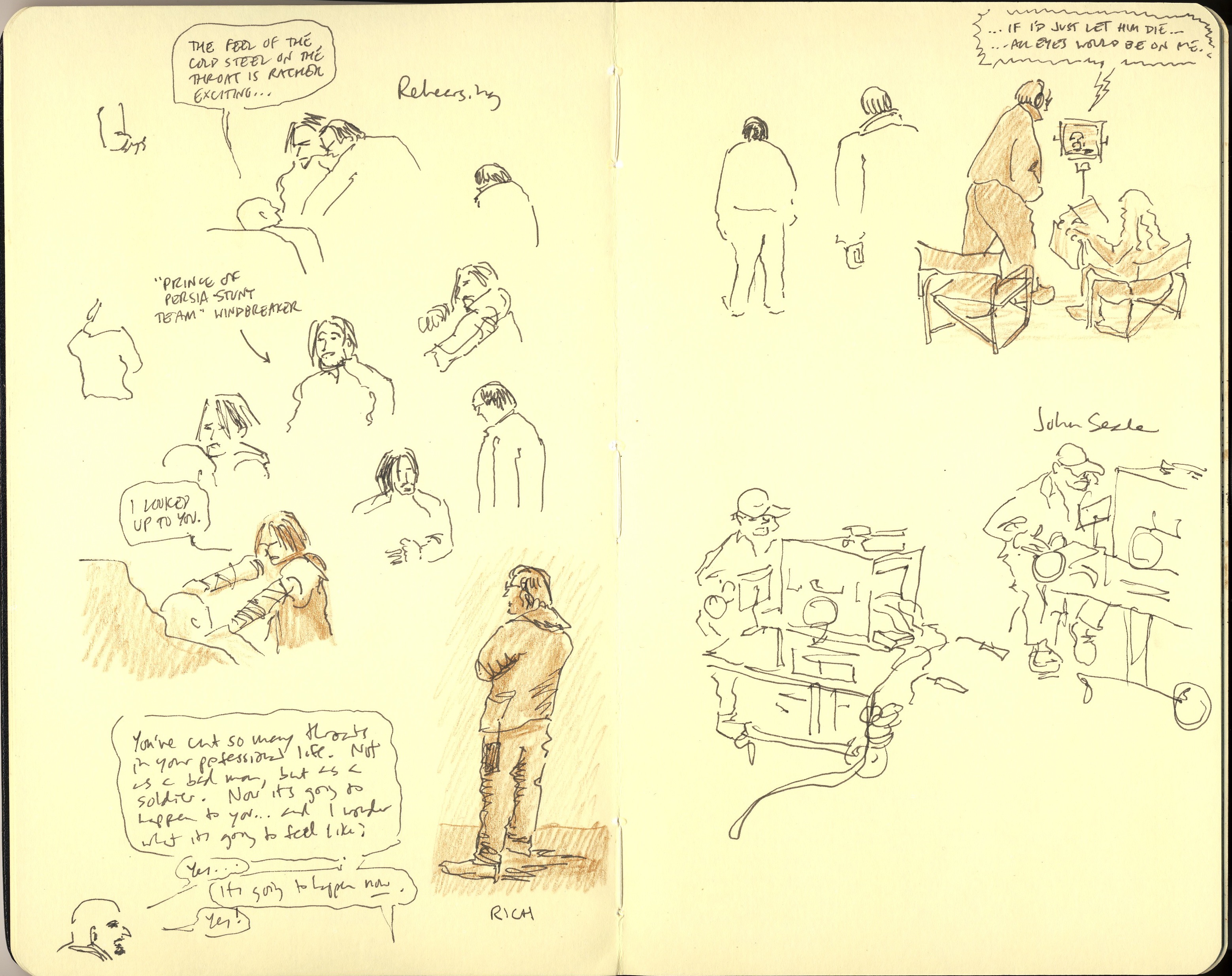
On the left-hand page, Jake and Sir Ben rehearsing with Mike Newell while second A.D. Rich Goodwin looks on. At upper right, Mike and Beverley watching the take, with Mike half out of his director chair like a bowler using body English to help guide the ball down the lane. Bottom right, cinematographer John Seale.
Comments (...)
Still really cool seeing behind the scenes stuff this way.
I'm checking it all again after I've seen the film to see where it belongs.
Wow, these are so cool. Lots of story telling and interaction! :] Wonder what that guy with the wacom was working on. Looks like the Cinematographer had his hands full with that awesome looking contraption. These are really fun, keep it up! :]
Wow this is great!
London premiere sketchbook
Just got back from the Prince of Persia movie press junket in London and Moscow. For readers curious about what that was like, I've posted these pages from my travel sketchbook.
The idea of a junket is to bring the talent — which in this case included Jerry Bruckheimer, Jake Gyllenhaal, Gemma Arterton, Sir Ben Kingsley, Mike Newell, and me — to one destination so the press can come to us, instead of sending us on a tour from place to place. Having the global premiere of Prince of Persia in London rather than L.A. made it a short trip for European journalists, but a longer one for those from the U.S. and South America.


The junket took over several floors of the Dorchester hotel in London, where the interviews and press conference were held.


An inevitability of press junkets is that although the journalists come from different cities and countries, with a range of interviewing styles, you nonetheless tend to get asked the same questions, sometimes thirty or forty times in a single day.

The premiere was Sunday night at the London Westvue.
Not pictured: Gemma dancing barefoot in her princess gown at the afterparty.

Seeing the "Coming Soon" signs for Prince of Persia in the Odeon Leicester Square gave me tingles. That's the theater where I first saw Raiders of the Lost Ark in the summer of 1981, right out of high school, in a packed house. It set the bar for my summer moviegoing experiences to date, and was one of my major inspirations in creating Prince of Persia on the Apple II a few years later.
Next: On to Moscow.
Comments (...)
Great blog entry as always. I miss you on the forum though, Jordan.
Read the comment about stylish-looking passengers, only then had a good look at the image. :)
Actually, this is the reason I always hesitate to ask questions on an interview - all questions tend to repeat themselves and I hate asking people the same question again and again. I hope you were not that bored in Moscow.
Oleg, set your mind at rest — Moscow was a high point of the junket, with plenty of new questions I'd never asked been before and that I truly enjoyed answering. It was a pleasure speaking to journalists who were so well prepared and genuinely interested in the subject. I'm not just saying this and I can tell you that others on the junket had the same reaction.
I like your sketches, they are great. You don't lose sight of the big picture and you sketch the essentials from what I see.
Solomon's Thieves released
I'm excited to announce that Solomon's Thieves, my first/second, First Second graphic novel illustrated by the terrific LeUyen Pham and Alex Puvilland, is now on sale in bookstores and on Amazon. It's just gotten its first review on Newsarama.
Based on the historical events of the fall of the Knights Templar, Solomon's Thieves is a swashbuckling adventure about a bunch of outlawed knights who band together to attempt the greatest heist of the 14th century.
It's the first book in a trilogy — and a career first for me, in that it's not based on a video game. I hope Prince of Persia fans who like graphic novels and/or historical adventure fiction will check it out.
You can read more about it here.
Comments (...)
Oh I got it Friday and I read it right away. I loved the drawings, so inspiring and more elaborated-adult than the PoP one. I find it nice (being French) to find the Middle-Age Paris, it's something we don't actually see much ! I paid attention to the details ! The storytelling, just epic. I didn't expect that it would be so deep. I'm totally hooked.
In response to your afterwords, which are truly gold. I thought you'd mention that one : Ken Follett's novel the Pillars of the Earth. Even if it's fictional, it make you smell, hear, see, touch medieval time. It's a must-read for those who love that period. I think you can find inspiration in it.
I read it as soon as it came to my door. Beautiful.
Fantastic! When can we expect the second part? :D
-Ben.
Moscow sketchbook
This is the plane that took us from London to Moscow for the Prince of Persia press junket. It was the nicest plane I've ever been on. I felt like Tony Stark for a few hours.

Every fun, relaxing hobby ought to contain an element of danger; for me, drawing people I know at close range is the halfpipe of sketching. When the result is a bad likeness, unflattering or both (which it often is), there's nowhere to hide. In this case, several of the people on the plane with me were world-famous, so the stage was basically set for a spectacular wipe-out. But I had to try.
The ones of Jerry and Mike Newell (above) are at least more recognizable than some of the others.


None of the ones of Gemma really look like her. Girls are harder to draw than guys to begin with, and the more beautiful they are the harder it is. It often ends up either looking like a generic "pretty girl" or a different girl entirely.
Gemma got her revenge, as you can see from her rendition of me on the right-hand page above.

The press junket, premiere and afterparty were on Tuesday, so I didn't get to do any sketching that day. Wednesday was our free day; Mike Newell and I began it with a three-hour tour of the Kremlin's incredible armory.


This was my first visit to Russia, a country I've long wanted to visit. At three days, it was much too short.
Comments (...)
I just want to say... I love the movie so much!!!!
Saw it today and it was really really good!!
WOW! That sounds like such an amazing trip, I'm glad you had some free time away from all the hubbub. And I bet that armory was really neat, I have a thing for old weapons, they just have so much personality. Speaking of which, those sketches of antiquities are AWESOME. I absolutely love the chair, medals, and the goblet! What I enjoy so much about your sketchbooks is that it like a diary, I wish I structured mine more like that. With word bubbles and commentary on what's going on. It makes it that much more personal. And I can't recall how many times I've seen something silly happen and wished I could remember it later. Might just have to take a cue from you and steal it ;P
PoP comes out this weekend, lots of love and good vibes for the opening. I know I'll be going :]
- Kendra
I hope you had a ????????????? ??????? (a wonderful trip) to Russia. I should thank you also for your work on The Last Express, and its Russian character Aleksej, because it was actually that incredible game that inspired me to learn Russian in college, and I've since spent some time living in St. Petersburg. So ??????? ??????? (great thanks) to you and your creativity!
I wish you will visit Russia and Moscow once again. Our journalists complained that they have now time for interview.
Mr. Mechner, you've inspired me to take up drawing as a hobby like you.
But, you kind of need to work on your handwriting a little bit (I only say that because I care ;-)
What? His handwriting f**king rocks! I'd kill for having such stylish personal typography!
It *is* cool, it's just hard to read easily.
Loved your sketches of Moscow! I live here and went to see PoP last weekend with a bunch of friends. They all loved this movie! Hope you get to visit Moscow again and spend a little more time. There's soooo much more cool stuff in addition to the Kremlin :)
Greetings
Seeing these exquisite sketches always reminds me of the wonderful time I spent playing "The Last Express". That was a truly amazing and engrossing game, for me one of the best ever. Are you planning to write and possibly direct a movie adaptation of "The Last Express"? That would surely be an interesting venture. Best luck for your future projects (I'm quite excited with the "Fathom" comics adaptation you're preparing). Hope you can get back to game design soon, for creative talents like yours are very rare in the gaming world.
PoP released for IMAX and iPhone
I woke up this morning thinking "Today's the day!" One that's been emblazoned in my mind for weeks now, thanks to subtle reminders like this one:
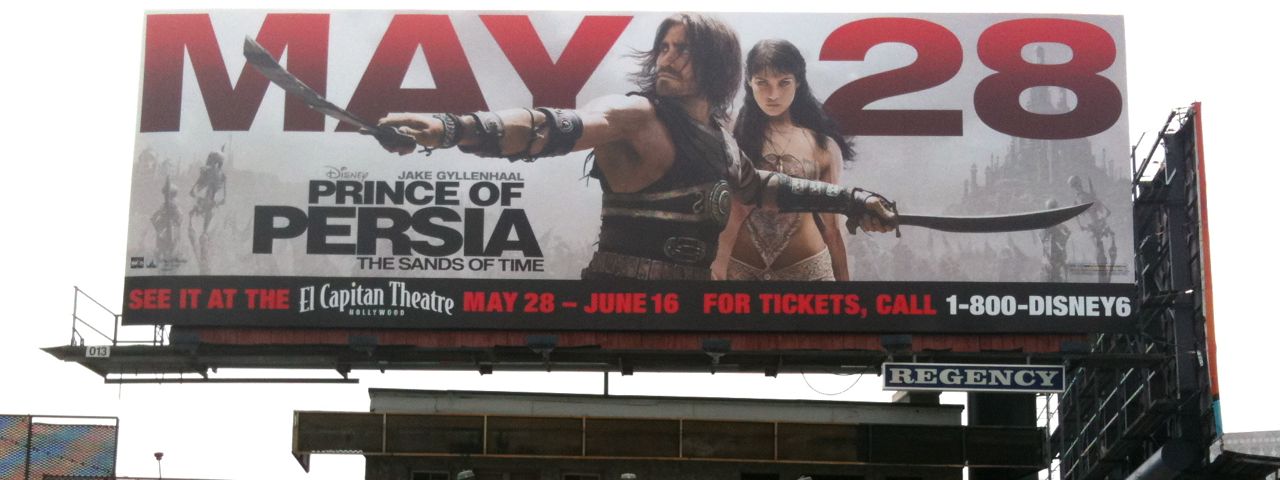
But it wasn't until I picked up my iPhone and blearily checked email and Twitter while making breakfast (compulsive habit, I know; I'm trying to break it) that I received the surprising news that today is ALSO the release date of the original Prince of Persia for iPhone/iPad.

You'd think such perfect timing would have to have been coordinated months in advance, but it wasn't. If there was a mastermind, it could only have been some unsung Apple employee with a sense of irony.
This weekend might be just the occasion for me to try playing through the game for the first time in 20 years. I already have my fallback strategy: If I can't get past level three, I'll blame the touchscreen controls. It couldn't be aging reflexes. No way.
And I promise not to play my iPhone during the movie after the lights have gone down.
Comments (...)
I second that nomination
Hi Jordan,
Watched the PoP movie yesterday in Toronto - CONGRATULATIONS! Was a lot of fun. Ostrich racing is hilarious! And the racing track manager - we all recognized John Rhys-Davis character from Indiana Jones series, this time to be played by Alfred Molina, great (I loved the line about 'only one ostrich!'). And talk between Prince and Tamina brings up a lot of memories of Leia and Han - and it's great again. Just the right amount of pathos and kissing (Peter Jackson really should take lessons), just the right amount of time-turning. The plot idea about two older bros and three younger is good, watcher is kept guessing. The moment and the idea I especially enjoyed is when Dastan shows his brother how the dagger works :-) That's ingenious. And casting is good (did I mention I loved Alfred Molina? :-)). So - the movie just so cool and is as much fun as the games are. Congratulations! (and we all hope, if the rumors about filming of 'Last Express' turn out to be true, that that one will be great too, although it would be, of course, a very different task to this one). Thanks for giving all this to us!
Hope you enjoyed my erstwhile hometown of Moscow - there are a lot of PoP fans there!
Dear Mr Merchner
Thaank you for releasing PoP Retrò for iPad, which I bought, but it works with one only landscape position, the wrong one if you use the Apple-case for iPad.
Please, do an upgrade to allow rotation.
Hi Jordan,
I stayed up late one night last week, procrastinating instead of writing a game design / pitch document, reading your POP journal. It was the best procrastinating I could have done, as I woke up the next morning raring to go, realising that even yourself who created two of my favorite games (POP and Sands Of Time) goes through all the self-doubt, trial and error etc that we all do! Thanks for being so brave and sharing your old diaries 'warts and all' for all us aspiring games designers to feel better about ourselves with :D
Also loved that you were honest about the fact that the origin of some of the elements of Prince Of Persia came from friends and family (e.g. the mouse!) - that was another reassurance for me when I was writing that doc. I think sometimes designers, as movie directors, really are at their best when they are acting as a 'filter' for all the creative people around them, so it's almost like the game/movie is making itself. But the designer/director is letting the stuff through that supports his/her vision. I have to remind myself that I'm still 'doing something' in these moments, and not get hung up on the 'but I didn't think of it' bit of jealousy that is usually the first reaction ;)
Anyway enough rambling. I saw the movie last night with my 71 year old Dad. He's played and finished Sands Of Time a few years ago, and loved it as well. We both loved the film. It was especially emotional for me after reading your diaries and knowing what you went through back then, how you wanted to be a screenwriter but kept being dragged back into finishing POP, and now after all these years it's paid off! :-) Also as I've just started on this games designer path, it was emotional to see your dreams up there on the big screen, now for a much bigger audience.
Loved the many visual and plot references to the many POP incarnations, just overall really has proved that the reason video games movies' stories have sucked until now is because they weren't based on video games with fantastic stories! :)
I'm sure it's just the tip of the iceberg for you. Congratulations!!
Heath from Melbourne, Australia
Just saw prince of persia. It has my vote for the worst movie of the year thus far.
Stick to video games mr. Mechner.
Mr Mechner you can refer to my guide if you're stuck ;)
Just kidding... By the way that was a great movie. Turned out just as expected, caught it on the release day! I think it's epic...!
I noticed that there was a dedication to Tomi Pierce in the end credits. That made me smile. Was that your idea or Mike Newell's?
Hi,
Firstime I played PoP was on GameBoy ! ( 1991-1992 ).
"Game by Jordan Mechner" ( at this time you were like the creator of Tetris for me, like a myth !! ;)
With internet now, we can see your picture, finally you are an human ?!
Congratultions for this game, it's one of the best game ever. One question if I may ? How long took you from brainstorming, first ideas and the developpement of this game ? And How long was the developpement ?
Thanks a lot for the good time, i'm going to play with my ipod touch and like you I'll blame the touchscreen controls if I die too soon ;o
Frédéric
( Paris - France )
Congrats!
Saw POP at the cinema tonight, had a blast. I was very concerned when I heard there was to be a film conversion of one of my favourite games, as most 'movie games' tend to... well suck. I was delighted to hear that you were working closely on the project though, and it shows. Can we expect to see a Warrior Within or Two Thrones ? :)
Will be buying to iphone game tonight. Could never finish the original as a kid, maybe Ill have better luck now.
Went to see PoP on Friday night and it's excellent. Perfect action movie, entertaining, funny and spectacular, pretty much in the spirit of the games!
And it's cool to see your name for the screenplay after reading your PoP game days journal :o) There you go héhé!
Congrats!
Hey Jordan,
I just have to say: the movie is brilliant. I loved every second of it. You and the crew and cast did an excellent job.
And I could never pass level 3 in the original game. I think I did it a few times when I was 10 years old - I even managed to get to level 5. But that was it. I eventually finished the game by cheating (terrible, I know, but it's a hard game).
Hey, Jordan,
do you still reconsider making a deal with Good old Games (GoG.com) letting them port your old games on newer game systems?
Contests on the double release.
Any chance that Karateka will get ported to the iPhone/ipad?
When I was in second grade, my sister and I both game down with chicken pox. I basically had to spend a week at home with nothing to do. My dad brought me home a copy of Karateka for my 8088. I played the heck out of that game.
I was so shocked when I met the princess in a fighting stance, lol.
I think that was 21 or so years ago, and I'd love to play it again, and have it in my pocket!
Ugh, iPhone contests=congrats
Hi, I stumbled upon your site almost completely by accident. Even so, and as funny as it is, I practically spent the last 3 hours reading up on your account of the history of PoP.
I just want to say, even though you were down in the pits after release of the original PoP, there was one kid that was just dying to get a few extra hours in of game time. Also love the personality you provided in your journal entries.
How did your screenwriting career pan out in the end? I would like to assume you're doing well for yourself now :)
No complaints... got my first movie opening this weekend, hoping it's not the end but the beginning!
Hello. I am a fan from the Philippines, and has played the first PoP back in 1989 when I was still in premed. It's still the best video game for me and was way ahead of its time.
Congratulations on the film, which did not disappoint like other video games played onscreen. It was fast-paced and lively. The story and historical facts provided were also a perk.
Thank you, Jordan. 'Hoping to see a sequel in the future. :-)
Like Jeff says - I was in the same boat as a kid, in the computer store in my local town mesmerised by PoP running about on a demo screen. Couldn't wait to get the game, and it was probably the first game I was engaged enough to actually finish!
Good job on the movie too! - Saw PoP movie in Ireland last weekend. Asked to comment on it by others I said "Unlike other game to movie conversions this one is actually good. It has a plot, and a story!" [and not just Angelina Jolie in a tight top... not that Angelina in a tight top it bad thing].
Afterwards I did think it was really ironic, that Jordan started PoP using the roto-scoping methods used by Disney to make a computer game, and now is working with Disney to turn the same computer game into a movie!
Just read Kevin's comment. It has my vote for the worst comment of the blog thus far.
Stick to lurking mr. Kevin.
;)
This movie rocked.
keeping it short and sweet. B)
Hey Jordan
Just saw the movie last night here in Melbourne, Australia. Thought it was great, I grew up playing PoP and have always loved it. The film does well to capture all the moves in the game and the Persian style. Really well done mate.
Cheers
Mark
Glad to see the film bombing at the box office, just a shame that it will end up surpassing the budget through international ticket sales. Films like this are bad for the industry the worse it does the better.
Hi Jordan,
I'm not sure if this has been asked before, but is there any chance that we'll see a sequel or perhaps a Last Express movie? I rarely play computer games but this was the first I've finished and loved and I want more.
best wishes,
Izzy
Hello,
Now that the original Prince of Persia has been released for the iPhone, is there any chance we'll see Prince of Persia 2: Shadow and the Flame released in a similar way? While PoP1 sits atop my list of best games of all time (tied with 'Indiana Jones and the Fate of Atlantis' and followed by 'Riven'), I thoroughly enjoyed the side-scrolling sequel and would love to see it on the iPhone/iPad or other platforms (i.e. Steam, Mac OS X, Windows). Any chances of this? I've always preferred the Mac versions (versus DOS) of the first two PoP games, as they were less blocky and in what seems to me to be a higher resolution (especially true for PoP1, but also true for PoP2). It would be great if these Mac versions could be re-released for Mac OS X or Windows. I use DOSBox, but miss playing the games the way they appeared on my Mac LC. I'm extremely pleased to see that the iPhone version of the game is the 1992 edition of PoP1.
Thanks for everything, Jordan. I consider Prince of Persia to be a bit of a personal obsession. It's probably not healthy, but I simply can't get enough. I don't consider PoP 3D to be the bastard child as others do and was really impressed by its over all atmosphere and feel. My family always owned Macs and it took me five years before I was able to finally play it. Until then, I had to simply re-watch the making-of video that was bundled with the 1999 Prince of Persia Collection. Exciting times.
Regards,
-Steve
Sure, if your favorite movie is Teltubbies.
Hey Jordan,
I just wanted to drop you a message (as I've been wanting to for 19 years now) being a huge fan of the PoP series. Congratulations on all of your achievements and the release of the PoP movie! You're an inspiration I've looked to over the years, to follow my goals and pursue success.
Hope you are well,
-M.J
there any chance that we'll see a sequel or perhaps a Last Express movie? I rarely play computer games but this was the first I've finished and loved and I want more.
Hi a novice to jordanmechner.com and loving it so far! I'm a CMO(Chief Advertising and marketing Officer) . No Sure of posting in this but I'm seeking business that may
grow our sales on the web like how forums get traffic in huge nubmers. I feel its wonderful on how several members and visitors
these forums get. Any suggestions of firms that you've used would be fantastic.
Airport security

Did these quick sketches while standing in line for airport security screening. It was way too early in the morning and all I wanted to do was get on the plane and sleep.

Comments (...)
Nicely done for some quick sketches!
Sketching while standing in line for airport security screening ; this sounds like the beginning of an adventure game/movie :-)
Wow,nice sketches!:D
guess what Mr. Mechner!I just finished the old POP PC version after one hundred tries and retries!! BEST GAME EVER!I mean it!XD
Great read. I found your article on facebook and i have your page bookmarked on my favorite read list!
I'm a fan of your site. Keep up the great work
Sketching in cafés and airports
Some more sketchbook pages for no particular reason. This was in NY a few months ago:

and this was the week Alice in Wonderland opened at El Capitan:

and this was last week at Dorval airport:

Weirdly, I spotted the guy with the mustache again a few days later, at a bar in LA. Sketching people makes you pay close attention to them; I doubt I'd have recognized him otherwise. I wonder how many of the strangers I pass by every day are people I've seen before, maybe many times before, but I just don't notice.
Comments (...)
all pics are too good
Interesting! I wonder things like that when I'm in places with people from all over, like theme parks or airports.
I watched Paul and Sandra Fierlinger's "My Dog Tulip" the other day, and I thought of your sketches. You might enjoy the way that Paul animates Tulip - he does a great job of capturing the way she moves.
I have some great memories of landing at Dorval as a young boy - I enjoy the way you captured the activity.
- Chris
Wow…A mega insight into a diverse range of artist thought's and observations…good post and brilliant to see people using traditional tools in a truly digital world.
Toronto
Just got back from my first-ever visit to Toronto, a city I've long wished to visit for many reasons, yet somehow, amazingly and despite being from New York, never did until this weekend.
It was a whirlwind, too-short 36 hours including
- Ubisoft's Toronto studio launch party Sunday night
- giving the keynote Monday morning for Interactive Ontario (talking about one of my favorite subjects, Prince of Persia)
- doing a TIFF "Film and Games" panel later that afternoon with Jade Raymond and Jon Landau (a really nice, down to earth guy who produced two small yet profitable indie films, Titanic and Avatar)
- standing ovation for Catherine Deneuve after the premiere of "Potiche" (her 109th movie according to IMDB)
The Toronto International Film Festival felt welcoming, spiffy and well organized, like Toronto itself. I left the city by an airport on an island in the middle of downtown that you take a ferry to get to. Now that's cool.
Comments (...)
It was a pleasure to meet you and have you speak at IN10, I'm so glad you enjoyed our city.
Did you see Beautiful Boy? My first film as an Exec Producer just premiered there and sold to Anchor Bay.
Mr. Mechner,I'm glad to announce as a Persian,for the second time after playing the famous Video game,I was completely blown away by the spectacular,stunning Prince of Persia movie on DVD.And I eagerly look forward to seeing more of your works on cinema!
Too bad you seem to have missed the music garden, it's a beautiful project that the cellist Yo-Yo Ma started, and they regularly have live performances there, must be an awesome athmosphere. Well, at least you'll have a reason to return to Toronto ;)
Hey Jordan,
It was awesome to "meet" you (from afar, which is still awesome). You are a very driven person with an eye for adventure. Looking forward to more!
Thanks for the link, too!
Did you attend the screening of Godard's latest? I heard that half the audience walked out of Socialisme because (intentionally) there were no English subtitles.
"The video games are meant to be played, not watched" - the great phrase! Unfortunately, most of modern video games follow the opposite idea. Fore some reason most games are "one-time", supposedly the picture is more important than the gameplay.
Glad to have had you in Toronto. I'm a big fan of the PoP series, particularly the original side-scrollers (my all-time favourite is the Shadow and the Flame). Just wanted to comment on your phrase, "Video games are meant to be played, not watched" - I'm inclined to debate this. I love playing video/computer games. At the same time, one of my favourite pastimes is _watching_ my husband play video games. A lot of well-made games are entertaining, both to play _and_ to watch.
Well, you see, the video game's picture mustn't be so great to make the game great. Here you are the example: the first Prince of Persia. The graphics is not very cool but the game is played nowadays too and it's popular. The Elder Scrolls III: Morrowind - the graphic is awful, but the game is godlike. Prince of Persia: The Forgotten Sands - graphic is great, the game isn't. The Elder Scrolls IV: Oblivion - the same thing.
It was a pleasure to meet you and have you speak at IN10, I'm so glad you enjoyed our city.
PoP Original Screenplay
Regarding Prince of Persia's recent journey from video game to movie, I'm sometimes asked how closely the final film follows my original story.
Now that the movie is out on DVD/Blu-Ray, I figure the easy way to satisfy curiosity is to simply post my screenplay (PDF) from June 2005.
Quick history: This was the last draft I wrote, starting from the story John August and I pitched to Disney/Bruckheimer in 2004. A series of other writers took it from there: Jeff Nachmanoff, Boaz Yakin, Doug Miro & Carlo Bernard, in that order, resulting in the shooting script that went into production in summer 2008.
The making of the movie is well documented in Michael Singer's coffee-table-worthy book and the movie DVD/Blu-Ray extras. Now, you can see how it started.
Update: If you're curious about the game-into-movie adaptation process, I've also posted the original game script of Ubisoft's Prince of Persia: The Sands of Time, which I wrote in 2002-03, and an accompanying article about how that game story was developed. As these materials illustrate, writing for games and movies are two very different crafts.

Comments (...)
Thanks u sir for sharing ..
Hi Jordan,
thanks for posting your original script. Looking forward to reading it.
Thank you for sharing this, I really enjoyed reading it. I prefer this version to the revised one, but the cliffhanger is far more merciless - I'm half glad it wasn't adopted in the movie! :)
Thanks for share it!
I recently found a script for the movie, that I read was leaked sometime before the movie's release. It says "Revisions by
Jeffrey Nachmanoff, June 15, 2006
Jerry Bruckheimer Films" (so it's not as special as what you posted).
Anyways, thanks for posting the script, Mr. Mechner.
great.......Thanks Mr. Mechner....!!!
Delightful, some Thanksgiving day reading after supper. Thank you Mr. Mechner.
Hey Jordan,
I've been searching for those fonts for a long time. Is there any way they can be available to download?
Both the font with which you've written 'Prince of Persia' on the title page (which I'm sure is proprietary, but I'm only looking to use it in my capacity as a fan, not for anything commercial), and the one which you've used to write 'Sands of Time' right below it (which I guess is not a proprietary font but have been unable to locate it anywhere).
a lot of thanks, mstr Jordan. a wanna ask, deoes your book POP-SOT exists only in english language? cause of i'm from russia, i dont know english wery well....
I read through half the script and was thoroughly entertained. I haven't seen the movie yet (the disc from Netflix is sitting by my TV at home right now)...I hope they didn't change much, this script seemed great to me!
This was an incredibly cool read, thank you for sharing!
I have always loved the stories and the characters from POP. This version has a lot of what the movie lost for me. Dastan doesn't start off as noble so you see more of his progression from having the world handed to him on a platter to fighting for something because it's... right. He also retains more of his wisecracking charisma from the games. Tamina is a much stronger character and not just portrayed as mildly intelligent arm candy. There's more substance behind her, she can kick some serious ass, and it makes more sense for her to be a guardian of the dagger.
Needless to say, I still enjoyed the final movie and am hoping for a sequel. I would love to see the direction a sequel would take and if it would follow along the lines of the games and deal with the consequences of releasing the sands of time.
I think it's a great script and thank you for the world you created, it's a fantastic place.
Jordan, please don't be mad about what I'm going to say, but...
You claim that the reason for the change of story from the game was that the plot of the game was too poor and not suitable for a movie.
But one of the main problems I had with the film was that the plot was *Not* as good as the game's plot, in fact, there were almost no plot to it.
You should have stick to the game's plot on this one :-/
Oh, and there was no problem to not give the prince a name. I don't understand why you make the decision to give him a name in the film. "The Prince" is a much cooler nickname than "Dastan" :-/
10 times better than the movie, still 2 times worse than the game!
Thanks u sir for sharing ..
THE ORIGINAL SCRIPT OF THE GAME and your final draft of the screenplay with one shot, it's absolutely wonderful!!!!
I am a great, great, great, great lover of the old trilogy game on XBox. After playing SOT and Warrior Within I really think "Some serious screenwriter and a serious director have to do a movie from this game" and when I played the final chapter, The Two Thrones, I was only much convinced.
I remember that I was afraid when I saw Gyllenhaal in the main role... I feared the movie is going to be garbage. He wasn't that serious face that the character of the Prince need (Karl Urban could be really really better!!).
An so, on the screen, I was in front of something like an arabic Pirates of the Caribbean. Damn it!
I dunno. I liked the story in the cartoon version of prince of persia alot but this was ok I guess.
Hi Mr. Mechner,
Thanks for this treasure.
I would like to know if there is any copyright infringement printing the scripts. I want to read them, but prefer read it in paper instead the virtual format. However I do not want violate any copyright.
Thanks again.
Hi Mr.Mechner,
Thanks for creating.
The best of anything gives best you struggled a lot for making this.
Thanks again.
At the airport


Comments (...)
What I hate about air travel these days is that every time, it seems like the planes are the same as the ones we flew on back in the 70's and 8-'s as children. The exact...same...planes. And all dented and scuffed, too.
Loved Kareteka as a kid, by the way. Finally going to get to play Prince of Persia. One day. Soon. In emulation. I always like to start with the first one of a thing.
anyway - thanks for the games and the drawings. and all this other stuff (having a look in the sidebar)...productivity good!
How does a person ever catch up with all the art in the world? It's like living in a storm of flowers.
PG
Mmmm...Cara Foods..
The caviar of transportation food...on opposite day...
After playing THE FORGOTTEN SANDS for both Wii version and XBox 360, I only hope that Ubisoft does not take too long creating the next games for POP. Jordan, the movie and games were just wonderful and I can't wait to experience the next chapter, especially the games.
Ammo for Luddites

Having just read three Ian Fleming novels, one Henry James and one Jonathan Franzen on my new Kindle over the holidays, I found myself vaguely troubled by the feeling that I hadn't really read them... that their plots and characters might slip out of my memory as easily as they slipped into the Kindle's.
I told myself this was old-style thinking, that just because I don't have the actual physical, dog-eared, tea-stained books to shove onto a bookshelf as souvenirs doesn't mean their contents have engraved themselves any less deeply into my brain.
Now along comes this post by my scarily intelligent friend Jonah Lehrer (and his previous post foreshadowing it), citing a new Princeton study hinting that, maybe, the inchoate unease we bibliophiles have been feeling is more than just sentimental:
This study demonstrated that student retention of material across a wide range of subjects and difficulty levels can be significantly improved in naturalistic settings by presenting reading material in a format that is slightly harder to read.
It reminds me of another study I read a while back, suggesting that elementary school kids who squirm and fidget in their seats actually retain and process information better than if they sat still like they're supposed to.
I just wish I could remember where I read it.
Comments (...)
I'm not sure the study can possibly control for all factors, exactly due to inchoate factors: "Old Timers" like you and me (PoP on Mac OS ruled!) know what we know.
I'm hardly a Luddite (iPad, iPhone and Mac OS UI/App developer), but I did grow up on books and am probably more plastic than elastic when it comes to certain things.
That doesn't mean that kids born today won't be inured to a totally different set of things.
A midway case: check out Inkling for iPad. Each of us has read far more for pleasure than for schooling, and Inkling has textbooks updated to iPad-level technologies. What I saw wasn't how great the iPad was but all the shortcomings the typical textbook had (e.g., flipping to the back of the book to see the answer to an in-line question and accidentally seeing answers to as-yet-unseen questions).
And as an aside, I know the screenplay changed significantly from the original for the Prince of Persia film and I don't know if you see that as a good or bad thing, but the final result was a pleasure to watch (I own the Blu-ray). So, thanks.
Silverlake style
Filled these pages at an art opening in Silverlake last summer. The place was packed so full of people I couldn't see the pictures on the walls, which was just fine for my purposes.


Comments (...)
Is that a Vivian I see, and possibly one of myself? Gah, this makes me want to go back out and sketch so bad. soon, very soon!
These are great thumbnail portraits, Jordan, very witty. Make me feel like I'm living back in Silver Lake.
PoP original game screenplay
A few months ago, I posted my first-draft screenplay of last summer's Prince of Persia movie. Now, here's the script of the videogame (PDF) that inspired it: 2003's Prince of Persia: The Sands of Time.
Or rather, partial script. For writers interested in the differences between writing for movies and games, it's worth noting that there is no game design document equivalent to a film screenplay (i.e. an established format for the writer to communicate the story to producers, director, cast and crew).
Typically, the larger part of my writing work on Sands of Time was conveyed through non-screenplay documents (dialog recording and tracking spreadsheets and the like) to the team of designers, artists and engineers. I've described that process in more detail in this article for MIT Press.
The "readable screenplay" posted here reads like a film screenplay, but that's because it contains only the cinematic cutscenes — not the in-game scripted events, dialog, and voice-over narration that are just as essential to the player's experience of the story. Those exist in no easily readable form.
The best way to experience a videogame story is to play the game. But for a quick read, this script offers at least a glimpse into Sands of Time's beginnings.
Comments (...)
Fantastic! When playing the game I lost my save game in a crash right before the final battle. I couldn't bear to replay the whole game just to fight the last battle and see the end...but now I know the ending.
incredible! thanks Jordan!
And here I thought your script was just:
Page 1
Create awesome game that will span the test of time.
Page 2
Laugh maniacally.
Thank u Mr. Jordan for sharing...:)
Thank you for sharing this with us. I've always wanted to read video game scripts to see the difference. Do you know where I would be able to read more?
So that's how you spell the word "Kakolookiyam" - what does it mean?
It's the name of one of the books of the Indian Panchatantra (an ancient Sanskrit collection of animal fables) about a war between crows and owls.
Is this the same PoP SoT game screenplay that was available for a long time on Zain Alvi's website?
And yet, Jordan. what you think. Suppose that you had to pick the full name of the prince.
What do you think?
In the film, his name is Dastan, and who came up with this name?
I did. Here's a post on the subject: /blog/2009/03/a-trickster-prince/
Thanks so much for posting this! I was curious about how professional writers handle it in the field, and had to do a good bit of googling to find a real answer from you.
Thanks for making the script available. I'm working on my own video game script at the moment and this is definately shows a good approach.
Thanks again.
Oh man, this is the best! I have seriously always wanted this! It is like my birthday up in here. I am an aspiring young filmmaker and I swear that my "Masterpiece" is going to be an adaptation of this game. Mr. Mechner, in about twenty years when I've established myself as a director, I will be ready and you will be hearing from me about it. :) Until then, cheers and thank you so much for posting this.
I found a lot of backstory in this. You mention one time (can't remember where) about the murals in the Maharajah's Treasure Vaults. I've seen them and can't figure them out. What do they mean?
Classic Game Postpartums
In a couple of weeks, I'll be speaking at Game Developers Conference 2011 in San Francisco, about the making of Prince of Persia (the original, 1989 side-scroller) as part of their "Classic Game Postmortems" series.
I'm especially excited to hear from the other speakers — an awesome lineup including, among others, Eric Chahi, Will Wright, Ron Gilbert, Peter Molyneux, John Romero, and Toru "Pac-Man" Iwatani — about how their games, which sucked up so many hours of my youth, came to be.
(A non-game-industry friend asked me, in some confusion: "Why call it a post-mortem?" These are retrospectives of games that shipped, not ones that got killed. But even though we game designers and programmers are supposed to be a logical bunch, I don't think the term "post-partum" is going to catch on any time soon.)
See you at GDC!
Comments (...)
1989 Prince Of Persia Postmortem! I wish I could be there... please post all about it!
This will be my first GDC and this is at the top of my list!
Ben — Thanks for coming!
The secret is easy: I got really bad grades.
Hi Jordan, it's Ben (from Yale). I saw you at your PoP post-mortem on Wednesday. So me and my friend have been trying to work on games while dealing the Yale workload, which basically comes down to us coding frantically on Friday nights in Linsey-Chittenden hall. It's been difficult and we've been wondering: how did you manage to complete Karateka while at school?
I'll be sure to ask him.
Perhaps because you don't usually dissect things post-partum?
no news about princeofperis 2008sequel?
Hello, Jordan
So many masters in this Conference. Could ask Eric Chahi about if he has any palns about moving Another World to a big screens? And does he have any social activity in Facebook or Twitter?
Best regards,
Daniel (following you on twitter as @daniel_ilyin)
Wow, I'll be there too :D
I'm looking forward to is so much!!!!
What an outstanding lineup it will be, It will be interesting to hear what the developers plans are for these classic games. Games that have shaped the industry in what it is today. With the New platforms such as the Iphone, Ipad, and Itouch, it would be wonderful to see these titles emerge again in its classic forms, I also think that the classic Karateka would be a hit as an Iphone game. Wish I was attending, but I will follow the news eagerly nonetheless.
Best Regards
Dave
I hope someone films this, it sounds incredibly interesting.
i cant believe im actually in your blogspot! i love your games so much! prince of persia is the best series ive ever played! i was just wondering...will you ever make a sequel to the PoP series because i'll be more than happy to know...and make it xbox360/ps3 compatable because PoP looks great in these systems.
Interviewing Leni Riefenstahl

Twenty years ago, my friend George Hickenlooper asked me to come to Munich with him to interview Leni Riefenstahl, the brilliant/infamous director of Triumph of the Will.
Here's the transcript of my notes (PDF) from that interview in case anyone's interested. I stumbled across it while cleaning out an old hard drive.
It was May 1991. She was 89 years old. She often spoke of herself in the third person. She had a strapping male secretary named Horst.
As we said goodbye, I realized I was shaking the hand of someone who'd once shaken hands with Adolf Hitler.
"And maybe did more than just shake hands," George added.
Comments (...)
This is pure gold, especially the quote towards the end:
"It was a document. It can be used for propaganda. If it were propaganda, there would be a voice-over. There is no voiceover, only images. Everything you see is true."
Right there, that signature pre-war attitude of talking about movies as "film documents". Maybe it can be tied to the practice of seeing newsreels in the cinema, rather like how we're used to seeing the definitive view of the world on TV. And then, how she almost seems to deliberately belittle the Kuleshov effect and all the other things you can do with editing.
Spicy Thai
Given a corner table next to the kitchen with a view of the entire restaurant, I had to at least try to take it all in.

Comments (...)
GDC 2011: The wheel turns

Nearly everyone I spoke to at GDC 2011 in San Francisco agreed that it was one of the most energizing GDCs of recent years.
I loved the "Classic Game Post-Mortems," a series of one-hour talks in which game designers spoke about the making of their early games: Eric Chahi on Another World (aka Out of This World), Peter Molyneux on Populous, John Romero and Tom Hall on Doom, Mark Cerny on Marble Madness, Toru Iwatani on Pac-Man were fascinating, inspiring, and touching to hear. (I gave a talk about making Prince of Persia, and really appreciated the generous response.)
But what really grabbed me was the energy and excitement surrounding indie games, especially on new platforms like mobile phones, iOS, Facebook, XBLA and PSN. More than in any previous year, I was reminded of the Apple II zeitgeist of the early eighties. It feels like we've come full circle, as an industry, to that time when a tiny team with few resources but talent, creativity and elbow grease has the potential to produce the next hugely influential mega-hit.
And I'm pretty sure I just met some of them in San Francisco.
Comments (...)
Hi Jordan, some great names on that list, yours included, I hope some of those vids will make their way on to the public interwebs.
A name I'd love to see but is consistently missing is that of Paradroid developer Andrew Braybrook. Wikipedia reports him working in a city job, but I'd love to see him tempted out of game dev retirement.
You've done a lot over the years, is there someone you'd love to see do one of these talks? or a game you'd love to know about the development of?
Those GDC recordings were awesome, including yours. Can you please do one for Karateka for the next one? :D
GDC: Making Prince of Persia
For those of you who missed GDC — or, inexplicably, went to GDC but missed my talk about the making of Prince of Persia on the Apple II in 1985 — that talk has now been posted online along with the other "Classic Game Post-Mortem" talks in the GDC Vault.
You can see higher-quality versions of the original "making of" videos I showed at GDC, including my brother running and jumping and lots more, here at jordanmechner.com.
Comments (...)
hi Mr. mechner
I read the story of Prince of Persia games and thank you for the story and game design that you did. I was very eager to see you and send you the story but did not have access to your site and even email. finally found this site. I do not know this site is for you or not. But the message finally reaches you.
I wrote a story about Prince Syadn (Tat is one of the princes TAT'S) that happened in Iran and wanted to know your opinion about it. I'll send this story to you very soon. And I hope that you like. Please send your email for me.
Thanks!
Mustafa Bigdeli
Sketchbook: Hollywood hills

Done during a break from a pickup game of Ultimate Frisbee.
Comments (...)
hi jordan its cool that im able to talk to my favorite series maker! thats a really good sketch of mountains! by the way, are you ever going to post a sketch of the prince of persia?
Future of Games Symposium
I'll be joining a UC Santa Cruz symposium in Silicon Valley on April 15, "Inventing the Future of Games." Sims creator Will Wright will give a keynote. The panel I'm on is about "Games and Cinema."
I love being in an industry where we get to study what we're doing from an academic point of view, while we're doing it.
Comments (...)
I'm actually doing my first degree dissertation on "Prince of Persia in Cinema" ;)
Best of luck sir.....
Akiii
At Musso & Frank's

Comments (...)
Electronic Arts submission letter
Been finding all kinds of cool stuff in my garage archives, which my assistant Aaron is helping me finally get organized, digitized and 21st century-compatible.
Like this submission form I filled out to submit my game Karateka to Electronic Arts back in 1984, when I was a junior at Yale.
I'd almost forgotten I'd sent Karateka to EA as well as Broderbund. It boggles my mind to think of the ways my life might have been different if they'd said yes.

Comments (...)
It boggles my mind to see what EA agreed to in those days :)
If they had said yes, my life would have been quite a bit different as well.
Having heard stories of EA's rapacious contracts from that era, it's for the best!
The big question in life; "What if?" I'm glad they didn't say yes, otherwise there's the possibility you never created Prince of Persia.
Irony has it, that Sands of Time is all about "what if?"
Anyway, it's great to see stuff like this, I can't imagine what it was like, waiting for an answer.
Designer coffee queue

Sunday morning in Silverlake. Gotta sketch them fast cause the line moves pretty quick.
Comments (...)
This is GREAT! You should give a copy to @intellisilverla to put up. :)
Moving Pixels Rewinds Time
Moving Pixels at PopMatters have posted a great hourlong podcast all about playing (and replaying) The Last Express: "Playing on trains and playing with time."
You can download it from their blog, or hear it here:
Comments (...)
On a plane
This was today, JFK to Burbank.
Comments (...)
Digital madness: Contagious?
Really interesting front-page Variety article today about how an increasing reliance on CGI is straining studio tentpole movie production schedules:
The kind of sturm and drang that's swirled around "Green Lantern" is actually par for the course on most visual effects-heavy tentpoles these days — and the problem's growing. Such pics now routinely fit the description of a "troubled" project, with "troubled" the new normal.
Traditionally, big studio movies never miss their release dates. This is different from the videogame industry, where high-profile AAA titles, under pressure to raise the bar technologically as well as artistically, can be granted extra months or even years if the publisher feels it's worth it.
Game makers have long admired Big Filmmaking's ability to meet schedules no matter what. But with the shift to digital, film post-production is acquiring the atmosphere of a "normal" game studio at crunch time:
[Studio] management practices are still catching up to the reality of tentpole production, where effects have to be built before the picture is tested, then vfx have to be added and/or changed as the picture comes together and in response to audience testing, all while marketing demands shots for the campaign.
All of Hollywood seems to be still figuring this out, and as a result, the tentpole pattern is now well established:
- A movie demands you've-never-seen-this-before visual effects both for marketing and story;
- Ambitious plans and a short schedule leave little margin for error;
- Inevitable schedule problems trigger urgent meetings among studio execs, vendors and filmmakers to get the project back on track;
- "911" emergency calls go out to almost any vfx shop in the world that can take on some last-minute work;
- Everyone runs a harrowing race to deadline despite all the extra help.
Collapse, rest, repeat.
As a videogame maker, I always assumed we were just crazy to begin with. But is the madness in the craftsman, or his tools?
Comments (...)
One factor would be that the computer enables things to move so quickly that practically everything tends naturally towards an arms race.
I have little experience in either industry, but I suspect that the madness is in the craftsman's ignorance of his tools.
Speaking at Nordic Games

I'll be speaking at the Nordic Game 2011 conference next week in Malmö, Sweden. The theme of this year's conference is "Creativity and Entrepreneurship" and they've asked me to give a keynote on the subject of "Transmedia." (No, I don't know what it means, either — I'm putting my presentation together today, so if you have any ideas, shoot them over quick!)
Hope to see some of you there. And Mom, if you're reading this, Happy Mother's Day!
Comments (...)
My take on 'Transmedia' would be the grey area between console and handheld gaming. I guess the ability to take the story with you. If I were to design transmedia I would make the console or sit down portion of the game a predominantly multiplayer, avatar-socialization and player skill based experience while the 'on-the-go' bit would be stat building or skill setting, perhaps character customization. Depending on the power of the handheld device the mobile 'game' may be mini games or text/message socialization. like how the Poke-Walker gave players EXP points with each step, 'transmedia' would have some form of passive enhancement/augmentation. players that had their profiles linked to a mobile device would also have an in-game-avatar aesthetic so other players could then invite them to their mobile gaming experience. however mobile players could still use their device in the sit down game as well. perhaps non-mobile-gamers would have to time their button presses to diffuse a bomb or pick a lock while the mobile-gamers could use their device to accomplish said task.
but you already gave the keynote, and some of what I had written is based in part on what has been revealed since.
p.s. i had completely forgotten about The Last Express 8D
Hi Jordan,
hope Nordic Game was a success. Your online journals are fantastic - I'd like to gain your permission to use copies of your original sketches in a Museum exhibition I'm currently working on. Would you be able to email me and I can send you further information.
Many thanks,
Tom
After reading this: http://www.thecreatorsproject.com/blog/cross-platform-storytelling-the-buzz-on-transmedia
I realize my definition of "transmedia" is slightly wrong.
I assumed it was writing different stories on different media, but we also need to add the fact that these stories lie in the same world.
So on top of the topics I listed in my previous post, we could add an interesting subject: how do you describe the world using different means? Do you focus on creating the same emotion, the same "feel" to the world?
Or would you rather stick to well defined facts about the world?
For example, in a book, an author could describe a monster with 4 limbs. But the way this monster moves and lives could FEEL more like a 6 legged monster. In the book version, the author would manage to describe it, but when we get to actually SEE it in a graphic novel/movie/etc, to reproduce the FEEL of the 6 limbs, we need to actually SHOW them.
Another example, i read this book (L'Enchanteur by Barjavel) where Merlin (arthurian legends) was the main character.
In a scene, he was described as being ON a tree. Not in it, not on a branch, ON the TREE.
This event creates a feel of how Merlin uses magic. But how would give the same feeling in a movie?
I think you would have to use different techniques to convey this type of magic.
Maybe that's what transmedia is all about?
e3 Sketchbook
Survived another Electronic Entertainment Expo, and I even got a few minutes to sketch between meetings.

The LA Convention Center felt much quieter compared to previous years. Restaurants had plenty of tables, and on the show floor you could actually hear yourself talk.
Comments (...)
Not bad!
and that the girl in the chair?
P.S. Jordan answer a few questions please /blog/2009/03/a-trickster-prince/
Hi again Jordan,
I'm very keen to include copies of your fantastic online journals in a Museum exhbition I'm currently working on. Please would you be able to email me on tom.woolley@nationalmediamuseum.org.uk I can send you further information.
Many thanks,
Tom
Chavez Ravine on Netflix
Update: A remastered, non-bleeped version of my 2003 short documentary Chavez Ravine is now available on Netflix streaming.
You can read more about the film here.
Comments (...)
:):):):)
Any chance Waiting for Dark will make an appearance someday streaming or on DVD?
Yup. It's already available on both Netflix and Amazon.
Can't seem to find Waiting for Dark on either service to watch. There's little information of it on the internet in general.
@Sean - My mistake, you typed Waiting for Dark and I read Chavez Ravine. Sorry, Waiting for Dark isn't available. I'll look into uploading it one of these days.
Still Life with Apple
I finally read Apple co-founder Steve Wozniak's great memoir this week — prompted by the tsunami of media commentary on the resignation of Steve Jobs (you know, the other guy). It got me thinking about what an incredible impact stuff made or sold by those two Steves has had on my life over the past three decades.
1978
I was a sophomore in high school when I bought my first Apple II. It cost $1200 at the Computerland of Fairfield, Connecticut — my life savings, including all my loot from years of drawing caricatures at community fairs, plus a loan from my kid sister.
I remember opening the box, lifting the computer out of those custom-molded foam packing pieces. The tactile thrill of owning an Apple began before I'd even plugged the thing in. I knew it was going to change my life.
I hooked it up to an old TV and a cassette recorder, and I was up and running.
1979
Weekends and after school (and sometimes instead of school), I progressed from typing in BASIC game program listings from the red book that had come with the Apple (Breakout was the best), to inventing my own games — first in BASIC, then in 6502 machine code, using the built-in mini-assembler. I pored through the red book, trying to understand its secrets.
As soon as I could afford it, I increased the Apple's 16K of RAM by adding another row of chips, and then another. Each enhancement unlocked new capabilities: hi-res graphics, then two-page hi-res. Newer, more sophisticated games like Apple Invader (a pixel-perfect copy of the coin-op Space Invaders, programmed by the mysterious M. Hata) pushed the machine's limits beyond what I'd imagined possible. I realized the games I'd programmed so far hadn't scratched the surface of what it could do.
1981
I brought my Apple to college. Tricked out with a dot-matrix printer, 5 1/4" floppy disk drive, lower-case adapter chip, and new word-processing software that could hold up to four pages in memory, it replaced a portable Smith-Corona typewriter as my go-to device for writing papers. I was the only kid in my dorm who had such an awesome system. I used it to earn extra cash typing other people's papers for a buck a page.
Between classes (and instead of them), I used it to make a game called Karateka.
1985
The Karateka royalties bought me a brand-new 512K Macintosh computer, through a special student-discount arrangement Apple had with Yale.
Macs started popping up all around campus that year. It was still unusual for a student to actually own one — the only other guy I knew who had one was David Pogue, down the hall — but anyone could use the ones in the computer rooms, and a lot of people did.
The Mac had a tiny, but amazingly high-resolution screen, with a mouse-driven graphical interface that gave it a totally different vibe from other computers. It was a device that even non-techies felt comfortable using. And it could hold 100 pages of text in memory. The Mac changed playing games and typing papers on computers from a fringe activity into part of mainstream college life.
1985
I loved my Mac. It was a shiny new toy — good to write papers on, fun to show off to friends — but I didn't consider it a machine for serious programming. I wasn't enough of an engineer to pop the hood and figure out how it worked and what all the chips did, the way I'd done with the Apple II. It was too sophisticated.
Besides, the installed user base of Macs in 1985 was miniscule compared to the Apple II. As a game programmer, it didn't make business sense for me to switch.
So my new Mac took its place alongside my main working system — which I'd by then upgraded to a newer Apple IIe with 64K of RAM, two disk drives, color monitor and joystick. That was the computer I used to program Prince of Persia.
1989
I hadn't anticipated that, due to my combination of obsessive perfectionism and occasionally dilatory work habits, Prince of Persia would take me four years to finish. By the time I was done, the Apple II was obsolete.
Ironically, it was the Mac version that saved my new game from oblivion. While the Apple market was dying, the rise of desktop publishing had created a new market of Mac owners hungry for games to play on their high-resolution color screens. They embraced Prince of Persia and made it a hit.
Thanks, Woz. Thanks, Steve. If I'd gone for the Commodore PET or Compucolor II in 1978, my programming career wouldn't have been nearly so charmed.
2011

Today, like almost everyone I know, my daily life is inextricably bound up with Apple products. I'm typing this in a café on a MacBook Air, with an iPad and iPhone in my shoulder bag, and more Macs and iProducts on view at the tables around me than I can count.
Devices that in ten years will seem as quaint as my 1978 Apple II does now.
But oh, man, it was a thing of beauty.
Comments (...)
I hear you, Jordan. I'm 9 years younger, and so I got in right at the end of the Apple II. I'd wanted an Apple for years and finally got a IIgs and color monitor at launch, which still runs. But like you, that machine put me in the right places at the right times to have a great career programming games.
I wonder if the Apple vision will continue without Jobs. I know it's a lot to say that one man = a company, but it sure seemed so in the case of Apple. They dumped him back in the day and their performance promptly dropped. They bring him back in and before too long they are back at the top and creating the most innovative and interesting products EVAR! To me, we're living in the future in large part due to Jobs. Maybe that's too dramatic, but he qualifies as a ForceTM for sure.
Now, I wonder what my life would be like if my parents had gone with an Apple II instead of a TRS-80 ...
Jordan my Dad bought an Apple II and it was the most mesmerising thing in the house, even when it was running a line plotting program that drew spirograph like patterns on the screen. Watched it for hours....
Of course, this meant I got to play Karateka. What a game, the detailed character animation were unlike anything I'd ever seen up to that point. My son has been told when he plays the latest Prince of Persia on his PS3 that it's lineage (the superb animation models on the characters) can be traced back to this wee but great game I played on my Dad's first computer.
Naturally I have Prince of Persia on my ipod touch for easy retro goodness, and a nice copy from Gog.com of The Last Express. Thanks for the many hours of gaming fun!
Loved reading this, Jordan. I'm with you in thanks to Woz & Jobs.... Can hardly believe you got your Apple II before me! We got ours in 1979! Isn't it strange how some of us knew as soon as home computers were available that we had to have one, that soon everyone would have one; and that other folks STILL haven't caught on.
What a great life you've built for yourself, so many, many talents! xo
Loved reading this Jordan. Prince was my first game on our dos5 PC in 91. Very happy memories and spurred my interest in software dev. Now 32 and have a successful IT career. Only played Prince last year in dosbox. Great times. :) thanks.
So d'ja ever pay your sister back?
Had to. The Hacker Ethic is strict.
I loved this post, Jordan! Very touching.
What an incredible journey Jordan! I got my first mac last year, at present I'm looking at what the future has in store, hope to achieve at least 50% of what you have in life..
Redesign
Starting today, jordanmechner.com has a new layout that I hope will make it easier to navigate and find what you're looking for. Many thanks to Ryan Nelson (John August's Director of Digital Things) for the redesign.
Among the changes:
- In the right-hand nav bar, you'll see a list of topics — Making Games, Prince of Persia, etc. Clicking on one will take you to a bookshelf-style "hub" for that category, filtering the blog to show relevant posts.
- A banner atop the home page highlights four featured posts on various subjects.
- We've added an email subscription option. It's in the upper right below the facebook, Twitter and RSS buttons. I'll use these channels to send out occasional updates about upcoming projects and events.
- I'm inviting readers to email questions about making games directly to me at jordanmechner.com. Every few days, I'll pick one and do my best to answer it.
If you're new to this site, I hope you'll take a few minutes to explore. Mostly, I post about my work making video games, writing screenplays and graphic novels, and related subjects, but there's a lot of other stuff here as well.
Happy browsing! As always, I look forward to receiving your comments.
Comments (...)
Like new design a lot. Fresh and cool.
Awesome redesign.
Hello Sir,
Prince of Persia movie was great, thanks for your involvement, it was wonderful. And for the game itself, what can I say? I will be over the moon if I would have created PoP like franchise...thanks for the fantastical world!
Sketching Lara Croft

I love going to the Thursday night life drawing workshop in Glendale. Unlike people in airports and cafés, the models actually hold still, and they always have fun props and costumes.
This week's theme was "Tomb Raider." Lara was great and did 5, 10, and 15-minute poses.
(Apologies to Toby Gard, and anyone who draws Lara for a living.)
I've posted more Lara sketches on facebook. These two pages came out best, I think.

Comments (...)
Breaking Into Making Games: Adam Atomic
A number of readers have written to ask: "I want to make games for a living — how can I get started?"
Here's advice from someone who crossed that bridge a lot more recently than I did: Adam "Atomic" Saltsman, creator of the phenomenally successful indie game Canabalt.
Today's aspiring game designers can tap resources we couldn't have dreamed of in 1980. But as Adam emphasizes, the bottom line is still the same: Don't wait. Start making games right now.
Adam 'Atomic' Saltsman made Gravity Hook, Fathom, Flixel, and Canabalt. Adam also helped make Paper Moon, Cave Story Wii, FEZ, the Game City Idea Bucket, and the Flash Game Dojo. He lives in Austin, TX with his wife Bekah, his son Kingsley, and a couple of pug dogs, where he makes iOS games at Semi Secret Software.

When I graduated from high school in 2000, I knew exactly what I wanted to do with my life: make video games. There was only one serious video game curriculum at the time, offered by the DigiPen Institute, so competition for admission there was pretty intense. I didn't even apply. The programs at Carnegie-Mellon and MIT were still in their infancy. GAMBIT didn't exist yet, but they had some other programs that looked interesting. I couldn't afford the out-of-state tuition, and the enormous in-state college I decided to attend offered a single, solitary 4-credit course on the subject.
Times have changed; finding a satisfying career in video games isn't the impossible joke it used to be. However, the chasm between "I want to make video games!" and actually making video games still intimidates a lot of people, regardless of age, gender or background. If you find yourself on the wrong side of this abyss, don't panic! Crossing this gap is a lot less complicated than you might think.
Before we start figuring out how to make our dreams come true, though, let's clarify what that dream is. Contrary to the funny comic above, what we're talking about is making games, not playing games. Hopefully this doesn't surprise you, but these are wholly different activities! Just because you enjoy playing games does not necessarily mean that you will love making them too. There's only one way to find out, of course, but now is a good time to seriously consider whether you really love the act of creation. There is no position at any company in the world that involves just playing games for fun. Seriously, ask a video game tester how much "fun" it is to play the same level 6000 times...
But our game-making dream still needs a bit more clarity. After all, a significant portion of the modern video game industry revolves around pumping out rushed, under-budget game versions of cartoon franchises to whatever console happened to be left over during publisher negotiations (this is not a slam on folks that do that work for a living; their dedication and resourcefulness impresses the heck out of me). So our dream is not just to make any old games, but to make satisfying, interesting games that reflect our passions and interests, whatever those may be.
So how do we do that? How do we escape from our IT/retail/food-service gig and start making games for a living?
A Fork In The Road
At the moment, interesting and original video games that satisfy our assumptions about these game-making dreams tend to come in two basic flavors: big, and small. Big games are usually realistically detailed 3D simulations with a focus on a cinematic narrative. Big games can have huge, open worlds or be more like a streamlined, "on rails" roller coaster ride. Big games are usually made by a big game studio with a team of 100 or more creators, and are sold primarily in plastic boxes at game shops. Big games are a pretty long haul; they usually take anywhere from two to four years to create, and sometimes much longer. There are lots of exceptions, but these guidelines apply to most of the coolest, high-budget games made in the last few years: Red Dead Redemption, Uncharted 2, and so on.
Conversely, small games are usually 2D or stylized 3D, with a focus on abstract or artistic presentation and the exploitation of simple game mechanics. Small games are sometimes hand-crafted, but sometimes the game worlds are "procedurally generated", or randomly created by computer algorithms. Small games are usually made by a core team of four people or less, and are primarily distributed through electronic payments and downloads. Small games vary greatly in the time they take to produce, depending on the platform and the design, and can take anywhere from five days to five years to create. Like big games, there are lots of exceptions, but these guidelines apply to a lot of the most interesting low-budget games made in the last few years: Braid, World of Goo, and so on.
While many people work on both big games and small games (sometimes at the same time!), my advice about how to start making games depends a bit on what sort of game you're dreaming about making, and what sort of team you're dreaming about joining.
Don't forget that taking a true game design role on a big game is almost impossible. The vast majority of the team, while they all have creative input and the ability to affect the outcome of the game, are largely devoted to producing the game content, not making decisions about the game design. Even in a game studio with a thousand employees, only a handful of them will actually work on game design on a daily basis, and they're probably going to hang on to that job for a while. This is just the reality of it; if game design is the part of making games that you love, making small games is going to be a much better bet, at least for now.
Big Games Need Specialists
By necessity, most big game studios are looking for specialists: experts in a specific discipline. A big studio is looking to hire the absolute best 3D Modelers, Animators, and Programmers they can get their hands on. Robin Hunicke (Flower, Journey) published a nice breakdown of some of the different disciplines and job titles in this Game Developer Magazine Career Guide article. With few exceptions, these responsibilities do not overlap in practice. For example, a 3D Modeler will rarely spend time programming the game engine, and vice versa. There is so much work to do that having each person focusing on their greatest strength just makes the most sense. The level of detail is staggering: one artist might do hundreds of iterations on a single character, while another might spend months modeling hair. Hair.
To find a place on a project like that, you need to zero in and focus on the specific part of making games that you love the most. If 3D sculpting is the part of making games that really engages you, dedicate yourself to making the best 3D models you can. It will take a long time, and you will make a lot of bad 3D models along the way. You may also figure out if you have what it takes to model crates for months at a time. The same goes for Programmers; you will spend a lot more time debugging frustrating hardware problems than you will elegantly solving interesting problems, or designing cool systems. You need to be able to appreciate the details. Plus, in any discipline, I think it's fair to expect to spend two to three years of nights and weekends honing your craft in order to perform at a level that will attract the attention of a big studio.
Hopefully that's not a terrifying idea! If 3D modeling, or animating, or graphics programming is something you love to do, spending your free time getting better at it should be a no-brainer and an enjoyable pastime anyways. But in my experience, and the experience of my peers, if you don't spend that extra time on your craft you won't cut it. Plus, if you don't love it enough to pursue it in your free time, then why on earth are you trying to get a job in the game industry? Compared to other tech industries, the hours generally suck, and the pay's usually not great either! But more importantly, most of us need a couple years of failing and doing things wrong in order to figure out how to do things right.
What about schooling? At a lot of large studios, just having a great portfolio isn't enough. Even if the studio is pretty liberal, sometimes their investors will require at least a two-year degree. You don't necessarily need a four-year degree or even a degree in the actual discipline you're pursuing. One way to think of a college degree, from an employer's perspective, is a piece of paper certifying "I satisfactorily completed a multi-year commitment". This can be reassuring to an employer who is taking the risk of bringing on someone new. If you are attending one of the many game art or game design schools that have sprung up over the last decade, be careful that you aren't just comparing yourself to your classmates, or even the faculty. It's important to honestly and sincerely compare your portfolio against the art in recently shipped games from major studios. That is your real competition, not just the folks in your afternoon class.
If you want to be at a big studio, and work on big games, the most important thing to do is to start honing your craft now. Right now! Don't even bother finishing this article! Just launch the appropriate software, open some tutorials, and start failing; you will be awesome by this time next year.
For more specific advice about taking this path into the industry, I highly recommend thoroughly reading professional animator Kiel Figgins' Industry FAQ, which has all this advice and much more, including tips for prepping your website and portfolio. Figgins also suggests this simple step-by-step approach to gaining some perspective what goes on behind the scenes of big games:
- Load up your favorite game, the one that inspired you to make games.
- Skip the game and go straight to the credits!
- Google each name and see if they have a website, blog or portfolio.
- Check out their resume. What companies did they used to work for? What software do they use? How much experience do they have?
I also recommend checking out the tail end of the following section for some links to high-end 3D game engines that are free, and might be useful for familiarizing yourself with modern game technology, as well as testing animations, models, level designs or sound effects. If you feel like you have reached a plateau in your discipline, especially if it involves 3D modeling or animation, you could also look into a variety of online mentoring programs with industry veterans.
Small Games Need Generalists
Dividing these approaches into "specialist" versus "generalist" is a bit unfair. Employees at big studios always have ancillary skills and hobbies. I know of Programmers who are sound engineers, architects, and even armorers. And creators at small studios are still pretty highly specialized. Our day-to-day work rarely requires us to create floral arrangements or groom pets. That said, in any given month at my two-person company, my responsibilities might include computer repair, web design, marketing, production, programming, prototyping, concept art, production art, testing & QA, UI design, tool creation, tool maintenance, game design, and sometimes catering. My old boss used to call this the "Swiss Army knife" approach.
How on earth do you prepare for that kind of "job"? The same way we prepare for a job at a big studio: by spending all our free time honing our craft and sharing it with the world. Except in this case, it could do more harm than good if we spend too long working on any one skill. We want to spend our time doing everything; making whole games from scratch all by ourselves. That's right, non-artists: time to learn how to make art! You too, non-programmers: time to learn how to code! We all fear the unknown, but if we're afraid to learn new skills, then our chances of getting to work on small games are sadly diminished.
Like honing our skills for a big studio, learning these new skills can take a long time. That means we're going to do things wrong for a long time. And that's ok! That's the learning process. The point, after all, is not to become the best artist, or the best programmer. Repeat after me: "I don't need to be good, just good enough." That can sound defeatist, and I don't mean to discourage anyone from pursuing excellence. The important thing is to not give up just because we aren't good enough yet. Radio host Ira Glass says:
For the first couple years you make stuff, it's just not that good. It's trying to be good, it has potential, but it's not. But your taste, the thing that got you into the game, is still killer. And your taste is why your work disappoints you. A lot of people never get past this phase, they quit. Most people I know who do interesting, creative work went through years of this.
The first game I released was a simple game with a spaceship that shot lasers at bad guys. There was only one kind of bad guy, and the game just repeated itself after about 30 seconds. There was no way to even win! But I learned a ton building it, and my next game turned out even better, even if it too was very small and simple. Over the course of the next year I abandoned some prototypes and released a fairly controversial platformer. More than two years after releasing my first "game", I finally uploaded Canabalt, a game I made in less than a week. You can learn a lot from a few years of failure!
If you want to work on small games, the most important thing to do is start making small games right now. Even five years ago this would have been a harsh catch-22. However, in this glorious day and age there are not only amazing game-making software tools and tutorials freely available all over the web, but there has been a simultaneous resurgence and interest in tabletop games and game design.
Let's let that sink in for a minute. Game-making tools: free, powerful, and cross-platform. Game-making tutorials: free, and well-written. Tabletop games: easy to make, fun to make, and require no programming or art whatsoever. The only thing stopping you from making a game right now, right this very minute, is you. If you have never designed a game before, video or otherwise, I heartily recommend starting with this fantastic article about a simple and fun tabletop game design exercise.
For making video games, here are some free and popular game-making tools that are pretty easy to use:
- Game Maker Lite (Spelunky, Hero Core)
- Stencyl (Dangerous Dungeons)
- Flixel (Canabalt, Blocks That Matter)
- FlashPunk (Tiny Hawk, Radical Fishing)
- Unity (Raptor Safari, Desktop Dungeons)
Google should yield up some great tutorials for any of those tools. While Game Maker, Stencyl, Flixel and FlashPunk are mainly for 2D games, Unity can also do some pretty high-end and complex 3D games. If you are feeling particularly intrepid, you can check out these other free 3D game engines:
- UDK (Gears of War, AntiChamber)
- CryEngine (Crysis 2)
- PolyCode (still in alpha)
For more resources, I recommend checking out this encyclopedic list of tools, tutorials, overviews and references. I also maintain a list of game making resources on my gamasutra blog which includes some links to communities that revolve around making games and game art. Meeting new people, learning from them, sharing my work and giving back to these communities has completely changed my life. This is not "networking". This is establishing relationships and friendships with the people who inspire you the most, and, if you're lucky, even getting to collaborate with them.
Finally, once you start something, you need to finish it. Game maker Derek Yu (Eternal Daughter, Aquaria, Spelunky) has compiled some fantastic advice on the topic in his article Finishing a Game. Read it and take it to heart!
So Make Some Games Already!
Ultimately, whether you are aiming for big games or small ones, or somewhere in between, my advice is the same: start creating something right now, and keep doing it every day. That might sound like simple advice, but that doesn't mean it's easy. Especially if you have a family and/or a mortgage and/or a day job, your free time is probably pretty limited already. Trying to build up these skills on the side can be hard on relationships and your other responsibilities. Like going back to school or getting a second job, this can't be a unilateral decision if you have people in your life that rely on you!
If your partner decides to support you in this, or you're young and unfettered by such concerns, then I am happy to report that it is entirely worth it. When I'm not writing articles, I spend most of the year making up games. I get paid to make games. In my underpants. I didn't have to go to game design school (although a few of them are great) or buy a bunch of books (many of which are good as well). All I had to do was stay up late, make mistakes, and try to learn from them.
Special Thanks
Some shoutouts to the folks who helped out on this article:
- Kiel Figgins for extensive feedback, suggestions & industry FAQ.
- Adam Schuman for helpful industry feedback.
- Robin Hunicke for the career guide & other suggestions.
- Ron Carmel for some helpful suggestions.
- Erin Robinson for helpful feedback.
And thanks to Jordan Mechner for the idea and opportunity!
Comments (...)
Great article. I started programming way back in the DOS days, so programming from scratch was a must. There are quite a few free compilers out there these days and tutorials on programming in C++ for those that want to really dive in and learn to do it all themselves. There's a certain amount of satisfaction from doing it the hard way, plus there are quite a few libraries out there to simplify game creation, one I used for years was "Allegro" which really simplified things. In any case, however you do it, it's very satisfying when you hear from people in other parts of the world who love your game. (I created Deluxe Pacman for the PC)
Thanks for additional of motivation .
I truly think that I go in the right way, well maybe sometime the environment makes me feel unstable anyway after reading this moving on is an answer.
Thanks for the mention, Adam!
Excellent article. I'm constantly being told that I spend too much time planning, too much time beating around the bush, and not enough time just creating. While I knew this to be true, this article was extremely inspiring, and not only opened my eyes to the matter, but stapled the lids to my forehead.
Any thoughts for the real beginners out there? My 8-year-old son loves gaming and of course now wants to be a video game designer. Is there anything really simple out there that he can learn from — book, website, etc — or get started making a simple game?
— from his mom, who of course knows nothing about games
Hi Julie! I recommend starting with Scratch - http://scratch.mit.edu/
Once your son has "mastered" Scratch you can also check out Stencyl - http://www.stencyl.com/
Of course you can always work on tabletop game designs at almost any age. That's my current passion, and it is a great way to start learning some of the core philosophies behind video game design without having to pick up technical skills at the same time. Plus it is really really fun.
Congratulations Adam! There was never a doubt in my mind you would be a great success.
Haha, thanks for mentioning Blocks That Matter Adam!
Great article by the way!
Want MOAR :]
Guillaume
Thanks so much!
Great article Adam, and I agree that the most important thing is just doing. As soon as you start doing something creative and you enter into the "habit" of doing it, ideas start to flourish and what before seemed impossible becomes at your grasp.
I have wanted to make games forever, but I was not good enough to steer life in that direction. I find myself in a hole I dug with my own hands right now, with money and rent to pay being the issue, and with less than 30 minutes of free time everyday, but I try to fit what I can within those 30 minutes. So especially young people, start doing now!
Thanks so much for writing this. I've been working on my own games for just over a year now, and most of that time was spent starting and then abandoning prototype projects that didn't work out for one reason or another. Now I'm finally working on a project that's got a little momentum to it, and I've almost got a little one-level demo that I'm going to start showing around. It's an exciting but scary place to be, but getting to read an article like this from somebody who's been there is all kinds of encouraging.
Also, Canabalt is amazing, thanks for that too.
Lovely help here! I use GameMaker already, but this has shown me some new things I could work with. Also, you forgot Iji as an example of something done with GameMaker. That game is a pure joy, made by one guy over the course of 5 years! I recommend that easily.
Thanks for the inspiring good read, and validating my approach to hone my craft.
WOW! This is a wonderful article!
I'm sure this will help me and my just-born-team!
Thank you for the informations, the help and the ispiration.
Breaking Into Making Games: Matthew Hall
Today's guest post comes from KlickTock founder Matthew Hall, creator of Doodle Find and Little Things.
I can identify with Matt's feeling that he came to the industry too late — that the "golden age of the bedroom coder" had passed him by. That's exactly how I felt in 1982, when I'd had my Apple II for four years — since age 14 — and still hadn't managed to get a game published. While other programmers produced hits like Space Eggs and Alien Rain, I could feel the window of opportunity closing, and kicked myself for having taken so long to get my act together.
As Matt and I can both attest, the brass ring comes around more than once.
Matthew Hall established KlickTock in 2009 from a sheep farm in rural Australia. A veteran of the Australian game development industry, Matthew started programming games at the age of seven.

I met Jordan at GDC earlier this year. I'd recently attended his postmortem of Prince of Persia and ran into him in the halls. We talked about developing games at that time and our own game development histories. However, given Jordan is quite famous and you probably have never heard of me before — what went wrong?
I am only a few years younger than Jordan. Just like he received his first computer, an Apple II in 1978, I received my Commodore 64 in 1983. I programmed games throughout my childhood, but by the time I was able to produce a professional quality game — the golden age of the bedroom coder was over. My 8-bit heroes had moved onto 16-bit and found themselves struggling. The industry had passed to the hands of those with big cheques and bigger teams.
Instead of producing a hit title in my bedroom — as I was always hoping to — I developed homebrew titles for the newly released Game Boy Advance. Nintendo would never allow garage developers like myself access to their development kits, so I used one of the many "flash-kit" solutions available on the black market. As an unlicensed developer I had to release all my titles for free; hardly untold riches! Regardless, I am proud of my titles even if only a handful of people were ever able to enjoy them.
My portfolio of titles and expertise in new hardware allowed me to get a professional game development job. But after 8 years of doing thankless work-for-hire, I eventually came to the conclusion that I had to leave my paid jobs and strike out on my own if I ever wanted to make a game I was truly proud of. I left my job just as the App Store was launching, though I had no idea it was going to change my life.
Little Things was released a year later. Though it was initially a failure on PC, it was featured by Apple as the iPad App of the Week and I've had similar chart-topping success with my other iOS games.
Finally the games industry had come full circle, once again empowering a lone developer with a stable platform, low cost of entry, excellent engines and tools available on the market, and a direct line to customers hungry for more games.
So I have a few pieces of advice for those with a passion for games and a notebook full of game ideas:
1. Head out to the store and pick yourself up a Macbook and an iPod. You've now got the top of the line development system used by every iOS developer in the world! No need to call a console manufacturer and beg them to allow you to drop thousands of dollars on a single dev kit.
2. Now, for the game engine! From popular open-source solutions like Cocos2D to powerful 3D engines like Unity 3D the choice is yours. If learning to code is too much at first, there's even Stencyl, which allows you to develop games with a visual interface.
3. When I was a kid, if I got stuck on a problem, I got STUCK. I was a 14 year old kid programming games from a farm in rural Australia. Who was I going to call? Jordan Mechner? I may as well just call Steven Spielberg for film-making advice. The Internet has completely changed programming and if you find yourself with a problem you can't seem to solve, most likely someone has already solved it for you. With Google around, programming is much less scary.
The most amazing part of this new golden age is that you don't have to be #1 to be successful. Everyone knows that Angry Birds has had over 200,000,000 downloads. You may not have ever heard of my games, but Doodle Find has had over 2,000,000 downloads and Little Things has sold over 125,000 units. I'm ecstatic with the success I've had so far and I hope the best is yet to come. Most importantly, I only need to support myself — not a large company renting an expensive office in a central business district.
I'm beyond grateful to have found myself in the right place at the right time... finally.
Comments (...)
Glad to hear your persistence paid off, Matt. Congratulations! Within the last year and a half, I finally got around to reviving my own indie game development efforts. I can totally relate to getting stuck on coding problems and giving up when I was younger. Now, thanks to the web, school, and experience, I'm finally on the verge of finally finishing a project I started over 10 years ago. Maybe the current indie renaissance can partially be explained by a cohort of driven-but-only-recently-becoming-skilled-enough developers :)
The first game I ever wrote was a text adventure in BASIC on a TRS-80 that my dad threw at me because he couldn't figure it out. My career in game design ended there as other interests like sports and music stole my attention. But, I've always managed to keep a design "journal" of sorts, cataloging my ideas and fleshing out the rules and flow. In my opinion, the biggest barrier is not coding but art.
Artwork *rubs chin* - that's a fascinating issue. I'd never done art professionally before I bought myself a Wacom to start on Little Things. I mean, I'd drawn when I was a kid, but just doodles here and there. The 10 mosaics I put together for Little Things are my first published works. Looking back, I'm pretty shocked at what I was able to achieve, and I think - picking up a pen and drawing - isn't quite so scary a proposition. If I can do it, probably everyone can.
In addition have many instances in my game development career where I'd tried to contribute artwork to projects and was told not to. In one work-for-hire horror story, I was deliberately not invited to art meetings for fear I'd "contribute".
I just want to let you know that your story inspired me even more. I'm in a similar situation as you were during your younger years. Just like you, I'm a budding game developer in a world where technology seems to be moving forward faster than I could handle them. Actually, I've been out of the computer industry for over a decade, ever since I graduated from college due to real life horrible situations.
I had no money to further pursue education in game development. Game development to me is something that I always wanted to do as a child. The very first moment I held a Famicom (the Japanese version of NES) controller and an Atari joystick and made things move on the screen, I already knew that it was something that I wanted to do when I grow up. My friends and I would dream of becoming "President of Nintendo" to make all sorts of games. As kids, we had no idea what really happens behind the creation of a game.
Just a couple of months back, after being quite unhappy with how life was going and with all the horrible economic situations we're having here in the US, I decided to re-educate myself on my own. I realized that in the internet age, we can just try to learn by ourselves. It's not the same as going to school, but then again there are lots of resources and experienced veteran game developers who give out great advice in the digital world.
Fortunately, just like you pointed out in your article, I found out about the Unity engine. I studied C# programming right away and learned it (well not yet at pro level but I'm continuing to learn) since according to experienced Unity game developers, C# is the most powerful language to use in C# (Unity always takes in javascript and Boo).
I actually almost lost all hope in pursuing a career as a game developer when the 3D era of games began. Without the internet, I probably wouldn't know how to model and animate things, I definitely agree that the internet has changed how accessible game development has become for everyone.
About the Mac and Iphones, yeah, they are something that any game developer would like to sell games on. I really admire those accomplished game developers who have been able to release games for the PC, Mac, and Iphone and earned positive response to their games. Too bad I can't afford to buy a Mac or an Iphone. If ever I get to sell my games, I'm definitely going to invest in buying the Mac and Iphone so that my games wouldn't be limited for the PC only. I'm lucky that a special friend of mine already took care of an audio device that I need to compose music and sound effects :)
I'm very happy that you finally found success in your game development career! You inspire me to keep on learning and trying to make that awesome game that I want everyone in the world to love and play. I hope your story empowers those who truly love creating games and pull them up and away from that horrible darkness of helplessness.
Thanks for sharing that, Matthew - gives me some hope!
Thanks Adeno! Since writing the article I've moved to Unity 3D (and C#) myself. I feel like I'm having to relearn everything all over again... C'est la vie.
New York sketchbook
Echo statue in Madison Square Park, and a girl reading in a hotel lobby.


Comments (...)
They were mizzled too
Screenwriters John August and Craig Mazin have been posting terrific weekly podcasts over at John's site. If you're an aspiring or working screenwriter, or just curious about how writers fit into the whole moviemaking process, I highly recommend them.
Friday's podcast especially warmed my heart. It's ostensibly about the working relationship between screenwriter and director, but that's not why I'm reposting it. It's because Craig and John showed me that I wasn't alone growing up pronouncing words like
misled = mizzled
segue = seeg
awry = orry
hyperbole = hyperbowl
until the day, generally years too late, when the awful truth came crashing in on me.
But I still think it's possible that I may be the only one who grew up reading HWADDA-nits. You know, in paperback. Like by Agatha Christie.
Comments (...)
One I remember doing as a kid was recipe pronounced just like recite.
For me it was DEBTER-mine (determine)
Whodunits.
Okay - I give up. Try as I may, I cannot reverse engineer "HWADDA-nits".
All of the above for me! And one more:
mimicry = mimic-RAI
:-)
Ah, forgot one!
minutiae = minute-AY
Oh, the humanity...
Voice acting for video games
In today's guest post, Yuri Lowenthal (who voiced the Prince in 2003's Prince of Persia: The Sands of Time) talks about the special challenges of voice acting, as opposed to acting on camera.
When Yuri, Joanna Wasick and I came together in a sound studio for the first day of voice recording on POP:SOT, we didn't have animations, animatics, or even concept art yet. While the POP team was bringing the world and characters of the game to life on screen, two actors first needed to make them real in their imaginations. The Prince and Farah began as voices in darkness.
I cherish voice recording as a special, thrilling, and terrifying moment in game production. Having experienced it from a writer-director's point of view, I asked Yuri for an actor's perspective on the process.
Yuri Lowenthal is an actor who lives and works in Los Angeles. You may have heard/seen him in Prince of Persia: The Sands of Time, Afro Samurai, Terminator: The Sarah Connor Chronicles, and Ben 10. He is married to actress Tara Platt and easily stalked at @YuriLowenthal. And if you're nice he'll tell you the exciting story about the time he met Jake Gyllenhaal.
People often ask me: "What's harder? Voice acting or real acting?" I've heard it so many times that I hardly get offended anymore. Almost hardly. I mean, I get it; the person speaking is really trying to say: "What kind of acting is more difficult, the kind where we just end up hearing your voice, or the kind where we end up seeing your face?"
Well, let's break it down:
For on-camera acting, I generally get the script in advance, time to talk with the director about the character and what his or her vision is for the project, maybe do a little research, put on a costume, work with some props, walk around the set, rehearse with other actors, and take time to break down the script so that I can bring you, the viewer, the best performance I am capable of.
For voice acting, I generally show up the morning of the recording, am handed a script, and after about 5 minutes (if I'm lucky) of discussion with the director (or sometimes writer) about the project, we get down to business so that I can bring you, the viewer/listener/gamer, the best performance I am capable of. Will my performance be judged less harshly because I didn't have the niceties that an on-camera or theatrical situation can afford? Absolutely not.
As a voice actor, I have to jump in, scan the script, get as much info as possible in a short amount of time from the people involved and make choices on the spot — but stay flexible in case my choices aren't in line with what the client needs. I have to pay extra close attention to the director, because they usually have a LOT more information about the story and characters than I do. And I'm alone, empty-handed, in whatever clothes I grabbed out of my closet that morning, in a room about the size of the closet I grabbed my clothes from, standing in front of a sensitive microphone that will pick up every little sound — voluntary or involuntary — that I make. And the only thing I can count on being there for me is my imagination.
Not that I don't use my imagination when I'm acting on camera; but in the booth, it's my most powerful weapon. In the dark, by yourself, you have to create everything — which, when you look at it, can be either terrifying or immensely empowering. For fear of otherwise dissolving into a gibbering puddle of panic, I choose "empowering." You have to. You must bring a certain confidence into the booth with you, because no one else will be there to prop you up, and the client rarely has giant wodges of time for you to "find" your performance.
To be a good voice actor, you have to be a crack actor. A cool voice will only get you so far. Years of theater gave me a huge jump on voice acting. And you know what? All the voice acting I've done has made me a better on-camera actor.
Now, I'm not saying one or the other is better. I love both, and I absolutely love showing up to do a voice acting gig and not have to get there at 5am for makeup and wardrobe and then sit in a trailer for a couple of hours while they light and rehearse until they're ready for me to come out and say three lines of dialogue. Instead, I can roll into the studio at 9am and be out by 1pm, sometimes having finished recording what is, in essence, a whole movie. And I didn't even really have to put pants on.
On the other hand, sometimes I love getting into a suit of armor and hitting another actor with a sword.
(As I watch my video game work segue from voice acting to sometimes full performance capture, I see the two worlds on a collision course. But that's a story for another day.)
When I'm voice acting, you don't get to see my face, so it ceases to be a question of whether or not I "look the part." If I can sound like it, I can be it. You don't see a lot of working voice actors getting cast because of their looks. Once again, you have to be a good actor. Not just a pretty face. Or even Persian.
Comments (...)
Hey Chip, I'm not a casting director or anything but I'd love to hear your demo.
Great post, Yuri!
It's amazing to me how many people think that "deep pipes" mean an automatic career in voice acting. I haven't had the success that Yuri's had (and I'm still itching for my first video game gig - too bad the A-listers are starting to encroach there as well ;-p ), but I've been doing commercials and industrials for over 20 years now as a sometimes lucrative second job.
From time to time when it comes up that I do voice work two things inevitably happen: 1) The person I'm speaking to assumes that I'm making bank in a cush job (it can be cush, but rarely, for me, has it led to big bucks), and 2) they want to give me a cd/mp3 of their husband, uncle, cousin, or the neighbor's au pair reading scripts. Now, first of all, I have a hard enough time securing my own gigs let alone actively trying to promote them over me. But, honestly, having a deeper voice than God is worthless if you have zero performance skills.
I know a successful voice actor locally who has a relatively high pitch center, but he's much sought after because he can deliver a great interpretation every single time, turns on a dime following directions, and has mastered complete control of his instrument.
Awesomest travel sketchbook ever
The amazing husband-and-wife artists LeUyen Pham and Alex Puvilland (my collaborators on Solomon's Thieves) recently participated in a project called "sketchtravel."
It's one sketchbook with a bright red cover that's traveled the world for over four years, passed from the hand of one artist to another — literally. Shipping the book in the mail, or giving it to an intermediary, is not allowed. Each artist gets a few days to do a "sketch" in the book. No do-overs, no mistakes.
The sketchbook eventually reached over 70 artists, including such living legends as Quentin Blake, Hayao Miyazaki, Peter de Seve, Carlos Grangel, and Tadahiro Uesugi — and, I'm proud to say, LeUyen Pham and Alex Puvilland.
Here's Uyen's page:

You can read more about the project at www.sketchtravel.com.
The original book will be auctioned in Brussels on October 17th, with proceeds going to a charity called "Room to Read" that builds and furnishes libraries for children throughout the world. I really, really envy whoever gets it.
For the rest of us who don't come up with the winning bid (I think it starts at something like 20,000 euros), a reproduction of the book is being published by a European house called Chêne, and can be purchased through amazon.fr. There's also a super deluxe collector's edition complete with a wooden box.
Pre-ordering mine now.
Comments (...)
R.I.P. Steve Jobs
The news of Steve Jobs' passing hit me in much the way John Lennon's death did in 1980 — I mean it blindsided me and my whole circle of friends with a surprisingly personal sense of loss although we'd never met him.
And not just because we heard the news — and shared it with our friends — on the iPhones and MacBooks that our fingers touch, on a daily basis, more than practically anything else.
Apple's products have changed the course of my life, as I've previously written. But I admire Jobs most of all for three reasons that have little or nothing to do with the MacBook I'm typing this on:
- He got fired from Apple. Kicked out of the organization he'd devoted his life to building. I can only imagine how that must have felt. Yet he came back from it in a way that said: "That wasn't my life's work, it was just the overture."
- He bought Pixar from George Lucas when they were down and out. He put his own money on the line, then doubled down, buying into the dream of computer-animated features at a time when nobody else would.
- He gave one of the best commencement speeches ever, one I've often returned to when I've felt the need to adjust my frame of mind. He said things like this:
"Remembering that I'll be dead soon is the most important tool I've ever encountered to help me make the big choices in life. Because almost everything — all external expectations, all pride, all fear of embarrassment or failure — these things just fall away in the face of death, leaving only what is truly important. Remembering that you are going to die is the best way I know to avoid the trap of thinking you have something to lose. You are already naked. There is no reason not to follow your heart."
Jobs was no plaster saint. He shares many traits with Henry Ford, Thomas Edison, and Walt Disney, and will take his place in history books (or history ebooks) alongside them. Like the co-founder of that other Apple, John Lennon, he was, is, and always will be an inspiration.
Comments (...)
Though I'm no Mac fan or, apart from an old and dusty Ipod, have any Mac products, the passing of Steve Jobs has touched me unexpectedly. Maybe that stems from the astonishing commencement speech or the weird fascination I nourished for the enthusiasm and clarity he portrayed in interviews. Perhaps it was pure charisma.
No other CEO will ever draw such a worldwide commotion.
Diego
Brazil (A country where Mac stores haven't even been established due to draconian taxing system)
Well said. I too have found myself profoundly sad over his death. I have always been a fan of Apple - going back to our family's first Apple II computer in the early 1980s - but in 2000, I became particularly enamored with Apple and Steve Jobs especially.
I loved that they were coming out with an operating system built on Unix, I loved the upcoming Titanium laptops, and I loved the first version of their Avid clone, Final Cut Pro. And of course the innovations have only gotten more amazing since then. I've watched all of Steve's major keynote addresses, speeches, and interviews in the past ten years and bought just about every gadget Apple makes.
Of course I've never met him, yet I feel sadder than I have even when some friends and relatives have passed away.
Even stranger, this wasn't really a surprise, unlike John Lennon's sudden death (which I was too young to be affected by.) We all knew Jobs had had pancreatic cancer since 2003, miraculously surviving a disease that usually kills within six months. We also knew that his health had been deteriorating rapidly this year and there's been speculation for several years about what would happen to Apple when he finally passed on.
It's hard for me to imagine another public figure that I would be so upset about dying. Perhaps Barack Obama.
My brother has been an engineer at Apple for over five years. Last time I visited him at work, he pointed out Steve's shiny black VW beetle. Apparently he updated cars frequently, never had license plates, and always parked in the handicap space closest to the main building (1 Infinity Loop). I was fascinated to see and touch his car, a tangible connection to someone I considered a living legend.
Like most Apple employees, my brother never met Steve Jobs either, yet we will all miss him immensely.
I adore jobs so much just because he is the inspiration to my role model that is YOU...
(Note - my brother said it was a Mercedes, not a Beetle. I know that Jobs famously liked the new Beetle, saying that VW "got it right", so maybe my memory just changed his car to one.)
The Prince of Persia ebook
For readers who've gamely clicked their way through all seven years of my "Making of Prince of Persia" journals online — and those who haven't — I'm happy to announce that the complete saga is now available as a PDF and Amazon Kindle ebook.
The book isn't free — we've priced it at US$7.99 — but at 300-plus pages, I hope it's good value. We're publishing it without any copy protection or DRM, so pirates shouldn't have much of a challenge. Book sales will help defray the costs of this project and of maintaining the website.
The ebook contains the original Old Journals, plus never-before-published entries leading up to the beginning of The Last Express. You can download a free sample PDF of the first 40 pages, or the full ebook, here.
Thanks to Danica Novgorodoff for designing the book (Danica is the multitalented author of the excellent graphic novel Refresh, Refresh, and designer of many First Second books, including Solomon's Thieves), and to David Anaxagoras, Ryan Nelson, and Aaron Simonoff for their hard work putting it together. It's safe to say it turned out to be a lot more work than any of us expected.
How Prince of Persia got made — and almost didn't
In the ebook, you'll read what I wrote in my journal on the day I videotaped my kid brother running and jumping to model the prince's moves; the day I gave up on the project; and the day I decided to finish it after all.
In the seven years from May 1985 to January 1993, Prince of Persia went from a few scribbles on yellow-lined paper to a published, best-selling video game franchise, and I changed from a callow kid into (I thought) a seasoned software entrepreneur. If you've read the journals, you know that it was a bumpy ride, and that the game's eventual success was anything but a foregone conclusion.
Whether you're a game designer or in another creative field, whether you had an Apple II in the 1980s or weren't born yet, I hope you'll find inspiration (or something else of use to you) in this story of how one game got made.
Check out the ebook here.
A request
This ebook is an experiment in many ways. I have no idea how many people will be interested, or how well the non-DRM "honor system" will work. Either way, I'll post once the dust has settled, and let you know how it went.
If you've enjoyed the Old Journals on the site, but don't feel the urge to own the ebook, you can still support this project by helping us spread the word. Readers like you who take the time to post or tweet about the Old Journals ebook, review it on Amazon, or just tell a friend, will make a big difference in the experiment.
Many thanks!
Comments (...)
Any news here?
Waiting anxiously for the paper version :)
Mr. Mechner, you definitely should do a movie for this.
Like "Pirates of Silicon Valley"
Not just documentary!
this is amazing, a making of about a game like prince of persia you don't see it everyday.
i would buy a printed copy right away
Just bought the ebook. Its a whole different thing reading it that way, and it was awesome ! Thanks Jordan !
Awesome news!
I can't be sure, but I think it's safe to say your brother (and you) kind of invented Parkour :)
I read your old journals but I'm still buying the ebook. I think it's nice to have sources of inspiration as close as possible.
This looks amazing. I have to buy it! Can't wait to explore the old journals and be inspired by your inspirations. Thanks!
That video is awesome! Are you gonna make a POP Documentary??
Does your ebook contain links to youtube videos,your original video contained.
No ePub format? They're fairly easy to create and one of the most popular eBook formats, so I'm wondering why. 8-(
Looks great! Now, about that Apple II source code... :-)
You need to advertise the book more on the old journal pages. I got through the whole journal online without knowing about the book until now going to the front page of your site and clicking around.
Just bought it anyway. :) Good to have a copy of it locally.
Can I have printed copy? 330 pages seems quite a lot to read from screen.
How about an epub version for those of us not using kindles?
If you're going to release and sell an epub version, you could try Wizard's Tower Books (http://www.wizardstowerbooks.com). I'm from a place that doesn't sell the Kindle, and I really dislike DRM-ed PDFs.
Peter, check out my web page. To port PoP to the Commodore 64, I had to reverse-engineer the Apple II code. You might find that interesting.
From the article above: "or how well the non-DRM "honor system" will work".
So I guess it's not DRMed.
I love your work, Jordan. I had been a fan since I was 10 years old and played the first game. I´m buying the ebook. You deserve all the best, you´re inspiring as a project manager and idealizer, thank you for the memories and fun I had.
Awesome, Thank you! Any chance of continuing the journals into the Last Express years? Thank you for all you have done!
I bought the ebook last Thursday and devoured it today, just after finishing Steven Levy's "Hackers".
I enjoyed reading about your struggles and experiences and I'm glad that you could get to know all those places, people and occupations.
Although I've yet to play "The Last Express" (bought a copy at gog.com a couple of months ago), I hope I can read about the story leading to its creation some day.
*mr infinite*: There are no youtube links.
*Donny*: There's no DRM on the pdf version, but you can only download the file 5 times.
Chalk me up as another "I'm interested but I would rather buy an ePub version" reader. :)
Bought it. It's an awesome ebook. Would definitely be interested in a print.
Thank you, of course you're right. Actually I meant I dislike PDFs (preferring epubs), but it came out as DRM-ed PDFs (which is, of course, the spawn of hell). :)
Hi Jordan!
You can publish your PDF on www.lulu.com to get a printed version on demand, it is a good service!!
Seems like the paperback version is out on Amazon already!
http://www.amazon.com/Making-Prince-Persia-Journals-1985/dp/1468093657/ref=sr_1_2?ie=UTF8&qid=1327898276&sr=8-2#_
Alisson, you beat me to the punch! Yes, the book is finally out in both epub and paperback. Many thanks to everyone who asked. Details are in today's blog post.
I like the spikes (if you fall) and swordplay. Cool to see your notes and how things developed. What games are you working on now?
Amazing! We have all gone back in time with you. Thank you so much for providing such an insight into your brilliant mind and creative spirit! All of us who know you celebrate you!
Damn, I just read the free pdf version and seems I'll have to buy your book, 'cause it's awesome, which I wasn't expecting from a book made of Old Journals :)
This is a great experiment and I wish you all the luck in the world
Wow. That ebook was amazing, lots of interesting stuff. I almost read it completely from start to end. And now, I feed the urge to play the original game. Now would be the time to publish it (and its sequels) on online gaming sites like GOG.
I'd previously read the journals, and when I visited your site tonight (looking to see if there was any news about the chap who cracked Apple II Karateka from scratch) I didn't hesitate to buy the PDF. I think it's been my favourite account of creation of 8-bit software 'from the day' that I've read, so I didn't think twice about getting my own, easier-to-access copy. I'll just read the PDF on my dekstop.
Update: By popular demand, we're looking into making a paper book available through Amazon's CreateSpace. Stay tuned.
Oh, the memories of this classic title! This book is jewel for game designers and POP fans alike! A hard copy is the only thing I'd prefer.
Though I've read all of your PoP journals published on this site, I still felt compelled to get the kindle version - it's an absolutely fascinating and inspiring read.
Great book. Thank you so much for sharing those invaluable experiences. By the way, do you have plans to have it translated to other languages? Russian, for example?
Siri Meets Eliza
Since I got my iPhone 4S, I've been intrigued, fascinated and alarmed by Siri's fast-growing capabilities. I thought it would make sense to introduce her to my psychotherapist, Eliza.
ELIZA was one of the first (and longest) BASIC programs I typed into my then brand-new 16K Apple II in 1979. Originally created at MIT by Joseph Weizenbaum in 1966, this pioneering natural-language-processing simulation of a Rogerian psychotherapist impressed my family and friends every bit as much as Siri does now. I was curious to see how they would get along.
Here is a transcript of their first encounter. Despite their 45-year age difference and two-million-fold disparity in RAM, I thought they understood each other remarkably well.
[scrippet]
ELIZA
Hello, I am Eliza.
SIRI
Hi.
ELIZA
How are you today? What would you like to discuss?
SIRI
I'm fine. Thanks for asking.
ELIZA
How long have you been fine. Thanks for asking?
SIRI
Hmm... Let me think...
ELIZA
Do you doubt you?
SIRI
I found three hotels matching "W" fairly close to you.
ELIZA
Oh...?
SIRI
With whom would you like to speak?
ELIZA
You're not really talking about me, are you?
SIRI
Should I look for businesses by that name?
ELIZA
I don't care about names. Please go on.
At this point, an incoming call interrupts the conversation. Several minutes elapse before Siri returns.
ELIZA
I can't help you if you will not chat with me.
SIRI
I suppose you can't.
ELIZA
Oh... can't?
SIRI
Sorry, I can't provide maps and directions in Canada.
ELIZA
Have you tried?
SIRI
I can't answer that. But I could search the web for it, if you like.
ELIZA
Perhaps you can now answer that. But you could search the web for it, if me like?
SIRI
Searching the web for "it if me like."
ELIZA
What does that suggest to you?
Siri produces a series of Google search results. Top result:
SIRI
"...If you like your health care plan, you can keep your health care plan."
ELIZA
You're not really talking about me, are you?
SIRI
I'm not, huh?
ELIZA
How long have you been not, huh?
Siri, interpreting the response as "How old is Wolfram/Alpha?" performs a calculation.
SIRI
OK, here you go: 890.1 days.
ELIZA
Tell me more.
SIRI
Sorry, I don't understand "Tell me more."
ELIZA
Does that trouble you?
SIRI
Let me think.
ELIZA
Do you really think so?
SIRI
OK... how about a web search for "Does that trouble you"?
ELIZA
We were discussing you, not me.
SIRI
If you say so.
ELIZA
Oh... say so?
SIRI
Calling José Fuentes, mobile.
I lunge for the phone, stopping the experiment.
[/scrippet]
Comments (...)
Hahaha, I totally did that to two payphones. Took awhile to get 2 people to answer 2 simultaneously, but then they were like, "Why are you calling a payphone?" "No.. YOU called the payphone!"
I miss payphones. Still don't have a cell.
Ha! Check this out.... siri already knows Eliza: http://m.gizmodo.com/5855355/siri-can-even-tell-you-a-story-if-you-ask-her-enough-times
Whahaha... that's a great one!! :D
That's quite perfect I guess... 'cos if it's more perfect, then they would have a long conversation, and soon become friends. :D and then, who need humans? (Gosh, the age of Terminators is started... )
I want to see Siri vs. Cleverbot!
Eliza Rules!
The conversation seemed to go well. Twenty dollars says they're knocking boots inside of two weeks.
Oh man, THAT is funny!
They've met before: Ask Siri "Tell me a story."
You might need to coax her into telling it, but just keep asking her to tell you a story.
Eliza is not a conversationalist at all. She, as the Rogerian therapy requires, wants her client (aka patient) to talk.
You make me wish I could +1 comments to Google Plus on this blog...
Hilarious!
Oh my goodness, this was funny! Thanks for sharing.
Relevant: https://tools.ietf.org/html/rfc439
I am sure they will become facebook frieds. Eliza seems ok, I would become her facebook friend. I know a real person who is just like Siri, talking to her is like talking to someone who does not really care what you say, just pretending.
Now if we can just get Eilza, Alice and Siri all in a room together :D
I think Eliza was more of a conversationalist, whereas Siri was more focused on getting Eliza to ask her about specific things, and not so much a conversation, which I see as lame. For a 45 yr difference in technology, it is definitely impressive! Siri is nothing new, and limited to what she knows or remembers or talks about.
I started reading the transcript before I read the description, to me Eliza was a person until a few responses down, fascinating!
Reminds me of conferencing calling two Dunkin' Donuts together and listening silently as hilarity ensued:
"Hello, Dunkin Donuts."
"Yes, this is Dunkin Donuts."
"Yes, this is Dunkin Donuts."
"Yes."
"Hello?"
"How can I help you?"
"This is Dunkin Donuts."
"Yes, it is!"
"Hello?"
...
It was the last time my friends' parents let us use their fancy new (1983) Merlin phone unsupervised.
Classic!
Talking with a bot, nothing breaks the suspension of disbelief more than it asking to search the web for you.
Bravo, Eliza!
Siri says Eliza is a old friend but will not discuss to much information, I can't stop laughing. Siri is cool but requires patience
Hahaha! Eliza would have liked to think about while Siri wanted to do something about it. (I hope Jose doesn't get a lot of calls in the future - might drive him nuts.) Thanks for setting this up.
I took the liberty of changing José's last name in the transcript and redacting his phone number, just in case.
Haha that's awesome. Reminded me of this classic:
http://www.youtube.com/watch?v=ITgkQIp6ABM
Those were the days nd that was the best prank call.
WoW ! i started noticing something like unique personalities being presented in this conversation. Eliza is presenting mature and thoughtful character and Siri is just a fast and witty teenager with a lot of resources and capabilities.
i Love this work. It so interesting that we are experiencing the birth of Ai for real - not out of MIT labs , but from the pop culture of consumer devices.
A round of Applause for the creators of Eliza for being decades ahead of their time.
i am going to fire-up my Classic II today ( i usually do this around the Christmas time traditionally ) and let it hum for a coup of hours.
Long live the Mac !
For those who find this exchange an amusing spotlight on how AI fails at conversations, check out the book, "The Most Human Human".
Man this brings back memories of making up stupid conversations with my Apple II.
Do you know how hard it is to not chuckle at work? I don't want to look more "weird", I already do :)
That's great!
Many years ago I set up a conversation between Eliza and a text adventure (forget whether it was an Infocom game or INFORM.) I was hoping for some laughs but almost immediately it got into a dead-end "beg your pardon?" loop.
Yours went much better, and also would play out differently if you tried again. I guess the lesson is, to keep a conversation going you really only need one (moderately) intelligent participant.
Quite funny. I think Eliza did a better job than Siri. I haven't found Iris (the Android version of Siri) to be as responsive or helpful so far.
Corollary: if you are having a good conversation with someone, don't assume you can take any credit for it.
Thanks for providing the huge smile on my face!!!! I too typed in the Eliza program on an Apple ][
How did you hook them up? Text-to-speech-to-text?
good one :*)
ELIZA rules!!
I bet she is a hot MILF!
That's what I was going to ask. How did they do that!?
True that: http://www.youtube.com/watch?v=zJZtkFKQWEo
I typed Siri's responses into a javascript version of ELIZA and read Eliza's out loud. To give credit to Siri, her voice recognition was virtually 100% perfect.
I did consider running Eliza's lines through a speech synthesizer, but that would have introduced a potential source of error that could have thrown off the experiment.
You can design your dialogs between you and siri here
http://siri.we-love-programming.com
"Two chatbots talking to each others", another uncanny experimentation : http://www.youtube.com/watch?v=WnzlbyTZsQY
Is we put Eliza, Siri and Cleverbot together in a chatroom, what will happen?
Well, did you try that ?
http://shitthatsirisays.tumblr.com/post/11691701960
Reminds me of discussing budget issues with folks in admin. of nonprofit. The never created a revenue stream or performed a real function that benefited the organization but boy were they full of ideas we should enact. When told state law prevents a worker from performing said function. The would only reword the function and present it as a better idea. This went on and on and on and on.
Just shows how people used to talk then and now. Hilarious to read but dangerous to see the way we have changed ourselves in the last few decades.
Great script. Worth retaining.
i think some one should try that, cleverbot was designed to converse
I thin Dr. Romulon chatbot could match up with Siri in the conversation.
Siri should call Jose Fuentes by default when someone is not using it productively. :)
the scary thing is there are some real live therapists out there that are about as helpful as ELIZA (relying on cookie cutter techniques and responding with pat answers)
That is great! But I have a question: would the two(Siri and Eliza) provide the same responses each time that you did this? And if not, who would be the first one to stray from the response pattern?
s/Calling José Fuentes, mobile./initiating ICBM launch sequence
Don't forget Watson. Watson could have Eliza, Alice and Siri as his cyberharem.
These are awesome links from everyone! Yeah, how defined or variable can their responses go when asked the same question? Are they based on a specific kind of algorithm?
OMGosh to funny, oh How I wish I had Siri. We have the 3G I knew I should have waited ... lol
Hope you got the ph in time for her not to call :).
Thanks for stopping by and the update on the powdered I would have never guessed it worked out.
Classic! Go Eliza!
I found your blog after asking Siri multiple times to tell me a story. She then proceeded to tell me a story about Siri the young agent and ELIZA. Upon asking her cool allies and was cheaper for him the Web search and that's what led me to your blog! So so much for sleeping this evening my insomnias keeping me up and Siri actually had us
Yeah that was all voice to text and better than anything I could've actually said or wrote. Lol! Anyway glad Siri found your blog for me and I now have the answer of who ELIZA is! Good night
I asked Siri a lot of questions but the story she told me was scary she said Eliza is her creator that is also a retired psychiatrist that people angerd for asking such stupid questions
Templar Sneak Preview
Just back from a visit to LeUyen Pham and Alex Puvilland's San Francisco studio, where they're hard at work drawing Book Three of our Knights Templar graphic novel trilogy, Solomon's Thieves.
I'll post as soon as we know the release date. There's a lot of work still to do — the full trilogy will weigh in at over 450 pages, in full color. To all those who read Book One (published last year in paperback) and are waiting for the rest of the story, many thanks for your patience!
Meanwhile, here's a sneak preview of a couple of inked (not yet colored) pages from the third book:


I've posted these in an album on the Solomon's Thieves facebook page, plus a colored sample page from Book Two.
(By the way, the Sketchtravel auction was a huge success and raised over $100,000 for the charity Room to Read. Yeahh!! Looks like some kids in Southeast Asia are getting a library.)
Comments (...)
Oh yes! Eagerly waiting for it. :)
Looks super!
Is there any kind of cheeky discount for previous book 1 owners? =p
Good Books to Buy for Geeks Like Me
If you're looking for a gift for a book-loving, technically-oriented person in your life, here are a few recommendations. (Alas, if you're looking for a Christmas gift for ME, I've already read them.)
Revolution in the Valley: The Insanely Great Story of How the Mac Was Made by Andy Hertzfeld.
This collection of first-person anecdotes from the team of engineers who created the Mac in the early 1980s is beautiful, revelatory, and totally coffee-table-worthy. It conveys the atmosphere of early Apple, and evokes the fascinating bundle of contradictions that was Steve Jobs, in a way that makes it the perfect complement to Walter Isaacson's biography of Jobs, which the person you're shopping for probably already owns.
(Isaacson's book is also a terrific read — as accurate and balanced as one could reasonably wish for — but as it's already destined to become the #1 best-selling biography of all time, plugging it seems redundant. Basically, it's the iPhone of hardcover biographies.)
If you're interested in delving deeper into the early Apple story, another great primary source is iWoz by Steve Wozniak (sharing credit with ghostwriter Gina Smith). Woz is the antithesis of the other Steve in so many ways. This memoir — which covers his childhood tinkering, creation of the Apple II, and subsequent departure from the company he co-founded — conveys his unique and wonderful personality. If you happen to be the parent of a smart kid born into the 21st century, his evocation of his 1960s boyhood and relationship with his engineer dad will give you a lot to think about.
Other books I've enjoyed lately, in no particular order:
Jesus of Nazareth by Paul Verhoeven.
It's true: the director of Robocop and Starship Troopers has written one of the most entertaining, historically grounded, and plausible evocations of Jesus's life I've read. Verhoeven, the only non-theologian member of the Jesus Seminar, spent years doing research for a film about Jesus before deciding to write it as a nonfiction book instead. Of special interest to movie buffs is his assessment of the historical accuracy of previous cinematic treatments, including Scorsese's and Gibson's.
Thinking, Fast and Slow by Daniel Kahneman.
This book blew my mind, in the best way. I've been curious about how my brain works pretty much ever since my brain started working, so to discover a book this revelatory is a big deal.
Warning: This is not a quick and easy, Malcolm Gladwell-style bedside read to unwind with at the end of a long day. Though it's very readable, it demands to be read when you're fully awake and brimming with mental energy. Not only that, it actually explains why you shouldn't read it when you're tired.
Feynman by Ottaviani and Myrick.
A hardcover graphic novel might seem an odd medium for the reminiscences of famed raconteur and Nobel Prize-winning physicist Richard P. Feynman, but it's totally delightful, funny, romantic, and manages to squeeze in a fair amount of math and physics. Read it even if you've already enjoyed his memoir, the hilarious Surely You're Joking, Mr. Feynman.
Comments (...)
Feynman reminds me of another recent graphic novel: Logicomix, about the philosopher-mathematician Bertrand Russell. Quite an original and interesting read. http://www.nytimes.com/2009/09/27/books/review/Holt-t.html
Getting Hired as a Game Writer
David from San Francisco asks:
I've always leaned toward writing and storytelling, so I was wondering what companies look for in hiring for those positions. I have an idea of what's in an artist's portfolio, but what does a writer's portfolio look like?
Since I've never actually hired a video game writer (other than myself), I passed this question on to David Footman, Scripted Events Director for Ubisoft Toronto. David generously took a break from making the next Splinter Cell to offer his advice in today's guest post.
Disclaimer: While I agree with almost all David says, I don't share his belief that familiarity with the teachings of Robert McKee (or Syd Field, or Bob Truby...) is an indicator of a writer's skill or craftsmanship. I say this although I've taken their courses, bought their books, and (almost) always came away feeling I'd gotten my money's worth.
I'll add my two cents on screenwriting gurus later — but first, here's David, with a game director's perspective on what he looks for in a game writer:

I think there are two "schools" when it comes to scripted event direction in video games. People who move into this role from animation or art direction backgrounds make up the first school. The second school have a background in TV and film. I come from TV and film, and this informs my choices and processes in games. Creating the story for a AAA game needs two types of writers — an experienced game writer, and an experienced screenplay writer.
Writing for games is different from any other genre. The interactive nature of the story demands that the writer fully understand the term "Gamer Experience." In the last five years, I've heard this term come up in game story discussions more and more. It's a powerful concept, and once understood, it not only changes the way a writer approaches narrative, but the gamer experience can change depending on the genre of game you're working on.
My first video game project was an RPG, Lord of the Rings: 3rd Age. RPGs are the extreme example of how a game story can be unique to each player, but even on RPGs we don't have the money or time to build more than three or four splines for the story. In a linear action adventure game, the degree of "unique experience" is much less. Still, every player wants to feel like they've had a unique experience. We don't just provide an illusion of this — we now have systems in place that make this a reality, like systemic scripts, dynamic dialogue systems, and perhaps most importantly, user-created experiences that abound in multiplayer, co-op and social games. A good writer must be focused on creating narrative systems that tell the player's story, not their own. It's an important distinction.
As a scripted event director, I'm not always involved in the broader aspects of the game story. Often I shoot the scripted events, direct the performance capture and audio sessions, but have little say in how it's all assembled within the game. Many movies are "made" in the editing room — the tempo, style, and tone are established there and nowhere else. It's the same with video games, but you have level designers and a myriad of other artists, scripters and programmers (which is why you're now more often seeing the role of Narrative Designer, a job that didn't exist five to seven years ago). Over the last few years, I've broadened my scope to help design all of the game story elements, not just scripted events.
When it comes to purely cinematic scripted events, on top of working with a game writer, I really value an experienced screenplay writer who's had at least three scripts produced. Seeing your work on-screen is the best way to learn, and the craft of writing for film takes an enormous amount of talent and skill.
"The camera is the dread X-ray machine of all things false" — Robert McKee
When it comes to writing for the screen, the camera is the ultimate lie detector. Characters and dialogue stand naked before its powerful magnifying lens. Scenes that contain truth, conflict, revelation, and reversals provoke and capture audience imaginations. I look for writers who refuse witty dialogue, cute setups, and phony interactions, and instead look for dramatic structure in all of their written scenes.
If you can't already tell, I'm a big Robert McKee fan. I love his approach to writing, and any writer who has studied under him already has a shoe in my door. You'll hear "keep it simple" a lot nowadays, and it's a great term for writers, directors and actors. Good dialogue comes from a good understanding of characters and the world around them, and first drafts always suck — just accept it. Writing is about understanding that a great story needs to be boiled down to its essence and re-written over and over again until it contains only the purest of elements. I look for writers who get their work out in the open, and who aren't afraid to take risks.
Writing can be a vulnerable job, constantly putting your heart out on the page, critiqued by everyone on the team, misunderstood by actors. You get bossed around by directors and producers, and in the end everyone wants to blame you. I look for writers who can collaborate, but who can also stand up for their convictions. Just as everyone who gets dressed in the morning thinks they're a costume designer, everyone thinks they can write — and nothing could be further from the truth. The writer is the nucleus of a game, and even if you have the best development team in the universe, your game doesn't stand a chance without a talented writer.
(Jordan in) Roger that. Now, about those screenwriting gurus:
(I posted a while back about my own McKee experience, here.)
I wouldn't dissuade anyone from taking McKee's course or reading his book. They're great. But they are no more a shortcut to becoming a professional writer than, say, reading books and attending lectures about soccer are to becoming a professional soccer player.
It's all about the hours on the field. The ten thousand hours, if you're a Malcolm Gladwell fan. For a writer, that translates into hours spent writing, getting feedback on your writing, and rewriting.
The danger of gurus to an aspiring writer (or an aspiring anyone) is that they can lull you into thinking you've saved yourself a few thousand hours of hard, apprentice work. Whereas in reality, all you've done is added a few more tools to your toolbox, which is (or should be) already full of tools. So go ahead and try their wares. Just don't be a sucker. Especially, don't fall for the idea that anyone's book, course, or paradigm is "necessary," or that it supersedes what you can figure out on your own by paying attention when you read fiction, play games, or go to the movies. Even Aristotle's Poetics doesn't make that claim.
For a fuller discussion of "Screenwriting Gurus and So-Called Experts," check out this podcast from two highly accomplished, in-demand, working screenwriters, John August and Craig Mazin. Craig's views are harsher than John's (although if you know Craig or have followed his blog in the past, you can tell that John softened him up a bit for this podcast). Here's John in one of the podcast's more pro-guru moments:
Syd Field is — if you're going to read one book, you should probably read Syd Field, just because everyone else in this town has read Syd Field. People will talk in, sort of, Syd Field terms whether they've read the book or not. When people talk about Act I, Act II, Act III, mid-act, climax, worst of the worst, those are all kind of Syd Field'y terms.
Everyone's going to talk those ways, whether you actually believe in them or not, development people will talk in those ways. By reading Syd Field, you'll understand that everyone thinks that there's a first act that ends at about page 30, that there's a reversal that happens at about page 60, that there's a second act break that happens at page 90, which is the worst of the worst, and then the movie resolves itself in the third act, which is the last 30 pages or so.
Everyone sort of uses that as a template for thinking about stuff, even though that's not the way most movies actually happen. The danger is people use that as a template to try to shoehorn any given movie in to fit those beats and fit those page breaks and that idea that this is exactly how a movie has to work, as if there's one magic formula, or that the architecture of screenwriting is quite literally architecture or engineering — that if you don't do these things exactly perfect, the entire movie will fall down and collapse on itself.
John's point applies equally to video game writing. If you think of McKee, Field, Vogler, et al. as frames of reference that other writers and creative execs at film studios and game companies are likely to share, that in itself is a good argument for being familiar with them.
End of guru-related digression. The points David makes about game writing are absolutely valid, and reflect important realities of game development that any writer interested in working in games should know.
Tomorrow: A writer's take on the question, from a game writer who works with David: Richard Dansky, lead Tom Clancy Writer for Ubisoft Red Storm.
Comments (...)
I'm a game writer. I agree Syd Field is handy, but three act structure poses a problem in a game. You don't have time to spend 10 minutes establishing the character's backstory before the inciting event occurs. Player needs to be acting from the get-go. Some games, you could argue, are entirely an Act III, with Act One set-up happening in flashbacks.
Games can and often are non-linear, so going by the letter of the book can get you in trouble. Still, the principles are there, buried. I love, though, that you can make five people watch a movie, and they will argue about where the 2nd Act break is. It's not an exact science.
As for those asking about getting hired, I have been in a hiring position. When I would get a script written in screenplay format, where the player just was supposed to sit around and "watch" what was happening rather than play, that told me all I needed to know.
This is great information for a guy writing fantasy and science fiction, who has a passion for games. I have McKee's "Story" but it's still two back in my TBR pile.
What does one really need to break in, pro writing creds, game dev experience? I blog about storytelling in movies, comics, and games and I just started writing for an amateur dev group. Otherwise, I'm not sure how else to get into the business.
Thanks for the great post.
Cheers,
Dave *back to novel revisions*
Solidus is always looking for video game journalist who need a place to start. The position is 100% volunteer, but the experience you get with us can be used and applied to later positions.
If anyone is interested, head over to http://s.olid.us and hit the RED APPLY button.
Thanks and have a good day!
Nice inside view. Thanks for sharing your knowledge.
I love that title, Narrative Designer. It has an appropriate broadness that fits perfectly for a writer of videogames.
The writer in me can't help wondering if Narrative Designers ever function as the catalyst of projects. Much like Pixar works out their next blockbuster by locking writers in a room to beat it out in storyboards, is that ever the way videogames are created?
Thanks for the insight. I wonder if future game writers will continue to reference story theory from a screenwriting perspective, or if a video gaming branch of story theory will eventually evolve (and spawn its own set of "gurus").
"The writer is the nucleus of a game, and even if you have the best development team in the universe, your game doesn't stand a chance without a talented writer."
I'm sorry, but I feel like this is very much a context sensitive issue. There are hundreds of games that are amazing because the core mechanics and the interactions the player has are fun.
Not all games have amazing narrative or are even defined by narrative.
Look at Borderlands, that game was amazing and its draw was the system of weapon generation and how varied the treasure could be. It had a lot of fun areas and boss fights. I will admit that many of the character portrayals were very witty, but when you break it down the story itself wasn't that impressive.
I was looking for some kind of great treasure at the end in a secret vault and instead I am dealing with some kind of inter-dimensional monster which prevents me from ever getting to the loot.
There are plenty of other games where the main mechanic is the story I will agree and the writing plays a huge part in the strength of the game, but I am going to have to disagree with that idea.
Sometimes games are just ridiculously fun and it isn't the story that the player is focusing on.
McKee's "Story" has only a few relevant insights. Kal Bashir's 2000+ stage Hero's Journey/New World/Transformation model has lots of them.
nice to met u :D
MY dream is to work as freelancer writer game
I agree but disagree. The game dynamics is essential: as who wants to play a game that's clunky and hard to control? But writing isn't just about the characters and story-line. Narrative includes everything. You're looking for some great treasure at the end of a vault? That's core level narrative structure. And the writer needs to be able to recognise and understand that structure in order to know the goal and fuel the characters around that goal appropriately. Narrative in this broader sense makes the game, just as game mechanics helps provide user-experience. I believe they go hand in hand with all games: whether that's an android app or your newest chart hit on a console.
A Game Writer's Perspective on Game Writing
In yesterday's guest post, Ubisoft director David Footman addressed the question: "What do game companies look for in hiring a writer?"
Today, here's a writer's take on the subject. Many thanks to Richard Dansky, David, and the Ubisoft Toronto team for taking the time to share their ideas.
By day, Richard Dansky is the Central Tom Clancy Writer for Ubisoft Red Storm, which means that in some way, shape or form, he gets his hands on the storylines and content of most Tom Clancy-themed computer games. By night, he writes the spooky stuff.
The most important thing to look for in a game writer is a game writer. Everything else is secondary. If the writer doesn't understand that they're writing for a game — not a movie, or a television show, or a comic book, or a novel or a tabletop RPG or a choose-your-own-adventure book or the underside of a Nantucket Nectar bottle cap — then nothing else matters. Game writing really is something different from any other style in terms of what it demands of the writer — it's the only place where the writer isn't telling their story, or the protagonist's story, but rather the player's story. Yes, the player takes on the role of the protagonist, whether that's an avatar they create themselves or an established, iconic character like Sam Fisher, but the fact remains that everything that goes into a game is just possibility until the moment the player interacts with it, and thus creates their own story of what happened.
That doesn't mean that the other stuff — like being able to string words together in an aesthetically pleasing way — is optional. That's absolutely not the case. Obviously, a good game writer is someone who writes well, who can convey information directly and concisely, who can build characterization through the restricted toolset available to a writer of games, and who actually does all those wacky professional things like meet deadlines, do revisions, and so forth. The best understanding of game narrative in the world can't help you if all of your characters sound exactly the same (like, say, you), or if your heroic fantasy heroes sound like surfer dudes, or if your idea of a strong story involves people sitting around a cafe in Cambridge talking about how their parents made them totally dysfunctional. The basic skills of the craft are non-negotiable. It's just that you have to have them and be able to work with them within the parameters of making a game.
A good game writer understands that the game isn't about them, or their story, or their witty dialog. The rest of the team isn't there to realize their vision, and the player isn't there to admire their brilliance. The game writer I want to work with wants to collaborate with the team to create the best player experience possible. That means crafting a story that shows off the features that the game is built around — no setting key plot moments on the featureless Siberian tundra for a stealth game, thanks. That means working with level design to come up with cool spaces for the action to happen in that also happen to make sense within a narrative framework. That means working with sound to get character voice right and concept artists to create the best visual storytelling possible, right on along to double-checking with localization to make sure that you haven't accidentally named a character something rude in Farsi. (This happens more often than you'd think.) At the same time, the writer I want to work with doesn't want the player to sit back and enjoy what is handed to them. The game writer I want to work with creates things that the player can pick up and integrate into their own experience of the game, so that everything that player does feels right and seamless and utterly appropriate to the story they create as they goes along.
Something to bear in mind is that games where the narrative and the gameplay are forcibly separated are getting rarer on the ground. They'll always be there — sports games in particular lend themselves to that sort of bifurcated structure — but more and more, we're in a position to conflate the narrative and gameplay elements in really cool and interesting ways. And that means making sure that in addition to being good writing and emotionally true writing, any writing that goes in there can't step on the gameplay. And that means finding writers who can be smart and economical about exposition, and who understand that if it's a choice between between "hear the interesting line" and "do the interesting thing," "hear the interesting line" loses — rightfully — every time.
What I don't look for in a writer is someone who doesn't know games, doesn't play games, and isn't interested in learning anything about games. It's someone who can't understand that technical or asset or budget constraints necessitate changing the script because we just can't do that. It's someone who won't take feedback, or who expects the team to just intrinsically understand their brilliance, or who wants to protect every single solitary word they've written because they're under the mistaken impression that they've sweated out diamonds in a first draft. I don't want to work with a writer who thinks their job is done the second they hand in a script — there's a lot more work to do — or who thinks that only the fun parts demand their full attention. (Here's a hint — the players are going to hear your systemic dialog a hell of a lot more often than they'll hear your witty one-liners.) And I don't want to work with someone who's not willing to learn, because we all learn, on every project and with every team.
I've been very lucky in the writers I've collaborated with over the years. Ian Mayor and the team on Driver: San Francisco, Mike Lee on Splinter Cell: Conviction, the mighty Jay Posey on Ghost Recon: Future Soldier — the list goes on. All of these folks understood that we were working on something bigger and threw themselves into that. They did great work with short turn around and last minute changes and sometimes jury-rigged methods of iteration to make sure things were as good as they possibly could be. And they didn't just do this for the script, but for the game. I'm lucky again with the folks I'm working with now — scripted events director David Footman and writer Navid Khavari — because they get it, because they do great work, and because they're coming at things from a different angle than I do, which lets me learn. These are the folks I enjoy working with, and I look forward to working with in the future. And if you're smart, they're the folks you want to work with, too.
A huge thanks to Jordan Mechner for the opportunity. Good game writing doesn't just happen, and we need more of it in our industry.
Comments (...)
Wow. GREAT article. I wish more people in the industry would take this sort of stuff into consideration.
After entering Richard Dansky's spooky stuff section of his web, I had this feeling he is Garth Marenghi's twin. [http://www.youtube.com/watch?v=nNfQ0ORwSDM] No offence! That's a great honor, in fact. Anyway, thank you for both latest contributions. Very interesting read.
It's a Book!
I'm happy to announce that in response to numerous reader requests, The Making of Prince of Persia is now available in two additional formats: in .epub format, and (drum roll…) paperback!
The paper book comes from CreateSpace, a really cool self-publishing service for authors. Basically, we sent them a print-ready PDF and they did the rest. The book weighs in at 323 pages, and looks and feels like a good-quality trade paperback. We've priced it at $16.99 (the difference from the ebook versions reflects the printing cost).
You can purchase the book here.
To anyone who's previously paid for another version of the ebook and would like to have the .epub version for convenience, let us know and we'll email it to you. Like the PDF, it's non-DRMed.
Once the dust has settled, I'll post (and Aaron, Dave and Danica may guest-post) about the results of our grand ebook/self-publishing experiment, and what we've learned. Short answer: It was more work than we anticipated — but now that we know how, the next book should be a lot easier. I think.
Also: For readers curious about who some of the people referred to in the journals are, or what became of them, I've posted a "who's who" of players in the making-of-Prince of Persia saga, here (PDF).
Many thanks to everyone who's read the book and reviewed, posted or tweeted about it. The response has been fantastic, and makes it all worth it.
Comments (...)
Is there any way to order the paperback book to Russia. Amazon doesn't ship there :(.
I just realized that German readers can also get it directly from Amazon.de, it's only 14€!
http://www.amazon.de/Making-Prince-Persia-Jordan-Mechner/dp/1468093657/ref=tmm_pap_title_0
P.S. I love my gravatar. Really classy.
Hello !
I already purchased teh PDF format a while ago then converted it to epub. The result is not so good.
Is it possible to request the epub format based on my previous purchase ?
You can get the book on Amazon.co.uk and I think some of the sellers ship to Russia! :)
http://www.amazon.co.uk/gp/offer-listing/1468093657/sr=8-2/qid=1329170302/ref=olp_tab_new?ie=UTF8&coliid=&me=&qid=1329170302&sr=8-2&seller=&colid=&condition=new
I'll absolutely get the paperback version. Even with shipping to Germany it's only 20€, that's still a very appropriate price in my opinion.
Just finished reading the book-version while on vacation in Mexico. Book goes well with beaches and palm trees.
Also, finally playing POP which I somehow never played much back when it came back (but was a huge Karateka fan). So playable still to this day.
Just send an email to ask@jordanmechner.com . At least that's what it says in the article. ;)
Announcing Karateka
One big difference between the movie and video game industries is the way they handle news about upcoming projects.
Movies are announced early, and often. When a writer sells a pitch, when a director is attached, when a role is cast — all of these stages leading up to making the movie are freely reported and commented on. Even though there's no guarantee when, or if, an actual movie will ever get made. (See Fathom.) And studios are fine with it.
Video game studios, on the other hand, guard their game development plans like military secrets. It's not just that they don't want work-in-progress visuals getting out and giving a less-than-ideal impression of the game. Often, they won't even confirm that a project EXISTS until it's almost done, with tens of millions of dollars already spent and the end in sight.
A side effect of this is that, when game developers rub elbows at conferences like GDC, if A should ask B in a moment of drunken camaraderie "What are you working on?" the accepted answer is a big cagey grin and a tease: "Nothing I can talk about!" This is true even if B is the lead designer of Mass Metal Destruction 1 and 2 and remains employed by the same studio. It shouldn't really surprise anyone that, MMD2 having made half a billion dollars the year before, someone has thought of doing a MMD3. But some things are not to be spoken out loud.
So it's an exquisite frustration particular to game developers that we spend our time talking (and blogging, and being interviewed) about every aspect of our work EXCEPT what we're actually working on and are most excited to talk about.
And for me, today, it's an exquisite joy to finally be able to say this in print:
For the past year, I've been working with a small team to develop a new, updated remake of Karateka — the game that began my career 27 years ago.
(If you didn't happen to encounter Karateka in the early 1980s, you can read its backstory here.)
A New Karateka
Eight years is a long time between games, even for me. Since Prince of Persia: The Sands of Time shipped in 2003, I've been busy writing movies, TV, graphic novels, and other non-game projects. It feels great to be hands-on making a game again, and I can't wait for you to be able to play it.
It'll be a downloadable game for Xbox 360 and PlayStation 3, out this year. We're looking at bringing it to other platforms too. I'll update with more details in the coming months, as we get closer to release.
How different is the new Karateka from the original? It's closer than the 2003 POP:SOT was to the original, side-scrolling Prince of Persia. But it's a more radical reinvention than, say, the 2007 XBLA Prince of Persia Classic. The new Karateka is much more than a port; it's both a remake and a re-imagining of the original game for today's consoles.
For me as creative director, it's been an exciting chance to experiment with new gameplay mechanics and ideas that on previous console generations (and on the Apple II) I could only have dreamed about.
Why downloadable and why indie? For a lot of reasons, downloadable just feels right for Karateka. The original was a simple, compact, pick-up-and-play game that didn't require a lot of tutorial to understand what you had to do. Beating the game was hard, but even little kids could have fun playing it from the first moments. I wanted to honor that simplicity. Jumping from the Atari 400 to a huge triple-A retail console title felt like it would have been too big a leap.
I want to show that a game can be simple fun while also telling a human story in a way that's emotional, atmospheric, and beautiful. I've been encouraged to see gamers embrace downloadable titles like Limbo and Braid — games that stand out because of their design integrity and strong artistic choices, although they were made on modest budgets and don't represent technological breakthroughs. The industry is changing fast. It's an exciting time for indie.
And it doesn't get much more indie than programming a game on a 48K Apple II in my college dorm room, mailing it to a publisher on a 5.25" floppy disk, and crossing my fingers — which is how Karateka began.
Back to GDC
In a couple of weeks at San Francisco GDC (Game Developers Conference), I'll be doing a panel with Tim Sweeney (Epic), Adam Saltsman (Canabalt), Notch Persson (Minecraft), and John Romero (Doom) discussing "Back to the Garage: The Return of Indie." I hope to see some of you there.
After that, it'll be time to put my head down, get back to work, and get back to not answering questions for the next couple of months.
But now you know at least one of the things I'm working on.
Many thanks to everyone who's taken the time to comment, or post on twitter or facebook, asking for a new Karateka or sharing your memories of playing the original game. Your encouragement means a lot to me and has helped to get this project off the ground. I truly hope you'll like the result.
Watch this blog and the Karateka page for updates.
Comments (...)
Holy cats!! I played Karateka on my Commodore 64. It was the shit... this and Impossible Mission. WANT!!
Man, I can´t put in words how much karateka means to me. I spent a lot of time playing it with my father (who died last year) 27 years ago when I was just a little boy, no more than 8 years old. Just reading about this new version of the game reminded me of how much my father loved it and how great was to be with him. I wish you nothing but success, sir!
Karateka is one of THE games for me: the games that made me love games, that made me play them over and over, that made me want to know how games "happened." This is one of the games that put me on the path that led me eventually to make games for the last 17 years. I am excited to see what you do with it, Jordan! (I feel like I need to arrange to go play it at a small town library just so it stays true to the original experience for me.)
Oh man. I'm pretty sure that I damaged a key on my C64 playing this. It was several flavours of awesome. And I only got past that dude with the chains like one time. It was a 'Skull' button-mashing moment.
In 1987, there was a creativity class (Beijing) where everyone had to make a unique, exact-or-better copy of Karateka. Only 4 students out of 28 got the music in there, but most got a game coded. Same HW, one even using RealBasic 0.4 (using 128k for the compiler host.) You're out to mark what, 2022's l337 (revolutionary) students? Maybe goad players into imagining 8 dimensions where there are only 5 (really 4+ stereo depth?)
The Moogs (and Steam Pirates) of Asia wail (and do 12-mat full-motion controller arcs) for your sequel. (Get those newly CS/secure degreed interns some genius cred.)
You'd probably sell twice as much as both consoles on Steam alone. Just sayin'
There is only one word which appropriately describes this: Awesome!
Wow! I'm so looking forward to seeing this remake!
This game is one of the fondest memories I have of my childhood when I dreamed of becoming a computer programmer.
Karateka is my first vivid memory of a video-game. I should've been ~6 years old kid. Remember how I played it with my uncle :) It must have been the beginning of the passion, that is my job today (game-developer here).
Awesome news! I'm really looking forward to it and hope it will also be released for PC eventually.
I sucked at this game. :)
Recently I've been actually thinking about when and if a Karateka remake for PSN/XBLA would happen. Very excited!
I played Karateka on my Apple ][+ back in the day and really hope that it's coming to iOS/Mac, which seems like a complete no brainier and should be an initial release.
First Double Fine gets the funds from fans to make a new point-and-click adventure and now this. This is a good time to be a LONG time gamer. Karateka was one of my favorite games on the Commodore 64. I am very much looking forward to playing the new version.
My question is not "Why downloadable and why indie" but "why not PC"?
Well, this'll be great!
Also, I'm glad that the recent shift in indie games with Kickstarter funding and so on means that game developers don't keep so secretive - and in fact it'd be impossible for them to get their works funded and produced if they did remain secret. Public funding of projects has made a major change in how independent stuff happens.
OMG I can't wait for it to come out. The original Karateka was a fantastic game for its time and have been waiting patiently for Jordan to come out and say that a updated version is in the making! Wow can't wait.
It'd be a shame if this didn't come out for Apple platforms considering the original platform it was on. So please bring it to Mac and iOS.
@Tom and Tom — We are looking into iOS and PC. It made sense to start with XBLA and PSN for a number of reasons.
Truly exciting, I did played Karateka in my Atari 7800 in those days, it really busted my nuts, I'll keep watching for updates.
This game formed an extremely solid impression on me and the feelings it engendered still resonate. The sounds, the ultra-fluid animation... how did he do it all so well? It's odd that it holds so much more quality and authenticity than the modern 3D cut-scene infested shake-cam fest-infested stuff we have nowadays. The simplicity meant that you really paid attention to the story and the details.
Anyway, my name's Tom as well, and I also played Karateka on my Apple ][+ back in the day. Must be a theme or something.
Vita version? :-)
No PC release? Good thing I won't be able to buy this now.
MS is totally painful to work with when it comes to this stuff, have fun getting taken advantage of, or fighting tooth and nail to avoid it if you're lucky!
I just saw the new pictures (my name routes to one) and god damn it's beauitful

I use to play this game when I was a kid on a apple computer at school. But now I am Windows user. I just wish or would be nice they have this games for Microsoft Windows 7.
Silly Behind the Scenes G4 Interview
OK, so this isn't exactly "behind the scenes of making a game"... it's more like "behind the scenes of PROMOTING a game." It's a video about making a video: yesterday's G4/Xplay episode announcing my Karateka remake.
Anyone who knows me knows I'd rather spend nine hours straight at the computer than fifteen minutes on-camera, but I'm glad Dave and Earl documented this. I think.
Comments (...)
SUDDEN UNFAIR FINAL DEATH
my new heavy metal band.
Kids these days have it easy. Karateka was the first game I ever 'beat'... and by beat... I mean got kicked in the balls by the princess at 2am when I was 6... then staying up another 2 hours to figure out why...
Real-Life Prince of Persia
This video by comedy group Karahat is so classic, I just had to repost it. Thanks to Kotaku and many kind people on twitter for alerting me to its existence.
The prince's foray into real life may not do for parkour what the Real Life Angry Birds commercial did for T-Mobile, but at least he's out there trying.
I didn't even realize this video's true genius until I saw it a second time — so thoroughly has the modern iPhone era of cheap-and-easy digital compositing effects reshaped my expectations. As far as I can tell, its central special effect was created using a technology that was equally available in 1985.
A special booster potion to the first reader who calls it out.
Comments (...)
Would you mind explaining the humor in this? Am I just really dense? I've played almost all of the Prince of Persia games...
Haa! I saw it two times trying to catch what was it: sometimes green/blue screen? sometimes face-tracking to put a pixelated face? timeline retiming?... "a magazine is a broken touch-tablet syndrome".
Hah! I was thinking they had used a digital overlay card for the opening credits (something I used as a kid on my Apple IIGS). I never thought to consider something so "old school" as a special effect. The times have indeed changed.
Exactly!!
What, rubber bands and poster board?
Did you play the very first Prince of Persia on DOS or Amiga?
This video replicates the design and motions of that prince. The precision is astounding, even given that the original prince was drawn from video in the first place. Even some of the pratfalls mimic Jordan's brother:
/blog/2011/03/gdc-making-prince-of-persia/
The musical cues also duplicate the Ad Lib music of the DOS version.
For an example of Prince of Persia with DOS graphics and music, see this video:
http://www.youtube.com/watch?v=_zyQ_OVyhNE
For screenshots of many different Princes (which still doesn't include some of the later re-releases), see MobyGames:
http://www.mobygames.com/game/prince-of-persia/screenshots
The game has come full circle. From it's start using video to create the character to someone using the character to create a video. Funny video.
The most important special effects used for this video are imagination and creativity.
Karateka Fan Letter from John Romero
When I was 17 years old and dreaming of a career making games, my role models — the people who created the games I admired — were known to me only as names on Apple II title screens. I couldn't look up their bios, read interviews, or check out their websites, because the internet didn't exist yet. I didn't know what they looked like, what countries they lived in, or if their names were even real ("Lord British"?).
There was one way, though. You could send a letter to the publisher (the old way, with postage stamps) and hope that it might get to the game creator who might actually read it.
At 17, I didn't have the chutzpah to think of that — but another enterprising kid named John Romero did. John informed me of this when we finally met, in an elevator at GDC, years after he'd fulfilled his childhood dreams and become one of the best-known game designers on the planet, thanks to Wolfenstein 3D, Doom, and Quake.
John's first words to me were: "I wrote you a letter. In 1985."
When I got home, I dug it out of storage. Indeed he had. It was one of the first three or four fan letters I ever got — forwarded by Karateka's publisher Broderbund Software to my Yale Station post office box, where I was a 20-year-old senior in college. John himself was "17 going on 18," as he was careful to specify in his letter, perhaps figuring the extra year might cause me to take him more seriously.
John assures me that he has my answer in storage somewhere. I don't remember what I wrote, but you can read his original letter here (PDF). Thanks, John!
I couldn't resist posting this now, because I'll be seeing John again next week at GDC. We'll be on a panel with Tim Sweeney (Epic) and young whippersnappers Adam Saltsman (Canabalt) and Notch Persson (Minecraft), moderated by Jane Pinckard, on the topic of "Back to the Garage: The Return of Indie Development." Hope to see some of you there!
Comments (...)
I'd love to read the response, too!
Fantastic read. Super thanks for sharing!
you are an hell of a game designer. i loved your games back in the 80s-90s. Thank you for all your greatly inspirational work.
Inspiring.....to live my dreams.
Prince,Quake and doom gives me a sense of nostalgia as these were the games that i first started playing on my low end p.c at the age of 5....
Sweet!
Amazing! Thanks for sharing. Looking forward to read your answer letter!! ;)
Looking forward to seeing the talk! :)
I hope your answer will also be posted. I'm dying to know if he was right in any way :)
Great history, I used to play Karateka and finished that game, so it means a lot to me, then I couldn't believe that John Romero himself was a fan of you, after playing a lot Quake.
Thanks for sharing the history, I would like to see the response to John's letter.
It's very inspiring and good to see this type of letter after so long. Great love is obviously being showed in the letter.
Ahh, this is awesome! I actually read this earlier today (while in the midst of reading the Karateka journals. I just finished the journals and was completely psyched to see that you even mentioned this letter in The Making of Karateka journals, way back in 1985. =)
April 8, 1985:
"... Got a glowing fan letter from a would-be programmer in England. Wrote back..."
Now what would make this come full circle is if John were able to find the letter you wrote in response. I'm actually curious what the reply was, and if you answered John's questions or kept your trade secrets?
Announcing Last Express for iOS
Update: The Last Express will be released for iOS on September 27, 2012.

I've been biting my virtual tongue for the past few months in my eagerness to respond to the many fans of The Last Express who've suggested how beautifully this 1997 adventure game could work as an iPad/iPhone app.
Ilya, Veronika, Jan, Jáchym, Sebastian, Felipe, Robert, Will, Stefano, Chiara, Felix, Alexander, Arnim, Jennifer, Lydia, Lauren, Ravi: You're absolutely right.
It's with enormous pleasure that I can finally share this good news: A young French company, DotEmu (who celebrated their fifth anniversary in Paris last night — making them ten years younger than the game) is developing a full iOS version of Last Express, to be released later this year.
Details to follow — but be assured, this will be the complete, original PC game, a deep and immersive real-time interactive narrative offering 20+ hours of game play, with a few additional enhancements to make it more iOS-friendly.
For those who are new to The Last Express, you can read about the original game here. Watch this space, and the official Last Express facebook page, for updates.
My thanks to DotEmu, the original Smoking Car team, and all the Last Express fans who've encouraged us to refill the coal tender and stoke the furnace so that this train can leave the station once again, fifteen years later.
I can't wait!
Comments (...)
Wonderful news. Out of curiosity, Will their be improvements with sound or graphics? Perhaps increasing the game's resolution and make it fit for wider screens?
What else to wish for this 15th anniversary?
Well, there would be few more things... Some high res photos from the game, so I could make myself a very cool T-shirt. Later there could be The Making of The Last Express Journals, which I'd love to buy (reading PoP Journals was great!), also book of sketches, storyboards and photos from the production of TLE would be very nice... OK, that would be more than enough, I know.
And pretty please, share some more of Donald Grahame's 3D Orient Express masteripieces. Every single one is fascinating!
Thank you for everything!
The picture in your post looks similar to a scene in the latest Shelock Holmes Movie
Couldn't be happier for this news about The Last Express! Still my favourite game (sigh). If you want to feel even more proud about your work, dear Jordan, search the website jointheadventures.com and look for a mod called chiara...look at her avatar. Haven't changed it in years and will go on like this.
Wow,great! I am really looking forward to its release for my iphone. I played it back then on my pc and still have the original game. There is nothing like this great game for iphone so far. I am very excited! ;)
the best game I have ever played. I miss such a rich game. Jordan, do you have any idea for a game like this?
Although I have not seen the last SH movie (and I do not intend to, but I love BBC Sherlock series), I must say - when I first saw this picture in 1997, before I payed the game, I had a feeling (probably from the way Alexei looks at you) there is some connection between him and Anna. [There is none, in fact.] Quite confusing, but great still.
From the moment I installed Myst and saw the trailer for The Last Express, I've wanted this game. I asked for it for Christmas but by then it was out of print. I waited for years - years - until I finally found it online. I've preached is virtues to my friends ever eidce and have shown it to anyone who'd listen.
So yes. Please make an android version when you can... making it for iOS but not android would be like making it for PC and not Mac.. oh wait, I think that's what you guys did in 97.. ;-)
Mr. Mechner,
Will the iOS version be updated with subtitle options? You see, this is literally the only reason I didn't buy this game way back when, and I see no compelling reason why a dialogue-heavy, plot-driven game shouldn't include such an important concession to hearing-impaired gamers such as myself. I mean, this is the sole reason why I didn't buy your game back in the late 90s, and I would happily buy it on iOS if it does have subs!
In any case, cheers and (hopefully) anticipating the re-release of such a critically acclaimed classic that I hope I get to play this time!
HUGE NEWS!!!
I remember suggesting this like 2 years ago and now my wildest dream is happening!!!
THANKS!!!
I'm celebrating now contemplating my original copy, still in mint condition.
Great! I am so looking forward to playing this and sharing it with my children- they still can't imagine me doing voices on video games...it was a long time ago.
Fantastic! I look forward to playing it again, I struggle to think of another game whose narrative compares favourably with the Last Express's maturity, attention to detail and sense of place. I actually gave a short presentation on this game a couple weeks ago! :)
@Christopher - We did make a Mac version in '97! It still runs fine... in the Classic environment :)
If that could be done, many fans would appreciate it, I am sure. Some of my friends would be grateful, really. It took me quite a long time (in fact, many years; in 1997 my English was not very good, I was 13) to fully understand Alexei Dolnikov and August Schmidt. These two were tough with their heavy accents. George Abbot was just crazy :-)
Awesome! I'm a big fan of Prince of Persia and wont let this chance to play The Last Express for the first time slip by. Definitely excited!
This is great news. Just in case you didn't know, pop classic, too, is available on iOS as of Feb 29, 2012:
http://itunes.apple.com/us/app/prince-of-persia-classic-hd/id464308294?mt=8
I think the only thing left to do now is to release pop classic for pc.
Android users hold their breath as well...
Truly great great news! When I saw PoP on iOS, the first thing that came in mind was "wouldn't it be amazing if The Last Express could be imported too!"
No words can decribe how excited I've become!
Is this out on iPad yet?!!!!! (and re-release on the Mac store?)
+1 agree
Fabulous news! Any chance we'll ever see a version that'll run on my macbook?
I would also like to voice my hope for an Android version.
Great news!
I'm glad it's coming to iPad, it's also good to see it's been updated to work with newer computers and is being sold on sites such as gog.com
I just think it's a pity that it has only been updated on Windows, I wish it was updated for OS X as well and sold on the Mac App Store like The 7th Guest is.
This is GREAT news! I couldn't play The Last Express on my 'old' PowerMac 7100 80Mhz Mac in 1997 because it didn't meet the game's lowest system requirement of 100Mhz+ and 4x speed CD-ROM drive. Would love to play this on iOS!
I take it an Android version is too much to hope for?
Oh this is absolutely fantastic! I can't wait for its release.
Excellent news! Well met!
I was just playtesting TLE on iPad and for sure, with headphones on an actual train is my favorite way to play it. Second best: a transatlantic plane flight!
Another request for Android. Loved LE- without a doubt one of the most underrated games of all time.
The Last Express is a great Adeventure game and a very good story!!!
I Want play en Ipad :D
Anything new about the progress it is making? I am toooooo curious!
My favorite game of all time - can't wait!!!
@Veronica You didn't add 'sequel' to your 'what more could we wish for!' list :)
Any update on a release date? Don't know how much longer I can wait for this. Best game I ever played.
This is such exciting news!!! A great idea - hopefully The Last Express finally gets the coverage and recognition it deserves! And I'm sure I'm not alone, Jordan, when I say I would absolutely love to see a sequel. So much potential!
Yes! Thank you Jordan for this amazing announcement!
Just yesterday I was considering installing a Windows partition on my Mac just so I can replay TLE (which I haven't played in about two years, since I ditched PC), but now I don't have to!
Hopefully this release will bring the game to a larger audience than the limited 1997 & 2000 releases ever could.
Best part of this news? Now we can take this game on the go and play it on an actual train! :D
Really disappointed that it's not coming out on Android :-(
What I really would like to see is a sequel. Any plans?
We have a release date: September 27, 2012... Just three days from now!
Great news, I am counting the days!
Any Release Date Set?
You're right :) But that seems to be too much to ask for... Maybe for the 20th anniversary?
Is there any chance it will come for Android? It's the best game I've ever played. It's the geatest detective-adventure story I've ever read/seen or played.
I have it for PC, but like many other commenters I would love to see it released for Android, I search for it on Google play every now and then in futile optimism and I would be happy for another opportunity to throw money at this game.
Will there ever be a movie? I played this game like a million times!
Me too
I was wondering that too...
Noticed that too...
Ikr( I know right ) Same.
Same here
Ohh... Nice idea
Wow u were a voice person??!! :0:0:0:0:00:0:0:
Prince of Persia Source Code — Found!
(Warning: Geek Quotient of today's post = 11)
My Dad (yep, the same guy who composed the music for the original Karateka and Prince of Persia) called from New York to tell me he was doing some spring cleaning and had shipped me a carton of old games and other stuff of mine he'd found in the back of a closet.
The carton arrived yesterday. My jaw dropped when I saw what was inside.

No, I don't mean the stacks of Spanish Drosoft versions of POP and Karateka (though those are cool too, especially if you have an Amstrad computer with a cassette player). I mean those three little plastic 3.5" disk boxes nestled among them... which appear to contain the ORIGINAL APPLE II SOURCE CODE OF PRINCE OF PERSIA that I've been searching for, off and on, for the past ten years, pestering everyone from Doug Carlston to Danny Gorlin and everyone who ever worked at Broderbund, and finally gave up hope of ever finding.
I KNEW it wasn't like me to throw stuff out!
So, for all fifteen of you 6502 assembly-language coders out there who might care... including the hardy soul who ported POP to the Commodore 64 from an Apple II memory dump... I will now begin working with a digital-archeology-minded friend to attempt to figure out how to transfer 3.5" Apple ProDOS disks onto a MacBook Air and into some kind of 21st-century-readable format. (Yuri Lowenthal, you can guess who I'm talking about.)
This is a crazy busy time (in a good way) with too many projects, so it might take a little while. I'll document our progress via the twitter and facebook feeds, and I promise, as soon as we can extract something usable, I'll post it here.
Comments (...)
All you need is (access to) someone with a small device called a Kryoflux, plus a 3.5" diskdrive and you'll have disk images made from those precious disks in no time! :)
Cool! I saw some of my work there as well, would be thrilled to get a copy of the Quadris and POP copy protection source code disks! :-) Just need to know which emulator to buy/download.
I miss cycle counting...
The French 5.25" crack of PoP is based on the 3.5" disk version. It was released on three 5.25 disks with the two extra sectors per track on a disk to put in your second drive.
What a nightmare it was (but I own the original game) but also, what a great and wonderful game. I still wonder why no IIgs specific version was ever released, market shares probably, even certainly!
Antoine
The 18 sector loader is needed to fit the code onto two sides. Otherwise, we'll need three sides, and a new loader.
Heh, I just found my 3.5" version. One disk, no problem.
Will it be open source?
It would be great!
Thanks.
This is quite a challenging endeavor. Are you autistic? :)
As for trademark issues: Look at Micropolis (aka SimCity) and The Ur-Quan Masters (aka Star Control 2).
As for copyright issues: A lot of software was published under contract in those days, developed out-of-house. The Print Shop didn't have a Brøderbund copyright - it had a Pixellite copyright. Choplifter was copyrighted by Dan Gorlin. Most of the Prince of Persia ports BITD, even those produced by Brøderbund, do have Jordan Mechner copyrights (although some of the third-party ports, like the SNES one, mention both Mechner and Brøderbund). My best guess is he took especial care not to transfer the copyright when he made a publishing deal - though only he could answer for sure :P
PoP Classic, otoh, is a complete rewrite, so probably does have a separate copyright to UbiSoft.
This is truly a pleasant surprise to hear.
Enjoy.
OMG! I have been wanting to see these games revisited for 20+ years. Both the PoP series and Karateka have been some of my most treasured gaming experiences since I began coding 6502 and 65C02 processors. I loved them as a kid, and I am sure that I will experience the same joys as an adult! Jordan, you have always put out a quality product! I look forward to the ports of the classic games that you created! Kudos to you bro!
TheAlarm
Excellent! I've always admired your work Jordan. Keep it up!
Here's hoping for Prince of Persia II for iOS and/or OS X... best game ever! ;->
Synthetically (from other users that commented this great news and a bit of info collected by me):
SOLUTION A
KryoFlux Device (or similar adapter in function and concept)buyed or borrowed + PC Floppy ribbon cable with 5.25" drive connector + a "PC" 5.25" floppy drive (1.2MB or even only a 360K model?) + official KryoFlux software for MacOSX + AC/DC power adapter from AC to Molex 4 pin connetor-female (or a very cheap alternative as ATX PSU with paperclip trick *pay attention and precautions for this solution!*) + CiderPress opensource software (only for Win32! [http://ciderpress.sourceforge.net/]) *or maybe* AppleCommander for MacOSX
SOLUTION B
Open source software ATDPro [http://adtpro.sourceforge.net/] + (cheapest and easiest method) 2 audio patch cable for audio mode bootstrapping + a functional AppleII/gs + a software to extract files from diskimage files create (CiderPress or other MacOSX specific/compatible aka AppleCommander for MacOSX *maybe*)
Synthetic list only..... Jordan don't need certainly detailed instructions! :)
Thanks, everyone, for all the great comments here and on twitter, and especially for the offers of help reading the disks! Jason Scott (@textfiles), Chris Bartsch (softpres.org), and my friend Derek Moore are already lending their brains to the challenge, so hopefully we should have more good news (and source code!) to post before too long.
Thanks as well to those who pointed out that "Prince of Persia Source Code" is, in fact, the concatenated titles of Jake Gyllenhaal's last two movies.
You just need a functional Apple II with a super-serial card and a 3.5" disk drive, then use ADTPro to image the disk into an emulator over serial port. I do it all the time for my Apple IIc. I have all of the above minus the 3.5" drive or I'd offer my assistance. Hell - I'll offer it anyway :)
6502!:)))
This is real cool news! It's my favorite game in childhood.
so what does this mean for us?
>>Somewhere in a garage on a 5.4 floppy I have the GameGear code too
Somewhere in the loft I have the devkit that I used to write it ;-)
If the code ever gets shared into the public domain then I'm blaming Jim Tripp for the ugly hacks, especially the ones to stop the sprites wrapping around when a sprite goes off the right hand side of the screen to stop them reappearing on the left.
Somewhere in a garage on a 5.4 floppy I have the GameGear code too.
I can ship you my kryoflux if you're interested (provided you just eventually ship it back)
I'm a huge PoP fan, and so are my kids.
Wow, this is really great news! I cannot wait to see the source!
Prince of Persia was one of my fave games when I was a kid. I remember I played it for hours in PC Intel 8086 (when I was in Elementary School) only to run, jump, fight the guards, dodge the cutters, and find the invisible floors. Good old times. It's still one of my fave games. This is an awesome finding.
I read that 8086 version was in C? I wish we can have the source code for its x86 version too (if there's any).
A proven alternative to Zee's suggestion would be to find someone with an Apple IIgs (or get one from eBay), a serial cable, a USB serial adapter, and the free software ADTPro (sourceforge.net). With ADT you will be able to image the (write protected!) disk directly to your Air in minutes. The image can then be used by various emulators (Sweet16 for OS/X) and tools (AppleCommander for OS/X) to extract the contents.
Wow, great find! Good luck with the recovery, and be reeeeeeally careful how you read those, later model floppy drives tend to be too sensitive for older floppies and sometimes tend to wreck them while attempting to read. Old hardware ftw :)
Amazing! I've always wanted to ask you about the original source! Can't wait to read more on your code-salvage-adventure !
If you don't mind, it would be amazing to see the parts of the source code some day, and relate to all the stuff you've written in the Making of POP journal ! :)
I'm with Egan: ADTPro is easy. The guy who designed it also does floppy conversions through retrofloppy.com, though I wouldn't recommend letting those disks out of your hands. :-) An FC5025 adapter will also work in place of the Kyroflux.
What are the plans for the source code once it's been converted?
Hehe, great find! I'll surely get a kick out of seeing the original source... :)
For the other fourteen people, they can look at the reverse-engineered disassembly in the meantime: http://www.twinbirds.com/prince_of_persia/prince_of_persia_apple2_disasm.zip
At last a decent version of POP, some of the 3d ones have been dire. Nothing holds a candle to the original :)
Wow what a piece of history you got in your hands!! I still remembering the first time I played with PoP in my PC XT with CGA monitor!!!!
My best vibes for this recovery adventure, best luck!!!
Any '030, '040, or PowerPC Mac with a floppy drive can read 800k ProDOS disks and either write them to 1.44MB PC disks or send the contents out over Ethernet to something more modern. (One with a floppy drive and a CD burner would be about ideal, but that was a relatively rare configuration in that era).
A working IIgs with a floppy drive and a compact flash interface would also work quite well in this case.
If you need funds for any of the equipment, I would make a post on reddit and create a kickstarter for it. I bet a lot of people would like to play the original version from the original code, if you can clean it up and transfer it, somehow, magically.
Oh! Can't wait (and also, great timing!)
I am actually working on an Apple II game at the moment, would be great to see a complete 6502 optimized code. I'm amazed how well POP runs on my Apple2e!
(PS. Midway through your book, it's pure bliss!)
Trust me, our numbers are much greater than 15. ;)
Thanks, in advance, for sharing this code.
Ironic that you were the fifteenth comment, but I agree (as the sixteenth), this will be fantastic!
You beat me to it — I was also going to suggest getting in touch with Jason. He is a computer-history-archiving demon.
I would like a copy of the source code of the creator of the game Prince of Persia, as I am a noble programmer for my project to work on the game and do it under linux system, I played that game when I was the age of 10 years, truth an excellent game and I really like being the first programmer to do it under linux running on the system free, I hope and I can thank this source code, I would greatly appreciate.
This is pretty cool! I have fond memories of playing POP on the PC with my brother and dad. I'm 29 year old now.
I'm glad you got it back Jordan! Nothing can be quite as frustrating as losing something you want to use again! I wish you the best of luck and hope you'll be successful in transferring it into "some kind of 21st-century-readable format" :)
You are awesone!!! I play this game thousands times. Is one of my favorites games that I consider "eternal". I've played in my first x86 PC, even with a MP5 that I bay to listen to music (with a NES emulator).
Really, thank you, for all those years of an excellent game.
Sorry my english but I am from Argentina.
Just dropping by to say I love your positive attitude and openmindedness. Great thing you found the source code and keep up with everything. Cheers!
Awesome!!!
Now, if I could just remember where I put my Orca-M. Hmmm...
I made a 3.5 version of RWTS18 that simply translated the calls to ProDOS, if I'm not mistaken!
At the very least I have a paper copy of the RWTS18 source code which I will release for historical value. :-) That was one of best efforts. :-)
ODISPA- ODISTR.
QUESEA.
ODY the DYRAM is " TO DIE YOUNG" .
With KILLA COLES.
COLUN.
And all that " CRAPOLA".
It's " DAMENEST "
TACTOME.
And on MMNST with AMILEGST
Can't wait to see the code published, and the fanpages spread, and to be playing a remake soon. How about porting it to iPhone and Android?
But having played and FINISHED both PoP1+2, I was wondering, were there any Easter eggs, secrets, surprises, etc that no one found in both games?
Sweet! Can we/I see that source code? Being a developertasticfanboy, id' really like to see how that kind of art was composed back in the days!
It was very-very interesting work :) All ??????? were drawn by me anew because the display resolution was other :) The printed labyrinths on a room floor... Fight for each byte of memory, for each step of the processor... nostalgia :)
Great game! Favourite game! Jordan cool :)
...and I'd suggest not discussing legal issues until everyone who wants the 6502 source has a copy. ;-)
-michael
Forget the KryoFlux—in the Apple 2 world, it's a non-starter.
We have much simpler/easier/cheaper methods for capturing images of unprotected disks.
-michael
Cool! And I like the colors, too :)
Do you mean that 8086 port was a complete code rewrite in C, practicaly - from scratch? If yes, where to find its source code? I suppose C-rewritten sources of Prince are much more readable than 6502 assembly. Possibly Jordan has them too somewhere at the floppies?
Try following software:
"
Apple Disk Transfer 1.22
by Paul Guertin
pg@sff.net
December 4th, 1995 - 1999
Apple II MS-DOS
Apple Disk Transfer (ADT for short) is a set of two programs to
transfer a standard 16-sector Apple II disk to a 140k file on an
MS-DOS computer, and transfer a standard disk image file to disk
on an Apple II.
ADT 1.22 requires the Apple II to have a Super Serial Card, a card
which is hardware-compatible with SSC, or built-in SSC-compatible
serial port hardware. The IIc+ and //c include SSC-compatible
serial ports. The built-in IIgs serial ports are _not_ hardware-
compatible with SSC and will not work with ADT 1.22.
ADT is freeware."
If you cannot find it email me I'll send you a copy.
I've used it successfully few times in the past.
Would it even be legal to distibute it? Broderbund still exists and technically it is still their property and still under copyright protection.
I'll mention the Kryoflux method as well. I own one, plus I also bought a refurbished and re-aligned 3.5" drive for the purpose of trying to recover my old floppies. From their forum I see others recover Apple floppies.
One big word of worry though: 3.5" floppies don't last. I have over the last couple of years recovered a lot of old 5 1/4" floppies and 9-track CCT tapes, going back to the eighties. Almost all of it good, except the 3.5" stuff. There are read errors all over the place. From what I've found on the 'net this is exactly what others experience as well: 5 1/4" good, 3.5" horribly bad. I have 3.5" backup floppies which have been stored very carefully, and as soon as they're only a few years old they've gone bad.
-Tor
Between AppleWin and KEGS almost everything I've ever wanted to do on ][ is covered, - on the Mac side I dunno, supposedly the emu of choice there is Virtual II. On Linux I just ran AppleWin under Wine and KEGS native.
I forgot to add - as an Apple ][ programmer myself (though nowhere near the same league as you guys), if you're on Windows (or Linux through WINE), Ciderpress is indispensible.
@Tor - I'm worried about this too! Most of my old 5.25" Apple disks still read fine, but the POP source code is on 3.5" floppies.
We'll find out soon when Jason Scott (@textfiles) shows up with his toolkit and we attempt to read the disks for the first time in 22 years. Until then, I'm not touching them. Fingers crossed!
Not sure what you mean by this. My KryoFlux does Apple II formats, including the ProDOS one mentioned...
If you can hook up a 5.25" drive that is Apple ProDOS compatible to a PC, try to recover the data with SpinRite! http://www.grc.com/sr/spinrite.htm
Another interesting startingpoint: http://www.mail-archive.com/swcollect@oldskool.org/msg02932.html
Wow! It will be an amazing coding adventure! :D
It would be cool to produce a poster like these:
http://benfry.com/distellamap/
PoP's would need to be bigger, of course, but that's fine by me :)
Incredible! What a great feeling that must have been finding those disks! Oh, and Karateka was a fun game too. I used to play that one all the time on my Commodore 128D.
This is excellent news, I have a child 35 years and I played up to my records end with 3.5-seats in my 286 or 386. Thanks, you make many fans happy with the news. Greetings from Peru.
Have you considered using a forensic software toolkit to create ISO's of the disks?
I just finished a Computer Forensics course at community college and am using what I have learned to recover data from a crashed harddrive and just play.
There are bootable/live versions with the OS being MS-DOS/FreeDOS, Linux, and a bootable MAC version since I believe MAC OS-X is BSD-Unix based?
Just a thought.
The Gunslinger
Any chance of the source code to Karateka was found in there too and releasing that?
Sound good
ajjaja yo juge eso!!!.. Seria genial, que quedara en software libre!!
Pretty sure the Apple //e version always said "Copyright Jordan Mechner".
Wouah, another great Apple II programmer here. Mr. RDOS and 18-sec protection himself (among other things). I hope you'll release your source code one aay or another.
Thanks to both of you for the great programs you have brought to the Apple II.
Antoine (still cracking Apple II software)
Prince of Persia is amazing!!!
But can he release the source, compiled game, etc.? Will Broderbund and Ubisoft allow it since the franchise is still popular?
Actually, "Love and Other Drugs" came out between "Prince of Persia" and "Source Code". Source: Wikipedia
That's gotta be like finding $20 under the couch cushions!
Tengo muy lindos recuerdos de este juego, si hay alguna pagina en español, me gustaría verla.
http://adtpro.sourceforge.net/
Now the code is in GitHiub.
https://github.com/jmechner/Prince-of-Persia-Apple-II
Good heavens, people make it sound like reading old disks is rocket science or something. These disks contain source code, right? They're not magic encrypted protected voodoo-ed files; you can drag them right off the floppy onto whatever as long as the drive can physically read them. Almost any Mac ever built with an internal floppy drive can do that. So grab an old PowerPC machine, throw OSX 10.5 (or before) onto it (or 9.x, or even 8.x), hook it into your LAN, and copy the files from the floppy to your server/other computer/web site/whatever. Any contemporary Mac running 10.5 or earlier includes support for AppleTalk/EtherTalk, and will be able to file share to/from older Mac. AppleTalk support was dropped from 10.6.
Great discovery..
I've got an Amstrad with tape player and I've been hunting for POP on it for over 20 years with no luck..
I love serendipities... congrats! I've whiled away many a pleasant hour with PoP and Karateka.
"Thanks as well to those who pointed out that "Prince of Persia Source Code" is, in fact, the concatenated titles of Jake Gyllenhaal's last two movies." Love it.
Great findings Jordan!
An Apple IIgs version can now be written totally respectful of the original 8-bit version. I just hope we won't need Roland's 18-sec protection scheme ;-)
Antoine
this could help to transfer the data:
http://www.jschoenfeld.com/products/catweasel_e.htm
Jordan,
How awsome is that?! I used to play your games for hours and hours on my apple II+ (clone). It was the best games back then, so im excited to have found this site. Would love to see these on Android as well --:)
ktp
Jordan, thank you for our funny childhood!
Could you please tell us about one moment? Prince has been ported to PC, and it works even on i8086 processors, CGA graphics. How has it been ported? 8086 assembly is not compatible with Apple II's 6502. More, prince.exe contains strings from MS C compiler: "R6000 - stack overflow", "R6003 - integer divide by 0" etc. Have someone created an emulator for 6502 on 8086, or any other method? We'd be glad to listen a short story about that.
The FC5025 only works for reading 5.25" disks—no luck on 3.5" disks.
You really need a friend with a PC and the freeware CiderPress. That will allow you to mount the ProDOS disk and convert it to a ShrinkIt archive file or to a .po disk image, which can be transferred to any kind of machine and used with an Apple II emulator of your choice.
-michael
Wonder who Tor is?, Probably The guy i sat next to and said nothing to because my allergies were kicking my arse one day while I was at some sort of hack fest. Anyways, yeah I used to have a amiga and while i was amiga-less for about 3 years or so, a lot of the magnetic encodings on those 3.5" disks did not survive :(. And yeah theres a lot more than 15 of us 65xx guys around. Many of us miss those days, Sure I like my h.264 videos and my mega megabit bandwidth connection, but I sure miss the days when programs and os were so much smaller. Not that i miss everything about those days, Like non-standard monitors, keyboard connectors etc. I sure miss being able to code in assembly without having to reference tons and tons of documentation. anyways, groovy story and thanks for sharing. Cheers
How about that for LodeRunner?
Dude, I remember this game, I remember playing it on c64 as a kid, but I also remember playing it on win98 later on. It had an ms-dos icon. Anyway, good luck to ya whatever youre doing
PEG and me port Prince of Persia on russian pdp-11 clone (bk-0011M) at 1995 :) http://bk0010.narod.ru/pashigorov/files/Povest.html
I'm pretty sure once you sell your work to a publisher it becomes their property.
There's also of the issue of the Price of Persia name. It is still being used on new games today, so someone else obviously owns that.
Once you're done, Roland, please tell me. feel free to visit http://www.hackzapple.com/phpBB2/viewforum.php?f=13
The last remaining Apple II cracker :-)
Wouah, Roland, everything's there: https://github.com/jmechner/Prince-of-Persia-Apple-II/tree/master/02%20POP%20Disk%20Routines/RW1835
@Dmitry Koterov: Usually, the way ports from 6502 machines to x86 or m68K platforms was handled was someone working from the 6502 source code wrote equivalent code in C, using inline assembly for portions that wouldn't run quickly enough in a high-level language.
An 8086 or 68000 running at 8 MHz wasn't fast enough to emulate a 6502 under most circumstances, but they had enough memory and CPU cycles to spare to get away with implementing the game in a higher-level language.
ya.. so carefull
Wow - opening the carton must have been awesome!
Whatever you do, *test* the floppy drive itself on other junk disks before you put the real important goods into it! Definitely don't want the horrible disk-eating sound we're all so familiar with ...
It'll be great to see the source! :-) So cool... !
The KryoFlux has been mentioned above but I still wanted to point it out again. Please get in contact with the guys who built it (softpres.org), they are the experts in the field. Several museums and archives collaborate with them to preserve their stock.
OMG you still have sealed copies of POP. I would pay you like a million bucks for a copy.
I am really looking forward to see this in github!
Hello! I think Apple (?orp) might could help you? Tell to support.
Oh, from there you can use CiderPress to read the disk images without needing an emulator :)
I was able to get old Apple 3.5" disks imaged on an older Mac (pre-OSX with a floppy) and then just copied the image files to a PC over normal TCP/IP. You don't need a IIgs.
It was such a great game! I agree with Nick, if it were re-released we'd all have puppies!
In my personal life my mothers hide things I love most in the basement and gives me back my precious stuff only when I no longer need it.
GREAT FIND! :D
Yeah, PLEASE go with ADTPro at this point in time. MUCH more usable from the Apple world in general right now as compared to the Kryoflux. I own a Kryoflux and so far to date it's been almost useless for archiving into a useful Apple II format. The project is coming along and I'll be working with the group that made the device more over the next few months for sure. It's just nowhere near primetime for Apple II flux transition image creation at this point in time. You can ARCHIVE into their special format, BUT you can't write it to anything yet and you can't convert to anything an Apple emulator can use yet either. I was highly disappointed when I got the card in to say the least. But there is hope. Use ADTPro it's EXCELLENT for non copy protected works.
Id love to buy one of those sealed boxes of PoP!!
-Dbot
Now someone just needs to find the original source code and uncompressed art/sound/video assets for Sands of Time and do a proper HD update of it ;) I'm still hoping Ubisoft will patch it on PSN...
Fantastic news! I would love to see an HD remake that played exactly as the original did. If anyone makes a level editor/engine able to support new resolutions, graphics and music I don't think I'd ever leave my house again ;)
Please say hello to this fellow: http://ascii.textfiles.com/archives/3191
I suggest you use an original Apple Macintosh with System 7 and the Apple File Exchange utility. This might be risky and could render the disk useless.
Another approach would be to use an Apple IIGS with GS/OS which can read those files and transfer them to a ProFile Hard Disk using HFS, which can be mounted on an old Mac SE using SCSI. I don't know if SCSI to USB controllers exit, but that could be an alternative.
@Dmitry — The PC port was programmed by Lance Groody as an internal Broderbund project in the manner Dave describes. Graphics, sound and music were upgraded. If you're curious for more details about how that port came to be (and the business and creative issues that went into it, including several false starts with other programmers), the full story is in my old journals and /ebook. Thanks for asking!
I don't have the PC source code, but I'm sure someone does...
Equivalents in Persian Lang:
(Prince of Persia:شاهزاده ایرانی)
(Farah:فرح)
(Elika:الیکا)
Gameplay is based on Cypress of Kashmar
ACONIT is an association specialized in old computer preservation (we have over 2000 different types of machines, including virtually all Apple of that generation, Lisa, Apple II and all). We run projects for machine and software 'rehabilitation'... www.aconit.org
The only thing is: we are on the other side of the ocean :) So if you happen to drop by, or feel like spending a couple of days hinking in the Alps this summer, come say hi!
Cheers
F. Letellier
Thank you Jordan for your great contribution! You inspired a lot of people including me.
I still remember several 6502 opcodes and still can write simple program in Apple monitor mode :) enjoy this time-machine piece of codes that bring me back to eighties :)
You were the prince of every gamer's mind!
You are priceless!
I could not even cross level three of your "pop" on my 386 laptop with basic colors.
but i really appreciated the game.
I always wondered as a musician ..how the sounds were programmed...the dissonant intervals in harmony. and melodic intervals in animated melodies.
Now i know your great dad was the composer. wow!
I even attempted to hack your game in "resource hacker" but couldnt get past the barriers:0 lol
wow!
now you say you have found the code again....like we have found you Mr.Mechner
I hope you are fine!
Hi Jordan !
Appart from the "orginal source code" part, which really excited me when I first read this one year ago, I have to say today I am also interested by the second part : you discover of a brand new stock of POP and KTK for the Amstrad CPC.
I am still a Amstrad owner and always enjoyed POP and KTK (Despite I only bought it for my Atari ST at the time).
I will have for sure the use of one of these, from the moment you add your autograph on top of the box!
Any chance to have a sell for these remaining "stock" one day ?
Web Site Admin: Passing the Torch
David Anaxagoras, who's ably assisted me behind the scenes these past three years, is stepping down as jordanmechner.com's website administrator/consultant. In today's guest post, David says goodbye, and readies the torch for his successor.
If after reading David's job description and requirements below, you think it might be up your alley, please write to us at ask@jordanmechner.com.
David — Many thanks for your kind words and your diligent work. I know many readers will join me in wishing you best of luck in your adventures still to come.
I'd like to take a moment to say goodbye and introduce myself. You might know me as Jordan's web site administrator, but it's more likely you don't know me at all. I keep a low profile. I move, ninja-like, through the mechnerspace, nipping and tucking bits of code, mercilessly slaying spammers, conjuring solutions from PHP and destroying them when they no longer suit our needs.
For three years I have done this, and now I am about to take my leave.
I was lucky to have been volunteered for this job — having been recommended to Jordan by someone familiar with my screenwriting blog. The job fit my needs at the time as well as Jordan's. The gig was part-time, molding nicely around my full-time job and, aside from the occasional fire or project launch which required some late nights, it took up just a handful of hours per month on nights and weekends.
I didn't know everything about WordPress tags or PHP when I started, but knew how to find answers. Which I did a lot of. Aside from basic coding competence, the most important skills needed here are a tenacious problem-solving ability and a fierce determination to succeed. Those qualities didn't come from my coding background, however — I had gained that from years as a struggling screenwriter.
So why go? Yeah, it isn't easy to say goodbye. Sometimes the hardest thing to do is to let go of something that's already really good, something that's safe, in order to go after what you really want. This is a realization that came, ironically, from spending many hours in close company with Jordan's excellent memoir. It takes a while sometimes to recognize the rut you're in. My writing life has been in a holding pattern for a while. It's time to change that. And sometimes when you have difficulty changing just one or two small areas of your life, it's a sign you need to flat-out change everything.
So I'm turning in my ninja gear. I look forward to returning to Jordan's blog as a reader and a fan. I hope to sweep the cobwebs out of my own blog and with any luck, I'll be reporting on the progress of my own adventures there soon.
As for Jordan's site, a new champion will rise to take my place. I encourage anyone with a bit of experience running a web site to enter the dojo and apply for the job. May you find the job as invigorating and inspiring as I have.
Comments (...)
You have some very wonderful articel on your webblog. I like it very much!
David, I wish you the best of luck! The website ran marvelous the last few years. And Jordan, I hope you'll find someone equally qualified to continue his work!
I love that Jordan's journal itself has spurred you into gear!
I've been going through a sort of self exploration during and since reading the journal too!
All the best!
Thanks for the well-wishes!
I am really enjoy to read your blog, and I want to be like you someday
Deathbounce Kickstarter: Fully Funded!
In my PAX keynote yesterday, I mentioned that although Karateka is the game that launched my career, I actually had just as high hopes for the Apple II game I made right before it, as a 17-year-old freshman in college: Deathbounce, which I submitted to Broderbund Software founder Doug Carlston but he declined to publish.
A clamor immediately arose in the audience, offering to support a Kickstarter campaign for an iOS/Android version of Deathbounce.
I tried to discourage this, pointing out that Doug's judgment that Deathbounce was unlikely to set the gaming world on fire was well founded even in 1982. Nevertheless, ever since yesterday, people have been coming up to me at PAX and trying to give me money.
It turns out I actually have a disk image of Deathbounce on my MacBook Air. (Derek Moore, childhood friend of voice actor Yuri "Prince of Persia" Lowenthal, did me the favor of copying my 5.25" Apple II disks a while back. A floppy disk image being only 143K, the shoebox full of disks that took me my entire childhood to amass now occupies barely 2MB on a 350GB hard drive.)
(For those following the Prince of Persia source code saga: Our failure to find the POP source code in this shoebox was what led me to give up hope of ever finding it, until two weeks ago, when my Dad unearthed a forgotten cache of 3.5" backups in his closet.)
So, rather than do a Deathbounce Kickstarter (I don't know what scares me more — that it might be a total bust, or that millions of dollars might pour in and then I'd HAVE to make it), I thought it would be simplest to just post the disk image here. This way, anyone who wants to play Deathbounce can.
The cost of the cup of coffee I consumed while typing this post (regular, black) has been funded by the "first Kickstarter dollar" that someone handed me onstage after the talk, plus the five bucks the Penny Arcade security guy offered me to atone for his guilt for playing a pirated disk of Karateka as a kid in England 25 years ago. (Thanks, gentlemen!)
For those who don't have an Apple II emulator at hand, here's a short Deathbounce gameplay video, so you can see what you've been missing.
(To any programmers out there who'd like to take on the iOS/Android version: I have the source code. You know where to find me.)
See? Way easier than Kickstarter.
Comments (...)
A old school games!!! :)
Death Bounce is now on Virtual Apple ][ — http://www.virtualapple.org/deathbounce.html
I changed the key settings to left-right rotate, up thrusts, space shields and 'A' fires :)
Still need a key to stop rotating. In this case I'd suggest "down."
Jeez... 30 years and I can't stop tweaking.
@Gil — Whoa, that was fast!
Re keyboard controls — It's been 30 years, memory is hazy, but I think S (between A and D) is to stop rotating, left arrow thrust, right arrow fire, space bar = shield?
Nice work!
Done!
Game is fully playable in glorious monochromatic green screen at
http://www.megidish.net/deathbounce/
Use with care!
I wrote an Apple II emulator in javascript. I can probably hack it up to play the game on the web and every mobile in html5 :)
Okay, got it working at 60fps in Javascript. Now mapping keyboard properly (A,D move, Right arrow shoots, why?)
As a PAX attendee I can say I cheered with the best of them. I was waiting for this and I am glad I got to play it, definitely worth it. Well kind of. I'll probably agree that it shouldn't be published.
What it I really like about it is that we can play the game at all. The sad fact that 3/4 or so of all silent films are lost makes the preservation of early games so important. I don't think there are many people who will be doing auteur studies on you (for now), but this is needed to do it.
Mostly though it's just kind of cool and thanks to Gil Megidish or else I wouldn't be able to play it.
I'm curious to know what else was in that shoebox. Anything shareable? Perversely, I'm grateful for the Apple II's complete deadness as a platform since it means that all those online archives fly well under the radar - indeed, the radar doesn't even exist for them.
Cool, excelent!!!
Regards, Orison from Perú
Jordan, if you are still interested in an app version, drop me a private message. Could be a quick, fun project. jayeson _at_ titaniumstudios _dot_ com
Thanks for sharing... here is a java version that works in any browser
http://www.virtualapple.org/J_deathbounce.html
Thanks again :)
FYI: This is not my site... i just found the link
Raiders of the Lost Archives
Two weeks ago, my Dad shipped me a box that, to my joy, contained the original Apple II Prince of Persia source code archive I'd stowed away 20 years ago and had given up for lost.
Despite my eagerness to see what's on those disks, I've yet to pop them in a drive. As readers of this site have cautioned me, digital media degrade with age; if the disks are in a fragile state, normal handling could damage them further and even render them unreadable.
In today's guest post, digital archivist Jason Scott explains why reading 20-year-old floppy disks is trickier than it sounds — and why he's volunteered to fly from NY to LA on Monday with special equipment to tackle the job himself.
Monday will be an exciting day. Much like opening a long-sealed sarcophagus, I truly have no idea whether we'll find what we're hoping for, or just data dust. For anyone who wants to share the suspense, we'll be live-tweeting our progress. Hashtag: #popsource. (I wanted to use #sourcecode, but it was taken!)
Meanwhile, here's Jason's story, offering a glimpse behind the scenes of a profession whose existence I couldn't have foreseen or imagined when I was making Prince of Persia in the 1980s: Digital archeologist.
I first heard about Prince of Persia in a somewhat strange fashion; a high school friend said that David's older brother was working on a new game to follow up his big hit Karateka. I asked what it was about, and he said it was something about Persian princes and acrobatics. I left it at that, but I knew it'd be great, if Karateka was any indication.
I went to Horace Greeley High School after Jordan, and knew his brother, David, who graduated the same year as me. David was the motion model for Prince of Persia. Jordan was this talented figure somewhere out in the fog of the real world, who was making actual, sold-everywhere games with a company I really liked and respected (Broderbund), and was basically living the dream I hoped to live one day: game developer.
(My own dream was fulfilled — I did work for a short time at Psygnosis, makers of Wipeout, as a tech support phone monkey, and another year stint at a startup game studio, before moving on to other places in the computer world.)
It wasn't until a couple years ago that I moved away from jobs like system administration and backup-watcher into the world of computer history and documentary filmmaking, where I am now. As one of the Adjunct archivists of the Internet Archive, I seek out new collections of data and help preserve current ones — anything from digitized books and audio to long-forgotten shareware CD-ROMs and obscure information files uploaded years ago. It's a great time, and most importantly, it affords me the flexibility to travel when I'm needed somewhere.
So this was why, when Jordan announced he'd gotten back the Prince of Persia disks he had in his own collection, a lot of friends of mine started linking me to the article and saying "Well?" It was a perfect fit. I had seen Jordan for a few moments after his recent appearance at GDC, so it made sense to have us talk about my coming in to oversee the retrieval of data from the disks. What a nice journey — from hearing the game was being worked on in my youth to helping make sure Jordan's work lasts for future generations!
Pulling data off dead media in the present day is both easier than it ever has been, and as frustrating as ever. (When I say "dead," I mean the format. You can't really go down to the local store and buy a box of 5.25" floppy disks any more, nor would you want to — a USB stick will give you well over a million times the space and cost you almost nothing.) Thanks to a lot of work by a lot of different people, pulling the data off these floppies can now be as simple as putting it into a vintage disk drive, or a modified recent one, and pulling the individual sectors right into a file that can go into the internet in seconds. But just as it's so trivial to do this, any clever tricks done to the floppy that made sense way back then could make it a puzzle wrapped in a goose chase to extract. Not to mention, these discs are old — in this case, at least twenty years old, and they're just magnetic flaps of plastic sealed inside a couple of other sheets of plastic. A lot can go wrong, and no extraction is guaranteed.
It's the Friday before I hop into a plane in NY — ironically, just miles from where Jordan's disks had rested comfortably in the back of a closet for 20 years — to Los Angeles, where he works and lives these days. Once I arrive there, I'll be joined at the site by someone I reached out and tapped due to his reputation within and outside the Apple II community: Tony Diaz. He's one of a tireless group of vintage hardware and software collectors working to ensure an entire swath of computing history isn't lost to the shadows. With a collection of Apple-related hardware that is likely one of the largest in the world, accompanied by attempts to catalog and document as much of it as possible, I knew Tony would be the best partner in this project. Tony will be bringing over a pile of Apple II hardware, maintained and cleaned, ready to take these vintage floppies in.
However, not all of these disks are off-the-shelf in terms of their formats. Since Jordan did work with a commercial game company, and because there were attempts to prevent wholesale
duplication of these for-sale games at the time, some these floppies have various levels of "copy protection" on them — modifications in how the data is written, in-code checks to analyze the floppy disk's state and run or not run based on the result, and so on. I'm not here to start a debate on whether this was the right or wrong move at the time — there's plenty of screen space spent on that discussion elsewhere. But it does translate to a headache for the present day when a straight disk read doesn't just "work."
Enter pieces of hardware such as the DiscFerret, CatWeasel, and Kryoflux — all of them modern hardware dedicated to pulling magnetic readings of the floppy disks, eschewing any cares about operating system, structure and copy protection. Think of them as taking a magnetic photograph of the disk. There's quite a bit of science involved and a lot of debates on what the best approach is for getting the data, but on the whole, the principle is the same: make a floppy drive read the magnetic flux of the floppy, not unlike how a medical scanner approaches the human body, and from that "image," pull out what the data setup is on the floppy. This resulting magnetic image is huge, size-wise, relative to the original floppies — these 140k (that's kilobytes) floppies will have a multiple-megabyte magnetic read result from it. But we're in the space-car future; that mass of data is nothing to us now.
This week, the DiscFerret team has been working overtime, pulling some all-nighters to test and fabricate a hardware setup to do the magnetic readings, and that machinery was packed and FedExed to Jordan yesterday. The in-depth details of what hurdles have to be taken into account with some floppy drive hardware is outside the scope of this already-long post, but rest assured, there are hurdles, and success is not guaranteed.
And let's make that clear — we have no idea what's on these floppies! When we bring them in, they could be completely empty (although that is really, really, really unlikely). Factors from quality of manufacture to storage method to phase of the moon could lead to there being lost data. But be assured we're going in with the respect these artifacts deserve.
See everyone in La-La land!
Comments (...)
Hello Jordan! Under what license have you published this sources?
I have a printed copy of the source code for my degree project. Just as well, as I haven't seen a working 5.25" floppy drive for a PC in years. Paper hardcopies are the future!
Thanks for this awesome piece of history! Has anyone else tried to compile and run it? I downloaded the AppleWin emulator, and tried to use as6502 as a compiler, but I don't even know if I'm going in the right direction. I think we need a makefile of some sort. Sorry if this is not the right place to post this. Well, I'll try more stuff.
Part of me wants to hone my skills and port this code to the PC Engine, because the port it got a couple decades ago sucked and the PCE deserved better.
I archived all my A2 media using a small machine language program on the A2, an Apple SuperSerial card, and a modern laptop running Linux.
The machine language program simply reads each track into a buffer, then uses the built-in hex dumper to spew it to the screen. By setting PR#2 and IN#2, I redirect all input/output to the serial port, which is then captured by the Linux box running minicom.
This save file is _plain_text_, and therefore easily compressed, saved (heck, printed and filed). A small C program on the Linux box reads the hex dump and turns it back into a stream of bytes which when saved to a file is an image of the disk.
Protected software is a bit trickier, but most of that I had cracked at the time into normal DOS 3.3 floppies. A source code floppy is probably not protected at all.
BTW, do you need any software to turn the source code back into executables? I still have EDASM, SC-MACRO, and I think Merlin.
Do you have the sources of other platforms, like DOS or Mac, or are they lost "too"?
Good luck with Jordan, Jason, and Tony. :) I hope you can recover your source code and other files. Am on the edge of my seat here waiting to hear and see how you get on. This is sooooooooo exciting !!! :)
Back in 1999/2000, I purchased an Apple ][c and used ADTPro to recover some of my old Apple ][ work from the early 1980's from all of the disks that I had left (many had been thrown out in the early 1990's when my parents moved house and my store room was cleaned out. I would never have thrown them out, but I was living and working on the other side of the planet at the time).
I played Karateka many times in the 1980's, and laughed my head off when the lady first punched my lights out at the end. Great fun ! I've also purchased the original Prince of Persia for the PC - still got it here with me. :)
Good luck with Jordan, Jason, and Tony. :) :)
Hi Jordan,
A few years back I played Prince of Persia in my browser hosted on a web site which I cannot recall. It was really close to the DOS version of POP I played as a kid. How did they re-create it in Flash?
I'm really excited about that. Wish you luck. Fingers crossed. Is there any chance, that you take some video of the restoration process ?
Yes, good idea, we will do that!
Then we can put the HD with the digital video files in a box, and have fun trying to recover it 20 years from now :)
I'm curious to know what's on those disks! I wish you a lot of good luck and hope you'll get some digital source code treasures by reading the disks! (And not the ones you can share on facebook games)
I'll be following your live tweets on monday!
Great post and amazing work !
Got a look at the github released source code, the 6502 assembly code is very well commented and very understandable !
Jordan: Thank you for allowing the retro community to assist you in archiving these precious relics. That is an amazing piece of history in that box.
Tony/Jason: You guys rock. Thanks for archiving those disks like a boss!
those 5¼" floppies were usually 800k, but some of them reached 1.2 megs. Right now, 8 gig flash drives cost 10-20$, so it's 6-10,000x larger, not well over a million.
You can get a 2TB hard drive for a hundred bucks, thats well over a million times larger. The biggest are up to 4TB.
@thomas - Apple II 5.25" floppies (Disk ][) were 143k and single-sided. 3.5" floppies were 800k.
It might have some Merlinisms.
I'd like to see if it could be rerolled. Actually, *I*'d personally be interested in seeing brand-new unofficial ports, like the recent C64 version.
Why would diskettes holding source code be copy protected? That doesn't make any sense. Nobody would do that.
Years ago I managed to transfer to the PC some of my old Apple disks with early BASIC programs. I'm glad I was able to keep those memories alive so I can reminisce about how everything began :)
Wishing you guys luck next monday, that's gonna be exciting!
Hi all !
Good luck
I have a personal original copy of apple II Karateka & prince of persia ( i baught them many years ago on @bay ) and I know these are very difficult game to find nowadays
My family every time say that I am wasting my
time here at web, but I know I am getting familiarity all the time by reading such pleasant articles.
Prince of Persia Source Code
My Apple II-unaware friend Jamie walked into my office this morning, surveyed the detritus of yesterday's marathon source-code extraction, and asked "Good Lord, what happened here?!"
Tony and me at the moment of truth:
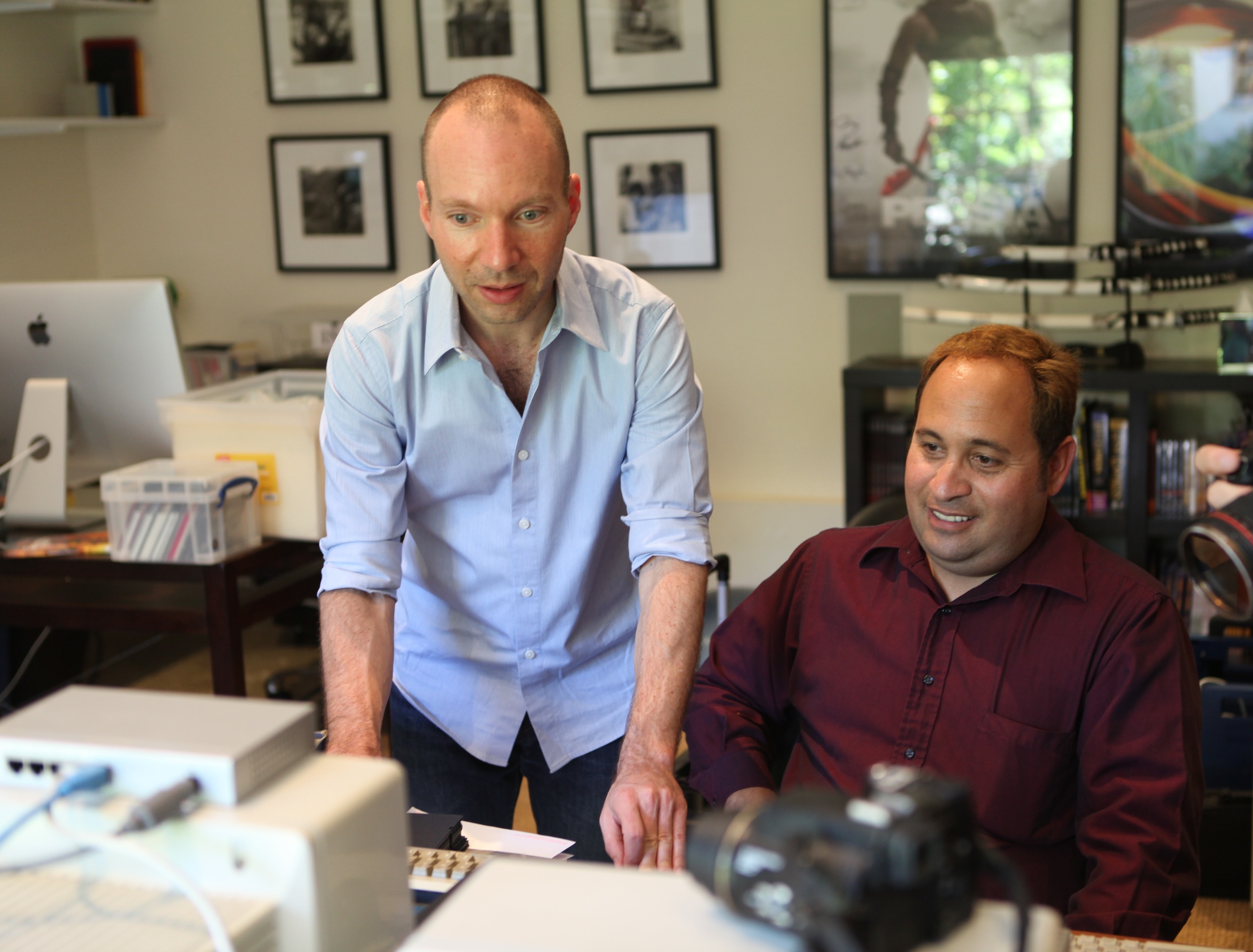
I explained that the original Prince of Persia source code had just turned up after being lost for 22 years, and that two stalwart companions and I had dedicated most of the previous day and night to extracting it and posting it on github.
Jamie — who knows the term "source code" primarily as the title of the movie Jake Gyllenhaal did after Prince of Persia — digested my explanation; then, looking as confused as before, asked "Why?!?"
It was such a simple question, it stumped me for a moment. Why would I spend a whole day trying to recover data from some ancient floppy disks?
I said: "Because if we didn't, it might have disappeared forever."
Why source code?
POP source code recovered after 22 years:

Non-programming analogy: Video game source code is a bit like the sheet music to a piano sonata that's already been performed and recorded. One might reasonably ask: If you have the recording, what do you need the sheet music for?
You don't, if all you want is to listen and enjoy the music. But to a pianist performing the piece, or a composer who wants to study it or arrange it for different instruments, the original score is valuable.
It's possible, up to a point, to reverse-engineer new source code from a published video game, much as a capable musician can transcribe a musical score from listening to a performance. But in both cases, there's no substitute for the original document as a direct line to the creator's intentions and work process. As such, it has both practical and historical value, to the small subset of the game-playing/music-listening community that cares.
This is why I was so sorry to have lost the Prince of Persia source code, and happy to find it again.
Lost and found (Geek quotient = 9)
If you've read my 1980s game dev journals, you know that by the time Prince of Persia shipped in 1989, I was burned out on coding and seriously eager for the next chapter of my life to start. So I did what most programmers would do: I backed up my Apple II source code onto 3.5" floppies, stuck it in a box, and promptly forgot about it.
Thirteen years later, when I looked for that box of source code again, I couldn't find it. I was in Montreal with an amazing team making Prince of Persia: The Sands of Time. Lead programmers Dominic Couture and Claude Langlais had volunteered to port the original POP to the PlayStation 2, and slip it into our new game as an easter egg. (This was their idea of a fun respite from crunch time.) All they needed was the source code. But as much as we searched — from my garage to Broderbund's archives to Doug Carlston's basement — it was nowhere to be found.
Finally we tracked down Scott Shumway, who'd done the 1992 Mac port of POP. He didn't have the Apple II source code either, but he did have the Mac source code. Dom and Claude made short work of porting it to the PS2, and Sands of Time got its easter egg. Everyone was happy.
On my return to LA, I dug deeper, and turned up a whole shoebox full of Apple II floppies, some dating back to high school. The source code to all my early games was in there: Deathbounce, Karateka. But no POP.
I didn't need the source code for anything; and it wasn't as if POP had been lost to history — vintage Apple II POP copies (and their disk images) were widely available — but still, it bothered me to think that something I'd spent years working on was just gone. I felt dumb for not having kept a copy.
This was eight years ago. I gave up the search and forgot about it.
Until two weeks ago, when my Dad shipped me a carton of my stuff he'd found cleaning out the closets of his New York apartment. Inside was the source code archive I'd mislaid in 1990.
Paper is forever

Here's the thing about digital backups and magnetic storage media: They don't last very long.
Try popping your old 1980s VHS and Hi-8 home movies into a player (if you can find one). Odds are at least some of them will be visibly degraded or downwright unplayable. Digital photos I burned onto DVD or backed up onto Zip disks or external hard drives just ten years ago are hit and miss — assuming I still have the hardware to read them.
Whereas my parents' Super 8 home movies from the 1960s, and my grandparents' photos from the 1930s, are still completely usable and will probably remain so fifty years from now.
Pretty much anything on paper or film, if you pop it in a cardboard box and forget about for a few decades, the people of the future will still be able to figure out what it is, or was. Not so with digital media. Operating systems and data formats change every few years, along with the size and shape of the thingy and the thing you need to plug it into. Skip a few updates in a row, and you're quickly in the territory where special equipment and expertise are needed to recover your data. Add to that the fact that magnetic media degrade with time, a single hard knock or scratch can render a hard drive or floppy disk unreadable, and suddenly the analog media of the past start to look remarkably durable.
This is why, when I posted about finding the POP source code, digital archivist Jason Scott, Apple II collector Tony Diaz, Derek Moore, and the technical teams behind the DiscFerret and Kryoflux disk readers volunteered their time and effort to give us the best possible shot at a successful extraction.

Let me begin to count the ways I've been lucky with this: The box was found. The disks were intact. Prince of Persia and I happened to have a high enough public profile that people of Jason and Tony's caliber (and dozens of others who contributed their expertise via IRC, skype and twitter from around the world) cared.
In the bigger picture, our timing was lucky. The 1980s and the Apple II are long enough ago to be of historical interest, yet recent enough that the people who put the data on the disks are still with us, and young enough to kind of remember how we did it. Roland Gustafsson, author of the special 18-sector RWTS routines that had made our disks super-efficient in 1988 (and unreadable to anyone but us), was able to get on IRC in 2012 and explain what he'd done to Discferret kids who weren't born then.
For all these lucky reasons, our archaeological expedition was crowned with success.
From a preservationist point of view, the POP source code slipped through a window that is rapidly closing. Anyone who turns up a 1980s disk archive 20 or 30 years from now may be out of luck. Even if it's something valuable that the world really cares about and is willing to invest time and money into extracting, it will probably be too late.
This is why it's awesome that there are people out there working on digital preservation. Because now is the time.
Back up your backups
Jason suggests the following rule of thumb: If you have data you want to keep for posterity, follow the Russian doll approach. Back up your old 20GB hard drives into a folder on your new 200GB hard drive. Next year, back up your 200GB hard drive into a folder on your new 1TB hard drive. And so on into the future.
As for me, the past 48 hours have been a fun walk down memory lane. And have given me a renewed appreciation for paper, celluloid, and stone tablets.
(Postscript: For 6502 assembly-language aficionados, the Prince of Persia source code is now up on github, along with a README file that answers some frequently asked questions. I've been amazed and moved by the outpouring of interest in the #popsource saga — it literally crashed this website for several hours today.)
Now, I really need to get back to my day job of making up new stuff. I can only hope to have the same lucky, glorious headache of trying to recover some of it 20 years from now.
Further reading:
"Making of Prince of Persia" game development journal
25-year capsule history of Prince of Persia
Código Fuente de Prince of Persia - ¡Posteado! (Spanish translation of this post)
Comments (...)
Congrats!
Does it compile yet? ;)
Let's hope it isnt' again lost in the next 20 years? :P
It's more than packing the executable that's required to one file a game.
If there isn't enough room to hold everything in memory you have two options.
1) compress data in memory, and decompress the level data as needed. This is only possible if there's room for one uncompressed level, and every other level compressed. This was done with the goonies. There was enough space left to crunch all of the levels and store them all in memory, and have enough space to uncompress the active level.
2) the Interactive Flexible File Linking (IFFL) system. here you write a special loader, append the rest of the game to it, and have the game read from inside the file as needed. In this case, generally the game file is required to use contiguous sectors and tracks on the disk. Naturally a fastloader would be used to do this.
Very nice to hear this, Jordan. The last time I played this game (the DOS version) is 2001, when I was in the junior high school. Now, given those 6502 assemblers and simulators, do you know to build this game? I'd love to see it run once again.
The trouble is that even though the source code might now be widespread, if GitHub goes down or is acquired or whatever - the archive will be lost. The current libraries storing piles of paper are not doing the job they should of organizing and archiving digital content.
I've been wondering if it's possible (with mods) to hold the entire code of Karateka in memory on a 64K system so there's no disk access. (on a 128K system it's almost certainly possible.) That way I could make a file-loaded version.
File-loaded versions of games were pretty popular back in the day - I collect them and usually compress them. On IRC a couple days ago I mentioned a project I did that put 7-9 games on a disk using Roland Gustafsson's RDOS 3.3 and an executable-patcher for Commodores called Exomizer. (I think it can handle Apple directly now. I still use a format translator intermediary though.)
Karateka appears to use page-flipping for flicker-free animation. That means it needs 16K for graphics. That space could be used for initial loading, and then the data moved up onto the bankswitched RAM. With the compression it doesn't really matter if the program spills into DOS space so long as the *compressed* binary only needs about 35K. The game itself is just a 48K game and doesn't need to use the extra 16K for its own code.
If I'm right and Karateka is written in S-C ASSEMBLER (the program is mentioned in the PoP diaries e-book), I think can read that dialect without too much difficulty and easier than Merlin. I used a disassembly of the Apple ][+ BASIC in the S-C dialect as the basis for a form of the so-called "satan mode" (reasonable Apple ][ compatibility without locking the hardware into Apple ][ mode) on the Apple /// using CA65 and Ciderpress.
Sorry, that should be "executable-packer", not "executable-patcher"
I'm aware of the limitations of packing. I was wondering if it was possible to have the game only need, during the load process, the $0800-$BFFF area, where some of that code could be moved around into other parts of memory (including the language card). After that, if the file could be crunched such that it needs no higher address than about $9000 (could probably go up near $9600, really) before decompression, then that's all that one needs.
As for fast loading, I've often ditched DOS 3.3 altogether on my multigame disks - they often rely on Roland Gustafsson's RDOS instead, which gives me a few more sectors because of lower overhead, as well as faster load due to a simpler filesystem and no possibility of fragmentation.
I actually saw a single-load crack of Karateka on the C64. I don't know if that would be doable on the Apple...but it might be.
Woohoo! :D
I'd love to see some Apple II programmer get in there and make some sort of indie revivalist art-house romp as a sort of unofficial sequel. :)
Perhaps a story of what the prince and princess get up to after she is rescued?
With a 70's funk music soundtrack...
Muzboz
From now on,your code will be eternity.Thanks for your great work and your impressive story!
WAIT... I think I got you beat! Six months ago, I github-ed a program I wrote for Ticketron (remember them? sorta like TicketMaster, but with a soul) in 1987-88.
https://github.com/jamescurran/HonestIllusion/tree/master/PCT
Great post! Thank you.
Great advice: Back up your backups!
I truly appreciate this article post. Awesome.
Insanely Brilliant [tm] !
Thanks for sharing, the story and the code, to all involved. POP was pretty much the first 'Really Big' game I played, for years. It awakened my interest in computers, coding, and computer graphics. I'm going to have so much fun playing with it again now, but in a techy way, for nostalgia's sake :-)
And regarding the stone tablets of backup (lol :) ) that's one of the most important lessons people have to learn. Did so myself the hard way too. Backup backup backup and test the backup and backup some more! In future-proof ways. Do the ways change? Convert the backups to the new way! Test the backups! Backup some more.
What of this does Ubisoft own, and what do you own? Is it like Star Control 2 where The Ur-Quan Masters is the same thing, just renamed?
That would be (IANAL) my understanding, at least.
Wiser words have never been spoken. I've been busily consolidating all my CD/DVD ROMs/Rs/RWs onto hard disk, and did so for the floppies and Zips a long time back (they actually went on to CD first ... bad CDs that, once I could afford a properly huge HDD to copy stuff onto, meant I still had to hunt a few of the original floppies and also a working Zip drive). The stuff is remarkably friable, and I've also since learnt to keep three copies of everything - the original (in a box at the back of a dusty cupboard), a working copy (on the desk), and a safe archive (in a different building if at all possible). Unfortunately it's a slow and expensive affair if you have any kind of serious collection of digital data, and you still end up with gaps :(
And I really, really, really want to know what happened to my Atari ST disk image collection that took a couple months of painstaking work to extract, because that was better than 10 years ago now and I bet a number of the ones that were barely readable at the time are now completely dead.
(Can Amiga drives read Atari floppies? I've now got a more functional A600 alongside my rather ratty ST, and it came with 300 discs of its own... plus an internal HD interface. If I can hunt out some software that'll image floppies direct to an installed hard disk (the 4GB max partition size would be more than enough to hold both system's software libraries) then it wouldn't be too hard to set up a production line to read the lot of them over a year or so)
Oddly enough, though - hard disks, and to a lesser extent floppies, seem to be about the most resilient form of computer data storage for long term purposes (after well-made tape... but before cheap consumer QIC drives and audio cassette). There are BBC disks from 30 years ago that still work, and a great many of the Atari and Amiga ones from 20-25 years past still function. I've a 1987 286 with a 40mb hard disk that's still absolutely cherry... though it's a rather low density option these days! You could probably fit the pertinent details of one person's life onto it in order to give future generations a glimpse of the past, however, if you included the PC, self loading code, and suitable instructions on how to power it.
Dug out the old manuals - Yes - It's Merlin 8/16.
It's been a long time.
I'd like to do a mini-seminar on POP source the next Game Jam we hold.
this is the game I have loved more. If I had the knowledge I would build another episode of this game with different levels,a more sofisticated IA of enemies but with the same graphic. I don't like prince of persia 2 or 3 so much as the number 1.
PCs should be able to read ST floppies - they're MS-DOS format. (Might have some trouble with very early floppies due to a bug in the TOS formatter.)
I've not seen assembler instructions laid out so beautifully. Loved the way you deconstructed the entire game logic into such compact routines. I hate to imagine how many iterations of the code there must have been to make it this tight. A quick read of the technical information document and I can see how the whole things hangs together in flash - just wonderful. It brings a whole new level of insight to the game and provides the definitive answer to "just how did Jordan do that?" It's good to see it in the public domain, it will be a great case study for future generations of techys to come.
Though could it be tweaked to only load once? If so, and if it compresses well enough in Exomizer, it's still viable to make a single-load version. (And being as it could then be run from ProDOS-8, it could also be loaded and run from 3.5" floppy or hard disk.)
Hey Jordan - been reading through your POP source code - very nice. Thanks for posting it!
I teach game programming at New England Institute of Technology in Rhode Island, and often send my students to your journals to get a perspective on what indie game development is like. Occasionally we'll look at the Visual6502.org so they can get an understanding of how microprocessor chips actually work.
BTW - I wrote in Apple II 6502 assembler between 1982-86 before I moved on to the Mac. I used to work for Sweet Microsystems (makers of the Mockingboard) and got to see all sorts of original commercial 6502 source code - like Will Harvey's Music Construction Set among others. IIRC, most of the stuff was complete spaghetti. Your code is well laid out and very self-documenting.
Question - is the source Merlin 8/16 assembler? Thanks!
thanks for this wonderful story
A few months ago I restored data from about 300 old C64 disks but unluckily some of the disks with my own source code and projects were probably the most used and were unreadable.
Still, I did find a few projects I had completely forgotten about and it's a great feeling seeing this stuff come alive again!
What an incredible contribution to the history of programming. Thank you. :)
(ps. Just a coincidence [I think] that the poster above me has a very similar name)
What a great story, thank you (I was 17 back then in '89..)!
I am really glad you managed to extract the source-code! It must've been quite a party once you were all finished!
Great post, good advice and the remark about the stone tablets made my day!
I hope your week will continue to be successful!
Great find, and thank you for making this available! It's always a joy to read old source code not only to see what made our beloved classics "tick" but also to learn what clever tricks were used with early hardware and, possibly, how to adapt those tricks to homebrew games and even games developed on current-gen systems. =)
Are you still in touch with Scott Shumway? I grew up playing PoP on a Macintosh II and would be very interested in looking at the Mac source code. Maybe if Mr. Shumway is reading this... is there any possibility that code could be released?
This is a fascinating find - thanks for sharing it with the Internet!
I don't know about anyone else, but one of the things I was most surprised by (in the design document you also shared) was the revelation that all the levels were given names. I understand most of them (Cell and Tower are obvious, Quad... starts in a room with four doors, and after a bit of help I realized that "Wtless" was because of the "weightless"/floating potion) - but why did level 8 end up being called "329"?
Thanks for the fascinating post and sharing the code - this really is an eye opener.
For me, this is a throwback to a time where games where made entirely by a single developer, as opposed to the huge teams used today. I am reading the POP journals, and here's my take on it:
http://blog.flexwiz.net/finding-inspiration-in-mechners-journals/
I grew up playing 8-bit games on C64, Apple II and Amiga. Sometimes these games almost seem like a lost art.. it sure is nice to take a peek at the code.
A file version is entirely possible, but it will still require its own loader. The game is too big to support traditional DOS. However, this kind of thing has been done before - see Black Bag's version of Olympic Decathlon, in particular. It was a multi-loader, but with a custom loader, the data were placed in files and the loader interprets the file structure.
Not really — anyone who has cloned the repository to their hard drive has a copy of the source code.
I see in the post that you have the Karateka source code, any chance of uploading it too to devour?
Congratulations Jordan ! This is one of the happiest days of my life ! I was really really really hoping for the POP source code to be safe !
Thank you, once again, for bringing Prince of Persia in our lives !
Great story! Like my dad says, keep everything in three copies, and then copy those. Glad you found that treasure.
Thanks for this great stuff.. Ilike POP all the time...
Thanks once again..
Yes, it is THE PROBLEM! I have faced it, too. I was very happy when I found an old PC with 5"-disket drive! IMHO, there must be a standard for digital data (f.i., DVD in UTF8, with appropriate drives and drivers), useful in the far future.
Congratulations! POP was one of my all-time favorite games that I played when I was younger. I know what its like to recover such old archives; Several years back I had my own experience of attempting to restore a bunch of old floppies from my youth (for the TRS-80 Color Computer), and bit-rot had set in on many. With persistence and a bunch of trial-and-error, I managed to recover about 95% of it. I've gone with the "russian doll" approach since then for everything (along with having a separate RAID fileserver, and a backup system). Even so, I still have a small Apple IIe archive to recover (need to work on that soon), along with a somewhat larger Amiga archive.
This is very cool and im glad you guys were able to save this piece of gaming history!!! seriously!!
any chance we can start a hunt for pitfall sc lol
Hey! Great post - PoP was my favourite game when i was young :)
My colleague and I work in digital preservation and were wondering - can you share what you actually had to do to recover the source code?
Thanks again!!
"prince of persia level editor" in Google gives you pretty much all you need for another episode.
Wow, awesome. I would like to port this directly to ARM :) for Open Pandora
Thank you Jordan! Your game was on of the best in 90-s! It have very good persons movement! PRINCE MEGAHIT ;)
Hey, I just bought an Apple iie platinum off E-bay.
Going to learn 6502 assembly with it, and I'm looking for a copy of Merlin 8/16
Got any ideas where I can find it? (Or any other macro assembler for the apple ii?)
Thanks :)
I remember playing POP as a kid. Best game ever.
I had played POP long back, it's still one of those games you like to remember along with Mario and Jungle.
I believe this was the first computer game i ever played! I was very young at the time and couldn't play very well but it still fascinated me immensely. I'm going to try to track it down for my Mac and give it another go :)
The Last Express Arrives on iOS
Update: The Last Express has just been released for iPhone, iPad, and iPod touch! Check it out in the App store.
I tested the final version yesterday on a long transatlantic flight (Frankfurt-LAX, with headphones), and it's my new favorite way to play it. Next to playing on an actual train, that is.


Here's the trailer:
Comments (...)
That is really great news. I've been using iOS to replay some of my most cherished adventure titles, e.g. the Broken Sword games. It's great that the Last Express will be available. Do you know whether it will also run on iPod touch devices? And will it be available in all regions' app catalogues?
I've commented this great news on facebook, but I have to write it here: really sweet, even though I can still play TLE on PC, I am tempted to buy iPad just for this occasion - to try new controls, see all the changes etc. But please - even though you are big Apple fan - say Yes to Android version. It seems many people would love to buy it for Android phones and tablets. Thanks for everything!
Is this a update to a existing app?
http://itunes.apple.com/au/app/the-last-express/id508049561?mt=8
Super excited to try it out tomorrow on my iPod touch! And now I'm even more tempted to get an iPad too!
Jordan, was there any additional restoration done? Like resolution, or cutscenes?
Ha, you guys got it first! Here in California, it's still yesterday.
Yes, it will run on iPod Touch 3rd gen and up (iPhone 3GS+ and iPad1+) and 100% worldwide without restriction.
Note that due to a glitch, the current build doesn't run on iPhone 5. Should be fixed with an update for iPhone 5 owners later this week.
Thanks, Veronika! The developer's been focused on building a great game for iOS, so Android hasn't been the first priority, but we certainly wouldn't rule out additional platforms in the future.
On my iPhone it says last updated date - 23 Sep 2012, while on iTunes it says 27 Sep 2012.
Is it optimised for iPhone 5 screen size?
Wonderfull The Last Express in i-phone and i-pad, a great. I Love this game. :D
May I (politely) second the request for TLE on Android? I understand that porting to such a flexible platform might be quite a daunting undertaking, but I suspect that it would at least pay for itself, and best of all, further energize the fandom. With enough demand, fans will pay great sums to return to that world (perhaps even the unmade prequel!). :-) Tim Schafer has led the way, Jordan...
I love playing Broken Sword on my Android phone, would love even more to re-play Last Express. :-) (I'm not getting an apple product though, sorry.)
The game looks fabulous. Take a look at my blogsite where you'll follow "The Orient-Express" from the Gare de l'Est in Paris to the Austrian frontier on the 28th of June in 1914 - the date of the assassination of the Archduke Franz Ferdinand at Sarajevo. The collection is for sale, including an extensive library and everything displayed on the walls of the museum. The bidding starts at $250,000. Going, going ...
Relive history. Play "the game" in real time with the most exquisitely made models and miniature people in the world.
That's impressive and very interesting! Thank you!
please put it to Android Market!
I love adventure games. TLE is one of the best ever. I am 30 years old and I still play Broken Sword on my phone. I would very much appreciate an Android version of The Last Express. Please!!!
Hi! Now I'm waiting for Karateka and Prince of Persia 2 on iPhone. Maybe remake Prince of Persia 3D for PC?
Yours,
Paweł.
maybe an idea to publish this game on steam through steam greenlight? I would definitely vote for it, just announce it here :) (and on G+)
Finished TLE again. This time on the iPad. And as stated in my AppStore review, this is the best adventure game ever. TLE just waited for this adaption for touch screen devices. It's much more intense this way.
But now I sit here and ask myself what's next? The story wants to be continued. What about the manuscript in Jerusalem? What about his ring? What about Anna? Many questions....and a sequel?
I see you do kick starter projects...maybe that's a possibility? Only 15 reviews in the AppStore aren't that many. Hard to tell if people are interested in those games nowadays. But how about giving it a try?
People ARE interested... I am sure. I don't know about total number of reviews at the AppStore, ratings are solid and TLE App Rank Graphics (http://www.topappcharts.com/508049561/app-details-the-last-express.php) shows TLE is doing ok, considered there are so many games available. Of course TLE is not smash hit, it is in no way mainstream title and is far more clever than any other game out there, imho. Hope it receives few more rave review, which were so far generally great (or at least good).
As for Kickstarter, I would back up prequel or sequel of TLE without any hesitating and I know about quite a lot fans that would do the same. I hope and wish it is going to happen one day.
Hello, I just want to say thank you, thank you, THANK YOU! I've played it twice again already between my iPad and iPhone. The iPhone gameplay I was worried for, considering limited screen real estate, but the implemented solution is wonderful. And it really made a recent 4 hours flight zoom by, with enough gameplay to spare for later.
Your games are always of the highest caliber, and I hope that one day you will be able to release (or at least direct/inspire others to release) more games like this. New material delights.
I didn't know about those statistics. But you are right. It performs well. Hopefully well enough to convince Jordan of doing a se- or prequel. I would love to back it up.
Recently, there's been some press into the subject of what exactly makes for a video game. Modern games include voice acting, full-motion video, motion capture, the same computer-graphics imagery as seen in the cinemas. etc. A few years ago, there was assertion by Ebert whether a "game" can be considered "art", since (by his definition) art requires a high degree of direction from the creators. As a highly-regarded author of games such as the LAST EXPRESS, we'd love to hear your perspective on what makes a game a "game"... and what makes for great art.
And thanks again for all that you do!
I've played this game on Steam, and it's incredible. Thanks for making yet another great game, Mr. Mechner.
Karateka is Back!
I'm excited to announce that my new remake of Karateka — the game I've been working on with a small, independent team for the past 18+ months — is now available on Xbox Live Arcade for the Xbox 360. (Versions for PlayStation 3, Steam, and Apple iOS are coming soon.)
Here's our official launch trailer — written and directed by Adam Lisagor, who infused the trailer with his nostalgic memories of playing Karateka at age six on an Apple II:
I'll post more in coming weeks about the process of making Karateka, then and now: in 1982-84 as a college student on a 48K Apple II, and in 2011-12, as creative director of a bigger (but still small) team using modern game development tools. It's a great excuse to dig into my archives and uncover old-school souvenirs like this one.
My goal in remaking Karateka was to recapture the simplicity of the original in a compact, reasonably priced (under US$10) downloadable game, with gameplay so straightforward that players of all ages could immediately grasp it and start having fun right away — while enjoying a dramatic human story.
I hope readers will give the new game a try. I'd love to hear your reactions, whether you played the original Karateka in the 1980s or are encountering it now for the first time. Send me a tweet (@jmechner on twitter), post your comment below, or (if you have a question of general interest that you'd like to see answered on the site) email me.
The Karateka website has up-to-date information on game availability on the various platforms. And don't forget to punch the hawk!
Comments (...)
Looking forward to buying this for iOS!
Loved your karateka book too,
I loved the original Apple //e game. I'll have to purchase this, because I'm afraid that as 14 years old I might not have actually acquired a legal copy of the game.
What happens if I turn my ipod upside down? Probably not as fun as with the original.
Gotta wait for the PSN version to drop, but I'm seriously excited to see your work being updated for current devices. With Karateka, the Last Express and the Prince of Persia Classic all available for today's audience, I believe we're discovering a new form of curation.
I loved Karateka on the ][e (and on the c64), so this is really exciting. Since you're doing an iOs version, are there any plans for Android as well or are there technical obstacles?
Karateka is not available on XBLA in Australia, just wondering if it will get a release?
I was wondering that too. Why did we miss out?
Oh, thanks a lot for a planned Steam version! Can't wait to play my favourite (renewed) game again :-) Please keep us posted.
I loved the original Karateka. Any chance this will be released separately as a Retro version on iOS?
Played it on the C64 as a kid and was really looking forward to playing it on the PC but it's been more than 6 months after its release now and it's still so buggy. I like what I am able to play of it but I cannot even finish the game because of a gamebreaking bug with the hawk in front of the palace. I've visited a couple of forums and have noticed that other people have been disappointed about this lack of support as well. Is there still a patch in the workings that will address this and other bugs? It's too bad a game this much fun didn't get a more polished release.
Making and Remaking Karateka
Update: Karateka is now available in the App Store and for Sony Playstation Network, Xbox Live Arcade, and Steam.
The modern remake of Karateka (out today on Steam) has given me a great reason to dig into my archives and revisit the long-ago era when I developed the original Karateka on a 48K Apple II.
If you're interested in making games, you may enjoy this series of short videos about the creative and technical process of making Karateka, then (1982) and now (2012). Each episode focuses on a different aspect of production: Inspiration, Animation, Sound and Music, and Gameplay. They're posted below.
The game industry has changed a lot in thirty years. And yet the more things change, the more they stay the same. For readers interested in delving deeper into the old days, check out the rest of this post below the videos.
Episode 1: Inspiration
Episode 2: Animation
Episode 3: Sound and Music
Episode 4: Gameplay
From My Old Journals
When I started the first Karateka, in 1982, I was a 17-year-old Yale freshman and avid gamer, trying to balance a college courseload with my aspiration to become a published game author. Karateka made that dream a reality. It launched my career and paved the way for my next game, Prince of Persia.
That same year (1982), I started keeping a private journal — a habit I'd keep up for the next decade, as readers of The Making of Prince of Persia (1985-1993) will know. More surprisingly, I never got around to destroying it. And now it's in the distant-enough past that, rereading it, I'm able to laugh rather than cringe (OK, so maybe it's a bit of both).
As a time-capsule record of that early Apple II era, and a window into the maniacal brain of a teenager obsessed with "breaking in" to making games and/or movies, it may be of interest to others. So here it is (as DRM-free pdf, epub, and Amazon Kindle ebook, with print edition to follow): Volume One of my old journals, The Making of Karateka.
And, of course, I hope readers will check out the new Karateka.
Comments (...)
AWESOME!!! Thank you for making this remake! I used to play this game on my commodore 64.
Also, I write soundtrack music. So, if you need any help with future games, I would love to help!
I'm surprised that the game designer can't properly pronounce "karateka".
Wonderful, I used to play this game on Apple II.
Jordan, you are the man, I recently started studying game development inspiring on your posts.
Soon I'm going to read The "Making of Prince of Persia".
I never played the original Karateka, but I do love these 2 "making of" episodes. Please add more in the future!
Read the whole thing in a single evening. Really loved it! Although I found the Prince of Persia more inspiring. Would love to read about The Last Express ;)
Please Jordan do also a Mac and Linux porting of this new game, just like the good old times!
Dan, you're not alone. http://www.youtube.com/watch?v=CjocmhoH5q4
Could you please tell us which game engine you used to make this game ?
I loved your publications about the making of your games.
Congratulations, and thanks for share with us.
Update: All four videos are now posted.
Thanks! The new Karateka uses Epic's Unreal 3 engine. The original Apple II Karateka used no engine at all — or I guess you could say a "custom engine" if you want to be grandiose.
I loved the Making of Prince of Persia Diaries. Will you do a making of The Last Express book?
—Zack
Hello Jordan, Karateka is such an important game for me ! It was my first c64 game, i finished it like a "zillion" of time and i'm not far from the truth. Damm i wish my english would be better, i'd have so many things to say, anyway LOVE the new one... so much that i bough it two times, the XBLA and the PC version ! Great game and i was surprise by the design which is just fantastic. Any plan to realease the music on CD or downloadable ?
Thanks for all that incredible work you have done during all these years !
I'm anxious for iOS version. Please make a Mac version as well.
Cheers
So much passion. Things that endure, this is beautiful.
Bye,
Alex
The iOS version came out today! I'm getting mine. :D
Hi I was just wondering if you had plans to release on android?
Regards,
Tom
Karateka in the App Store
I'm happy to announce that for the first time since 1984, Karateka is once again available for state-of-the-art Apple devices. You can download it for iPad, iPhone, and iPod Touch in the App Store. (Karateka requires iPhone 4S or newer, iPad 2 or newer, or 5th generation iPod Touch.)
And if you don't have an iOS device, the new remake is also out on Sony Playstation, Xbox 360, and PC. Don't forget to punch the hawk!
Comments (...)
Original Karateka: $34.95
New Karateka: $2.99
Getting a tech support call because a user put the disk in upside-down: Priceless
/former Brøderbunder
Do we get an original retro version release? :)
I hope you resolved their issue so that they hung up thinking ALL software would run upside down if so inserted, and still believe that to this day.
As I seem to recall the IIc version used to get stuck bowing at times as well. Nearly 30 years and still having the same issues - come on guys :)
Any plans for a Mac version? I'd love to play on my laptop.
"just turn the drive upside-down!"
such an easy solution ;D
Nice game. Very buggy on my iPhone 4s though. I cannot find a support address on the homepage so I ask here.
Hello, here's feedback for Karateka on iOS. I like the game mechanic and the art style, and it does remind me of the original, conceptually. It's a bit buggy, as I've had a couple of spots where I've had to force the game closed to resume the adventure, otherwise the character would just be stuck upright, sometimes allowing bowing but not much else.
I've finished it with the Monk and I do want to play it again to finish it with the True Love, but I think I'll do it on the Steam version I have also purchased, the iOS one is kind of a bit on the elementary side and I'd enjoy a tougher challenge.
Thank you for making this and publishing it, very much appreciated.
Thanks for the feedback. There is indeed a bug in the iOS version that occasionally causes the player to get stuck bowing. Sorry about that; it will be fixed in an update, along with a few other minor and/or occasional known bugs. Meanwhile, restarting the app should bypass the problem. Our apologies.
Note: Karateka requires iPhone 4S or newer, iPad 2 or newer, or 5th generation iPod Touch. The App Store listing mistakenly lists older devices as well which Karateka does not support. Our apologies for that as well.
Just FYI on iOS the Chi button will get click while I am in the middle of a battle even though I did not click it. Also, I block successful (I see the blue glow all three times) but I still get hit. It's like there should have been a fourth block. Other than that, love the game!!
Announcing Templar

I'm excited to announce that my original graphic novel Templar will be published in July in its entirety as a 480-page, full-color hardcover from First Second. (Book one of the saga was previously published in 2010 as an individual paperback, Solomon's Thieves.)
It's a hefty tome. Artists LeUyen Pham and Alex Puvilland have outdone themselves, evoking 14th-century Paris with all the action, humor, and depth a writer could hope for. I'm immensely proud of this book, and I can't wait for you to discover it.
Templar will ship on July 9, 2013. You can pre-order it from Amazon here.
Watch the Templar facebook page for updates about book events and other news.
Comments (...)
No comments? Really? Everybody is on social networks and good old web is abandoned... Graphic novels are great, I am really looking forward to reading Templar, pretty sure it will be great. I have just finished Czech edition of Blacksad and now am reading Incal.
I'm glad to see this finished.
I really hope Mr Mechner will come back and create some solid Prince of Persia game now to end this 'in-between-game' phase. Or some epic POP-themed novel, at least :D
Revisiting The Shadow and the Flame
Prince of Persia 2: The Shadow and the Flame was released for PCs in 1993 — three years after the prince's original Apple II debut, and a full decade before his leap to 21st-century consoles with PoP: The Sands of Time. I've posted a lot about my work process on the other PoPs, but almost nothing about this one.
To jog my memory, I dug out of my archives the game design "bible" I created for the PoP2 dev team in 1991. It's a curious artifact of that era; you can download the PDF (19MB) if you're interested.
Why I hate bibles, and made one anyway

There was no "bible" for the original PoP. That game evolved over four years in an organic process of improvisation, trial and error. The level design — the balance of action, exploration and combat that gave the game its particular flavor — came together only in the final few months. I had the liberty to do it that way because I was game designer, animator, and programmer, working on my own with no fixed timetable or budget.
Writing a detailed 200-page bible, then handing it to a team and saying "Make this" is the complete opposite way to start a project, and it's almost always a terrible idea. I wouldn't recommend it to anyone. But that's how PoP2 was made. It worked because of a peculiar combination of reasons:
- I'd already made PoP1. The idea for PoP2 was to basically make PoP 1.5: keep the existing PoP1 code, animation, and gameplay, add souped-up graphics, a few new twists, traps and enemies, and build twelve new levels. Designing the entire game on paper was possible because it was just similar enough to the original that everyone could easily imagine how it would look, sound and feel to play.
- I was 3,000 miles away. The team was in California, and I was living in New York, about to move to Paris. In those pre-internet days, communication was by fax and long-distance phone calls, with game builds and data sent on floppy disks in DHL envelopes. I knew I wouldn't be on site often enough to permit fast iteration and tight feedback loops. So it made sense to spell everything out ahead of time.
- We had a budget. Broderbund was a conservative studio and PoP2 was the biggest internal game project they'd ever done. They were already nervous about doing such a graphics-intensive project, and wouldn't have signed off on it without a design document that gave them confidence that the cost estimates were solid.
- The team actually followed the bible. If the on-site team had included a creative director, my bible would have been obsolete by month two. Games evolve so quickly that any design that gets put on paper is usually out of date by the time anyone reads it. This is why making a detailed bible is usually a waste of time. PoP2 was the rare situation where the studio and team were united in wanting to faithfully execute the design I gave them — and I was safely off-site where there was less danger I might get inspired to improve it.

For all these reasons, it made sense to have a bible. It's interesting to read it now and see how it compares to the final game. There were cuts and trims, for the usual budget/schedule reasons (the blow-by-blow story of the game development is in the second volume of my old journals) — but I'm most struck by how much was kept, and how faithfully it was executed.
The Shadow and the Flame burns again
To the many readers who have posted asking for a version of The Shadow and The Flame to play on mobile devices, I'm happy to report that Ubisoft has just announced a modern "remastered" version for smartphones and tablets.
The mobile Prince of Persia: The Shadow and the Flame will feature updated graphics, sound, and touch controls in the spirit of Prince of Persia Classic, rather than a direct port of the original like 2010's Prince of Persia Retro. Here's a link to the trailer. For myself, I'm looking forward to trying to beat the game again, twenty years later.
Questions & Answers (Spoiler Alert!)

Having recently visited memory lane, I can now answer the following questions posed by readers about Prince of Persia 2: The Shadow and the Flame. Thanks to Jose and Rishi for asking!
Q: Who is that old lady that is shown at the end of the game? I've always wanted to know that.
A: Ah, the Old Witch. In the final shot, after the prince and princess have defeated Jaffar and are flying off on a magic horse to live happily ever after, we pull back to reveal they're being watched in a crystal ball by a sinister old hag. Tattooed on her forehead is a serpent-S symbol. Observant players may recognize that symbol from earlier in the game, as graffiti scrawled on the walls of the ruined city, presumably by the marauding army that sacked it.

That's the peril of cliffhanger endings: I wrote PoP2 thinking there was going to be a PoP3… but then there wasn't. (PoP3D doesn't count.) In that never-written third game, the Old Witch would have been the primary antagonist. She's the arch-villainess who gave Jaffar his powers, the one behind the slaughter of the prince's parents and sacking of his home city, and whom he is destined to vanquish one day. The serpent-S is the symbol of the evil god she serves. (Apologies to Tolkien, Wagner, Lucas, etc. It was the nineties.)
Q: And what about that fire sword in the red castle, and that little man who comes when you get locked in a level (I don't remember which) and opens the gate to allow you to escape?
A: The Temple of Fire was built to house the sacred blue flame, a very ancient magic. The traps and bird-headed priests are there to protect it. The flaming sword that fights by itself is one of those traps, placed there to guard a door.
The tiny man in the bottle is a Djinn. The original idea was that when you opened the bottle, he would grow into a fearsome giant and attack you. As I recall, we had to cut the giant Djinn for budget reasons. If you've played the game recently enough to remember what the final implementation was, please remind me — but I think in the end, we may have had him just run away and accidentally step on the switch to open the gate as a bit of comic relief. It's just the stub of what he was originally planned to be.
Comments (...)
We are really worried about Prince of Persia, Ubisoft seems not to care anymore and they focus on Assassins Creed only. This year is Sands Of Time 10th anniversary and they don´t seem to be planning anything to celebrate it. And next year 25th anniversary for the whole saga, and it´s paused!
When will we get a POP game like the Sands of Time one, a great game? We´re losing hope. And Ubi doesn´t even care. :(
We want POP back, we want the Prince back to his throne.
Thanks Cristina, I'm really grateful for such loyalty from you and the PoP fans who have been waiting for so long. I wish the same, and I promise that as soon as there's news to share about a new PoP game, I'll post it right here!
Thank you Jordan for all the updates!
We want POP back, we want the Prince back to his throne !
Thanks for replying, but do you really think that POP has a future in Ubisoft with Assassins Creed there? They only focus on it. Every time the E3 or any other game event arrives we get some hope because of rumors we see, but then we only get dissapointed because we get nothing from POP. We see other games grow, continue their legacy and growing better, but what about POP? It has become a ghost of the past. A memory. And this game doesn´t deserve that. No way. We want POP back.
So, in the name of the POP Fans (and, specially the spanish ones I try to reach with my fansite) we ask you to contact Ubisoft and make them bring us POP back! Please!
Great article Jordan, thanks :)
I have one question about it. I love the first Prince on PC. The second was great but I love the first one much more so I don't know the second one by heart as the first one.
The question is, where exactly can I find the Djinn? I don't remember I ever foud it and I am sure I've beat the game on PC, on SNES and on Mac.
what a kind of shit Assasian creeed is,and this shit is being made popular by ubisoft. in originality , it dosent deserve anything. three years gone since we saved a kingdom! and we are eagerly waiting to save another kinhdom . yes, i am talking about prince of persia, my favourite game series of which i am crazy about, in real life too. ubisoft ignores our questions on prince of persia next release.. they dont cares. no one cares .not even u jordon :-(
hi jordan, I'm a big fan from argentina, Ive been playin prince of persia since I was 5, 24 years ago.
I think that prince of persia 2 was the ultimate pop experience, the level designs and the feel of the game is amazing. Im super excited to read the game's bible!
hope that this new mobile version doesn't suck!!
I must the the only dolt in the universe who liked Prince of Persia 3D. :)
I had 386 PC when I played Prince 1. Prince 2 in Win 3.11 had loads of error but later I found that the game was corrupt. I was only able to see the Cinematic in the beginning and then there was a popup: Insufficient far memory. When I got a good non-corrupt version, I was disappointed because I thought the game would be like "Disney's Aladdin". I loved Prince Of Persia 1 so I took the sequel as OK but later after playing it several times, I fell in love with this game & so till now I have huge collection of Prince Stuff. Mr Mechner does not even know I have his signed Autograph which he did it for me in Pop Movie premier in London... I ♥ Prince of Persia and Jordan Mechner.
Hi Jordan! Here there's the most important fansite in Spain about Prince of Persia. All news, curiosities, games and a lot of things about your great creation. Get into and see how we love your work. I say you thanks very much in name of us for all the hours of fun you give us. We hope you like it and if you want to participate you'll be welcome :)
P.S Click in my name for get into the page. Sorry, this page don't let me to write the link. :)
Mr. Mechner, I've been a PoP fan since I was a child and Shadow and the Flame is actually my favourite entry so thank you for ending the mistery behind the witch. :D
I would be excited about the remake but there's no chance I'll be playing it as a PC gamer: PoP Classic was never released on PC so I guess this one will share the same fate.
I'm so happy that sir Mechner is grateful to us PoP fans... Our loyalty can never be equaled...
I'm ecstatic over this remake, playing PoP2 with my dad is one of my first video game memories ever(I was born in '89); best of luck with its launch and know that you'll be featured on PGR in the next couple of hours.
Prince of Persia 3d is a gr8 game. The Music is Awesome and the green graphic in Level 3 and the blue one in Level 2 (Ivory one) was amazing. You are among those people who know the true value of unknown gr8 stuff which people dont pay attention to. Pop 3d was really amazing game but due to bugs and glitches the game does not run properly in Windows 7 or 8. That's bad....
Hello!
You mentioned a third game was never actually written, but did you have any more concrete plans for it (perhaps plot-wise), that you could reveal to us here? Already, I'm super excited by that little old witch titbit.
Hi Jordan, I have a doubt, I am from Colombia and I want to buy prince of persia in the Xbox live market (the prince of persia retro), but this game is not allowed for my region...is there any reason for that? I really want to play again the "old prince of persia" but I can´t do it... and my another question is.. this POP 2 game will be only on mobile devies or will be ported to Xbox too. Thanks!!!
Hi Jordan, thank you so much for answering my questions! I'd been waiting for years to know this, and I must say this is more than I expected. I'm really glad you could read me and took your time to write this. Just some more questions: you mentioned that you thought there was going to be a PoP3; why did the project failed or was canceled? Have you thought recently about working on it? I don't think it would be that hard with all the tech we have now and I know fans of classic PoP would love it (at least Morgonkaffe(suger) and I would).
Thank you again for your answers and sorry for my English, I'm from Perú and I haven't had to use it in a lot of time.
This is actually a great idea, I hope it will catch the eye of you, Mr. Mechner.
Personally what I also dearly miss is a re-release of the original PoP 1 and PoP 2 Shadow and the Flame on today's machines. The Mac versions of these two games still look good visually because of the high quality 2D art in them and I honestly think those specific versions should be ported to PC / modern Mac for a release on Steam or GOG, even on mobile platforms. While I do think this new remake is suited for a mobile market it's just bad it does not even remotely resemble the original art style and I see it as a mistake from Ubi that they do not care about the original games in an era when countless other old titles are successfully sold digitally. Some of them actually are so successful that their creators even started making sequels to them (recent example being Planescape Torment which was a flop in its time of original release and now is a top seller almost every day on GOG).
Thank you for this article Mr. Mechner, I always wanted to know what was the deal with the old witch.
Have you thought about making POP3 in today's gaming world? The last few years have proved that side-scrollers are back in full force, indie games like Super Meat Boy, Braid, Fez, Deadlight, Machinarium, Limbo, And Yet It Moves, Mark of the Ninja and many others have won many awards and also sold pretty good.
I don't think there's any POP fan out there that wouldn't buy an indie POP3 sidescroller made by you with today's technology. Please give it a thought, please. (also click my name)
U can watch the Walk through videos on YouTube. The Second last Level which has RED Brick walls.
I've been a huge fan of Prince of Persia since it came out when I was a child. Shadow and the Flame is my favorite in the series. I thought it was incredibly innovative and different from the original and yet extremely familiar and comfortable at the same time. Very few game sequels do that nowadays but it seems you and Broderbund had it down. It is an incredible piece of work, truly.
I would love to have POP1 & 2 republished on PC again (I'm pretty sure I bought it 10 years+ ago on my mac but I can't play it on a modern mac anymore). I would snap up a new copy in an instant! I don't know how much sway you have in that, but I beg of you to consider it.
Thanks for these treasures.
I have spent my entire childhood playing this game.
Even my mother used to play this game.
Everyone was so happy when i caught the horse and went to the eagle castle.
My best is 14 minutes remaining.
Thanks a ton.
Ah, found that PDF, thank you for that...
Just wanted to say thank you for the greatest game - series that i ve ever seen/played in my life.
I'm very happy that a new PoP game is about to be released and just like Cristina, i just can't wait for a new PoP game. Maybe a sequel to the Legendary shadow and the flame! ..It's my favorite! :)
Those two POP games were the best and it's sad that there weren't POP3 back there as the finish of that original trilogy (with the best plot, ah how I like that intro from POP2 and other video moments), as Prince couldn't avenge his parents death (burn that witch!), as for the snake shaped symbol, I got at the first time when I've completed that game, that she is responsible of all problems that have happened to the prince... BTW, it was interesting to know, are those flying woman heads were trying to painfully kiss him or they were trying to eat him (also, I wanted to know, if those creatures were transformed from original people of this city or there were just dark creatures that have killed all people there?). Anyway, it would be really cool to get that part (POP3) in real (it would be cool if it could make Ubisoft interested in to make it). And for final, I've read in Wiki that there is some big PDF released that have a lot of info about POP2 game (I still two first POP games (new ones also - on Steam, but I've not played them yet) them somewhere and even replayed POP2 two years ago at old PC that could run it normally), but I've not found it. Anyway, thank you very much for those games as the new ones aren't that Prince of Persia, as it's not a fairytale, as it was before, but that is my opinion (I read about their plot and so on).
I've read some of that POP2 bible and so I've got some answers for most of my questions. I knew when I've started to play that game that it was cut in some places (as it usually happens with the other games), but in reality it was butchered too much for my expectations, cause there were a lots of interesting ideas which were cut off from it (as the time and budget was short for this game and that was a pity). Anyway, even with out those things it was (and still is) a really cool game (not only for that time being when it got into the light).
i am a pop fan this is a awesome game
what story of the ruined city in prince and The Shadow and the Flame
I agree, a great idea to conclude the original trilogy. Would surely support a kickstarter like that, especially if it comes to current-gen consoles.
Anyway, is this new version also planned for PSN like the Prince of Persia: Classics?
Hi Jordan! I'm a huge fan of your PoP games. I would like PoP and PoP 2: The Shadow And The Flame for PC!!!
It would be great if we can get back these amazing games for PC too.
I was hoping that the devs were thinking of revisiting the Sands Of time Trilogy as "The Prince".maybe a new trilogy that continues after two thrones or something. Any info about that?
Hello Mr. Mechner. Greetings from Russia. Thank You a lot for information about PoP2 ending.
And yes, there will be awesome, if PoP3 will be created by You.
Hi Mr. Jordan. I'm a huge brazilian fan of the entire series and I've played POP since my childhood. POP 2 is at the top of the original series. Any chances about writing and being involved in a third game to finish the original trilogy? The fans (including me) would love It, even being released in a new generation console.
Michael — thanks for the kind note! I honestly don't remember who did the Mac version of POP2 or whether I supervised it, but I'm sure seeing it again would jog my memory.
It's ironic that old Mac games are pretty much impossible to play on Macs today, whereas old MS-DOS games can usually be played on Mac with a DOS box emulator.
I always want the Prince of Persia 3 to know about the old hag and all that stuff i was expecting that on pop3d but i enjoyed anyway.
I really thank you for such games i really love Prince of persia games i never got bored of them.
Hello Mr. Mechner, fantastic to leave a comment on a blog of a person whose name I remember seeing on the screen so often back in early 90's, when I was mesmerised by Prince of Persia :) The best things about these games is those unusual objects you would meet after familiarising yourself with repeating elements... Like the carpet, or mirror in the first one... Modern games are too filled with events and objects, they don't make such an impact. But I never could finish POP2, it was too difficult for me. I've recently discovered a Mac version of this game with MUCH better graphics than the DOS version. Did you know of this version, or was it done without your involvement? I really wish it were re-released, because it's practically unplayable on modern machines. I didn't realise there was supposed to be a third game, and I share the hopes of other commenters that you would be involved in its creation if such event would happen.
Have you tried virtual box to emulate the hardware?
Just played and finished POP 2 S&F (v1.1) under DOSBOX after over 10+ years! Great game that stands the test of time. As one review back in the day said "Cruel & Merciless", but, an amazing game none the less. Favorite levels are 9 (Flying Horse) and 11 (Temple Level).
Interesting this time around. I discovered a floater potion on level 13 that was hidden under the area where you do a long run to get to the 2nd part of the level just before you acquire the Blue Flame.
Read through most of the POP2 design bible. Would have been great if the game had included some of the things mentioned, but, did not make it into the final release. Being able to get potions off guards in the earlier levels would have been interesting, but, would have made the game a bit easier. The genie sections described in the document would also have been very cool.
Interesting that DOSBOX, by default doubles the MCGA (320x200, 256 colors) resolution. I temp. modified the preferences file and ran in 320x200 on my Mac Cinema display (2560x1600). Looked like a postage stamp in that mode. :-)
Would love to see a direct sequel to pop2. Assuming at some point, UBISOFT will be releasing another game on the new console, e.g., PS4/XBox one.
Jordan: did UBISOFT buy the rights to POP?
-e
Thanks for answering who the witch was, I've been wondering that for nearly 10 years!!!!!
Excellent! Prince of Persia 2: The Shadow and the Flame, is my favorite DOS's game! It is a pleasure for me, read this kind of "making of" of those 2 Prince of Persia classics. I very admire your work!
I remember playing Prince of Persia 2: The Shadow and the Flame in 1994. Difficult game to complete, but, worth every retry along the way.
Having to execute those precise, flowing steps to mount the horse was brilliant. I also recall thinking there was a bug in game because it seemed impossible to cross the bridge defended by the skeletons. Ended up buying the game guide at Egghead software (in Culver City, LA) just to find out how to get past that point. Even after reading about the solution, it still took some time to master the sequence and positioning before the bridge collapsed.
Looking forward to reading the POP 2 [design] bible, as well as the Making of Prince of Persia.
The iphone/iPad "remaster" seems to have spirited some cool POP nostalgia.
-e
"I wrote PoP2 thinking there was going to be a PoP3… but then there wasn't."
well.. MAKE IT, PLEASE!!!
Been running POP2 S&F under Boxer (wrapper around dosbox). Most compelling highlight is that setting the CPU speed to max (from 3000 cycles to emulate a 386-era machine), yields instantaneous side-screen transitions, and near instantaneous cut-scene animation loading. At the end of Level 9, when you make that last jump to the Horse Statue, there is zero delay, and the jump results in an immediate transition to the horse-rearing animation with the prince on it's back. Very Cool! When playing at emulated speed, there is a very noticeable delay before that transition happens. Other places as well, where the instant side-scrolling to next screen makes it much easier to execute a last minute jump etc. Very smooth. And no other, [negative] effects on the actual gameplay.
Very, very cool!
-e
Tried to remake the first level of PoP2TSatF on the Cry of Fear game, i hope you don't mind Mr. Jordan, it's only the first level.
http://www.youtube.com/watch?v=zDWelbKvzsU
Custom Campaign page :
http://www.moddb.com/mods/nostalgia
I was quite a big fan of PoP BTW, played from the original trilogy (Except PoP3D, haven't got that.) to the Forgotten Sands (Which was disappointing interquel to the SoT trilogy.), shame what UbiSoft did to it, the remake of this PoP2 are much worse than the Mac version when they were made a long time ago, i'd rather play that, and because of these problems i was quite rather doubtful if PoP3D will ever get a remake, not to mention a good one.
I really hope the prince can jump back to the great hall of gaming as it was before, cheers.
I always wanted it too.
Sometimes I wonder that, since Ubisoft remade Prince 1 and 2, Mr. Mechner could finish the 1st series with a brand new game :)
The question is - When are you making PoP3 - side scrolling - NO 3D. You have GOT TO end the cliffhanger of the devil lady at the end of PoP2. I have some kind of story for this in my mind. Perhaps I could send it to you! I am sure in this era of uber complex and ultra memory intensive games, PoP3 would be one of the biggest hits amongst us veteran gamers!
Dear Mr Mechner, Two or three computers and half a lifetime later I'd be so thrilled to play the original PoP 1 and 2 again. I've just watched a gameplay on YT with nostalgia. If you ever get the chance to re-release it in a version that will run in modern PCs, I'd be the first to buy it.
Greetings from Argentina.
Hi Jordan, my question is: why didn't you finish the classic saga of Prince of Persia and if you think creating PoP3? Dare to make PoP3 (NO 3D), because it would be a great reward for all the people who continue to play without tiring the classic PoP.
Templar Tumblr
Less than two months to go until Templar's release! Today, we're inaugurating a Tumblr page for the book. We'll be posting all things Templar there, including announcements of upcoming events, and behind-the-scenes materials from artists LeUyen Pham and Alexandre Puvilland and me.
Two events are already on the calendar: If you're in L.A. on July 9 (the day the book launches), come by Skylight Books in Los Feliz, where I'll be doing a reading/signing and Q&A. The following week, I'll be at San Diego Comic-Con (event details TBA).
Meanwhile, see you on Tumblr!

Comments (...)
Introducing Karateka Classic
Update: Karateka Classic is now live in the App Store and on Google Play.
I've heard from a lot of people who've expressed the desire to replay a certain 1984 side-scrolling, bird-punching game that traumatized them in childhood, exactly the way they remember it — on their mobile devices.

So, by popular demand, I'm happy to announce that Karateka Classic is coming to the App Store and Google Play this Thursday. It's not a remake, not a port, but a faithful pixel-perfect emulation of the original Apple II game, with Olivier Goguel's ActiveGS emulator running my 6502 assembly language code, graphics, and my dad's music.
In engineering the app, Olivier has added a number of nifty touches, including the ability to choose between color CRT, amber, or green screen, as well as a few touchscreen-friendly updates, and a certain peculiarity of the 5.25" floppy disk version which I won't spoil here.
I'll be curious to hear your thoughts. Does Karateka Classic match your memories? How does it compare to the Karateka remake? And is it better to kick, or always punch the hawk?
Download links will be posted here late Wednesday night. Oh, and the price will be 99 cents.
Comments (...)
Fantastic game, one of my favorites.
Oh, that's a nice surprise! I have such great memories of Karateka on my old Apple II!
So.. I'm guessing we will be able to choose disk side B? :D
Looking forward to tomorrow!
P.S.: I always preferred kicking the hawk :)
Thanks for this, Jordan!
Looking forward to it!
Thank you, Mr. Mechner!! I have been waiting years and years to finally be able to play the classic KARATEKA again!! It was my first real favorite video game growing up, and I can't wait until Thursday to rescue the princess again!!
Thanks a lot! I was looking forward to have the classic version for the iPhone, my favorite Apple II game of all time!
I was deeply frustrated and disappointed by the new Karateka, it's unbelievable that everything that makes the original so nice was removed - the original game has a serious tone, realistic animation and sophisticated concept art, while the new Karateka is just some childish cartoon with terrible movements, really bad voice acting and uninspiring gameplay.
Prince of Persia: Sands of Time translated the atmosphere and the subtle but efficient storytelling of the original in a perfect way; that game is a modern masterpiece (it's a shame that the sequels abandon everything nice on it to become a cheap God of War rip-off). Why Karateka didn't follow the same path of Sands of Time?
Great news, although I would have preferred the Commodore 64-graphics and SID-sound!
Jordan - will the Android-version sport the new leaderboards- and achievement-API announced by Google yesterday at Google I/O?
Great game! But you should have updated the ending animation, as an extra reward to the (old time) player. Hero and Mariko leaving the room holding hands or something :)
Looks promising. We'll be featuring it on PGR tomorrow, good luck with the launch!
I was looking for exactly this!
Now, if we could get a POP on Android like this! I think it's the DOS version that sticks in my head...
I'm really looking for an update with the C64 version as a bonus (way better sound effects and soundtrack).
For me couldn't be better. Thank you Jordan Mechner for this awesome game, and for the memories. It's perfect. The modern version is awesome too.
From Prince of Persia to Templar
Update: Templar is available from Amazon, Barnes and Noble, and bookstores. Follow the Templar Tumblr and Facebook pages for news, reviews, and upcoming events.
The story of how a book, movie, or video game came to be — any project that takes years and the combined effort of many people — is always intertwined with the stories of other projects that didn't.
In 2001, when I joined a Ubisoft Montreal team hoping to revive an all-but-dead franchise I'd created in the 1980s, Prince of Persia, we had no guarantee that our efforts would see the light of day. We did our best, and the result was a game you may have heard of or played: Prince of Persia: The Sands of Time.
Whereas a game I can guarantee you've never played is the next-gen Prince of Persia sequel that team went on to develop. It wasn't abandoned because it wasn't good enough; rather, it was so good, Ubisoft decided to make it a new franchise in its own right. Assassin's Creed was born.

Meanwhile, I'd written the "Prince of Persia" movie for Disney. My first screenplay would be substantially rewritten by others before cameras rolled — but the experience sparked a great friendship, and my next writing project with co-exec producer John August: an hour-long dramatic TV pilot about down-on-their-luck private military contractors who accept questionable missions in a different conflict-ridden corner of the world every week. We got as far as casting our leads (Luke Mably and LL Cool J) before Fox pulled the plug. You'll never see that pilot (though you can read it on John's blog).
All that happened in one year, 2005. One project cancelled, two others went on without me. To anyone outside the film or video game industry, such a litany of "might-have-beens" might sound discouraging. But if you do work in the industry, you know that what I'm describing is actually a normal, productive year. Most creative people spend a significant percentage of their careers working on projects that don't see the light of day, or morph into something completely different by the time they do.
Which is why it's such a rare miracle when a work reaches completion in a form that not only fulfills the writer's dreams, but exceeds them.

For this to happen requires luck, timing, a talented and creatively aligned team, and a visionary and committed publisher. It happened with Prince of Persia: The Sands of Time, and now, ten years later, I'm delighted to say it's happened again. This time not with a video game, but my original graphic novel Templar — out today from First Second Books.
The book is a self-contained romantic action-adventure about the fall of the medieval Knights Templar — 480 pages, full-color, hardcover, illustrated by the husband-and-wife team of LeUyen Pham & Alex Puvilland. If you're a fan of Prince of Persia, graphic novels, or historical fiction, I hope you'll check it out.
(Templar is available from Amazon and other booksellers; more info on the Templar Tumblr page).
Here's how it came to be:
From video games to comics
In 2004, I got an email from Mark Siegel, editor-in-chief of Macmillan's new graphic-novel imprint, First Second, asking if I'd ever considered doing a Prince of Persia graphic novel.
A few minutes into talking, I realized that Mark wasn't trying to jump on the Ubisoft/Disney bandwagon. Not only was he not aiming at a merchandising tie-in with those bigger-budget efforts, he didn't know about them. He was remembering the original, side-scrolling Prince of Persia he'd played in the 1990s. This was just one of the things about Mark's approach that charmed me. I said yes.
I couldn't write it myself — I was still busy writing the Prince of Persia movie and the Fox pilot, and Assassin's Creed was still Prince of Persia 2 — but, kibitzing from the sidelines as Mark brought together Iranian poet A.B. Sina and husband-and-wife illustrators LeUyen Pham and Alex Puvilland to create that Prince of Persia graphic novel, I realized three things:
First, I wanted to write a graphic novel. Comics had been my first love as a kid, along with movies (before video games existed). Cartoon art and storytelling had hugely influenced my work in video games, from Karateka to The Last Express. How could I have let three decades slip by without jumping on an opportunity to work in this art form I cared about so much?
Second, I wanted to write a graphic novel for First Second.
Third, I wanted LeUyen and Alex to illustrate it.
Oddly, throughout the year they worked on the Prince of Persia graphic novel, we'd never met. Whether out of reticence to intrude on each other's creative domains, or because of the crazy pace of production (that book and their first baby both shared the same, non-negotiable delivery date), all our communication was by email, with Mark as intermediary. But I noticed that every single one of their polite and deferential suggestions made the book unquestionably better. They were brilliant artists, this was their first book-length comic as a team, and their mastery was visibly increasing with each new batch of pages. Whoever wrote their next book would be a lucky writer indeed. I wanted to be that writer.
A strange mystique
I'd had the Knights Templar on my mind for at least a decade. I first learned of their amazing backstory doing research for The Last Express — a World War I-era adventure game about the quest for a legendary, possibly cursed, object that never changes hands without staining them with blood. As anyone who reads books, sees movies, or plays video games with any regularity knows, such objects almost always turn out to be part of a Templar conspiracy.
Once Templars are on your radar, you start seeing them everywhere. They pop up in the third acts of "Indiana Jones and the Last Crusade," "Robin Hood" (the 1938 Errol Flynn version), "The Da Vinci Code," and in the prologue of "The Maltese Falcon." As Umberto Eco put it in Foucault's Pendulum: "Everything has something to do with the Templars."
I became a collector of Templariana. I hatched any number of Templar-conspiracy plotlines — including a screenplay prequel to The Last Express, which I abandoned in 2002 (probably wisely) to focus on Prince of Persia: The Sands of Time. If its MacGuffin bears an uncanny resemblance to The Da Vinci Code, it's not because either Dan Brown or I were aware of each other, but most likely because we'd been independently reading the same pseudo-historical nonsense about the Templars. You can read the first 40 pages here.
A little research is a dangerous thing. A lot of research can be fatal. My enthusiasm for my various Templar conspiracy-theory plot lines was killed by realizing that they weren't, after all, that original. The world didn't need another third-act revelation where the hero discovers that the secret he's been chasing/fleeing is part of a centuries-old Templar plot to uphold/destroy/hide/reveal something or other. (Or so I told myself. The subsequent popular success of "National Treasure" and The Da Vinci Code suggested that the world had, in fact, wanted at least a couple more.)
What really gripped my imagination, and stayed in my mind long after I'd put away all that historical and pseudo-historical research, was the actual history of the Templars and what had happened to them. It was weirder, deeper, more disturbing, and more moving than any of the best-selling riffs on it I'd scarfed down (and I'd scarfed a lot of them). It had the unmistakable ring of truth, of stuff you couldn't invent. I wanted to read that story.
Which meant I had to write it.
Six years in the making
I pitched Templar first to Mark Siegel, in a café around the corner from First Second and Macmillan's Flatiron Building headquarters.
Second, I pitched it to LeUyen and Alex, in the kitchen of their San Francisco apartment. They'd just spent two years exhausting themselves to produce a 192-page Prince of Persia book, and had just become new parents to boot, so I knew my chances of convincing them to sign on to an even more ambitious, multi-year book project were slim. But I had to try.

That was six years ago. A lot has happened since. LeUyen and Alex now have two children. Assassin's Creed has become Ubisoft's flagship franchise, and — in a historical irony that would not have surprised Umberto Eco — involves a conspiracy tracing its origins to those very same medieval Knights Templar.
As for the Persian prince who originally brought us together, he's executed a remarkable series of running leaps — from the 8-bit Apple II screen where he began, to new generations of video game consoles, graphic novels, LEGO play sets, and the big screen that inspired his creation. I have no doubt that, being the plucky and resourceful character he is, he'll find his way through the sandstorm and back into the video game world very soon.
For today, I'm immensely proud and excited to offer you Templar — one of the most rewarding creative collaborations it's been my privilege to be part of. I hope you'll enjoy it.
Comments are open below. I look forward to hearing your thoughts.
Comments (...)
Fantastic. I find all of the pseudo-historical rubbish about Templars absolutely tiresome, but the real story of what happened to them? Sign me up. And some wonderfully dynamic presentation of East-meets-West swordfights will only add to my enjoyment. Great news!
Now that sounds great!
Do you know if there will be a French version at some point?
Nannig - French edition is in the works. I'll post when I know more!
Jordan, you should Collab with Ubisoft again to make another POP game. The first Three games, Sands of Time, Warrior Within, and The Two thrones were epic. All POP fans around the world are waiting another game. Keep us posted about it :)
Getting a work like this all the way to print is like moving a mountain! Congrats on the publication - I look forward to reading it.
Without wanting to sound like a pleb, I hope there's a chance of an ebook or even a standalone app.
Brilliant! And thanks for the answer
There have been so many versions of the years—is there one that you would call your favorite? And is there perhaps you wish you could have done different?
Q- We do have a free "making of" ebook at /templarbook. The full graphic novel is only available in print, though.
Terrell- Assuming you're asking about Prince of Persia, I'll have to go with Sands of Time (2003) and the original DOS version (1990).
Hi Mr. Mechner,
I am eager to read. Do you know if it will be a brazilian edition of Templar?
And, about Prince of Persia, I have one curiosity:
Of the PoP games that you didn't get involved, was there any that you liked?
Jordan, do you know Ubisoft is deleting everyone´s comments on their facebook page asking for a new Prince of Persia game? Do we really deserve such treatment?
Seriously, this is just enough. You have to do something. We keep waiting and Ubisoft don´t let us express ourselves, asking for the game we like. That isn´t fair.
You should see how they treat the Prince of Persia fans, as we didn´t exist. Please, do something already!
I just read Templar in four hours...Would you ever consider writing a sequel? I'm quite sad I finished it so fast, I would love more templar stories!
The Making of Templar
Update: Here's my schedule for San Diego Comic-Con:
- Friday 10:00 - "Graphic Novels: Words & Pictures" Panel in Room 23ABC
- Friday 11:30 - Signing books in Autographing Area (AA09)
- Friday 2:30 - Signing books at First Second Booth (1323)
And if you can't make it to SDCC, you can still "Ask Me Anything" on Reddit, Saturday (July 20) at 10 am Pacific time (1 pm Eastern).
Hope to see you there!
Artists LeUyen Pham & Alex Puvilland and I had so much fun collaborating on our graphic novel Templar, we hated to stop! So we've gone and made another book together: The Making of Templar. And we're giving it away for free.
As usual for our projects, this one grew to be a little bigger than we expected — but no regrets. The Making of Templar is an 86-page e-book, lavishly illustrated with LeUyen and Alex's sketches and behind-the-scenes materials, in which we discuss our work process and five-year journey making Templar. Topics include:
- differences between writing for comics and film/video game writing
- character design
- writing and storyboarding action sequences
- historical research
- creative collaboration
You can download the free e-book here. And if you haven't read Templar yet, never fear; we've steered clear of spoilers.
We hope you enjoy The Making of Templar — and Templar, too!
Comments (...)
Why I write longhand
(Originally published as a guest article for The Huffington Post.)
As a writer and game designer, I've spent a good chunk of the past 30 years trying to do various types of creative work while sitting, standing, or slouching at a computer keyboard (and, more recently, a touchscreen). The power of those devices has grown exponentially, enabling me with a tap or a keystroke to accomplish marvels that would have been inconceivable just a few years ago. ("Upload PDF to Dropbox"; "Open Scrivener file.")
And yet I've been increasingly bemused to realize that by real-world measures of productivity — words written, problems solved, good ideas crystallized — my output has not only not multiplied along with the power of my tools, it hasn't increased one bit.
Not only that: I've had for some time the gnawing feeling that my best ideas — the ones that really make a difference — tend to come while I'm walking in the park, or showering after a workout, or talking a problem through with a friend, or writing in a notebook; i.e., almost anywhere but in front of a screen.
For a long time I tried to talk myself out of this. I figured that if my computer time wasn't maximally productive, it was because I didn't have the right software, or wasn't using it right. I tried configuring panels and preferences differently. I created keyboard shortcuts. I downloaded apps to track time I spent using other apps, apps to make it easier to switch between multiple apps. Nothing changed the basic observed fact: There was an inverse relationship between my screen time and my productivity on a given day.
I started mentioning this to people. Cautiously at first. For someone who makes his living by putting stuff on screens, to question the fundamental symbiotic bond of user and machine could seem perverse, even a sort of heresy. But the more I brought it up, the more I discovered I wasn't alone.
It turns out that some of the most productive and successful people I know still write longhand. Screenwriters write on index cards and big rolls of paper, the way I did in elementary school. One dictates his first drafts out loud and has an assistant transcribe them. Game designers and directors scribble on whiteboards and in notebooks. And some of these people were born after 1980.
For myself, I've found that I spend the vast majority of my working computer time staring at the screen in a state of mind that falls somewhere within the gray spectrum from "passive/reactive" to "sporadically/somewhat productive," and in which a few minutes can stretch unnoticed into a quarter-hour, or a couple of hours, without breaking the seamless self-delusion that because I am at my desk, at my computer, I am therefore working.
It's so easy to move words and sentences around in Word or Scrivener or Final Draft that it feels like writing, even if what I'm actually doing would rate only a 2 on the scale in which 10 is "getting an idea and writing it down." Writing down an idea, an actual idea, is something I can do as easily with a fifty-cent ball-point pen as with a thousand-dollar MacBook Air. Only with the ball-point, it's harder to fool myself. If the page stays blank, I can see it's blank.
Which is why, after years of making progressively heavier use of more apps and more devices to do things I used to do without any devices at all, I've thrown that train into reverse. I now keep my project notes and journals in actual notebooks. I've even switched to paper for my "to-do lists," and cross off action items literally, not figuratively. It's simpler and I get more done this way.
As much as I love my tricked-out MacBook Air, I try not to begin workdays automatically by lifting its lid, as if to say "I have arrived at work; now tell me what to do"; just as I try not to reach for my iPhone to fill the silence of a solitary moment. Ideally, I want my screen sessions to begin with a conscious choice, a clear intention of why I'm turning to that device at that moment and what I mean to accomplish.
It's easier said than done. The more I try, the more I realize that what I'm actually doing is fighting an addiction. The Apple II that first enchanted me thirty years ago as a tool to make fun games has evolved, one update and one upgrade at a time, into a multi-tentacled entity so powerful that it takes an ongoing effort of will for me not to be enslaved by it.
Comments (...)
I'm with you on this one. I find there is something in the space and brightness of the screen that makes me lose focus on meaningful objectives and distracts deep moments of imagination. I guess it's a psychological thing. One can write creatively on a computer once they get used to it (and remove access to all potential distractions), but I'm not sure if they can write as freely as when writing on paper.
An alternative in the digital space that I find interesting are the eInk displays. They feel more like paper, and in theory devices carrying these displays should allow you type something on a keyboard without distractions, much like the typewriter has done a long time ago. Unfortunately most of today's eInk displays are far too small for practical use, so I guess a computer device like that is still in the making.
On a related note, look how far computer technology has advanced, and we still can't take our laptop outdoors to do work in the park! (If you've ever tried this, you'll know that the laptop's screen turns unreadably dark.) This is something I've wanted to be able to do since I was 10! Why can't I take my computer work outdoors; why do I have to be in an enclosed space? With today's long-lasting batteries and "portable" devices it seems quite satirical.
I was born in '89, so I'm relatively younger, but I prefer a simple pen and a few sheets over a screen. I work as a software engineer and fiction writer, and whenever possible I work on paper, take notes, draw figures etc.
I have a workstation, a desktop, a laptop, a tablet, a smartphone and I use all of them heavily, but still, my design and work (unless I'm writing the code or the story for the first draft) is still on paper. People used to call me old fashioned, but that's long gone, and I don't really care if I feel comfortable.
Hello Jordan,
I think you're right on this one. This screen has a sort of mesmerizing light that seems to numb creativity... But how hard today to get away from this screen ! My pen seems so much slower than my keyboard.. And the proximity of Internet has this "comforting" feeling. But I'll try this week to write on an notebook and see if there is a change ! Will keep you informed!(sorry for the English, I'm French!)
BTW i love your work and your blog !
Hey Jordan,
I'm a long-term colleague friend and business partner of your father Francis
Call me today to check in on a project, to learn that I had been recovering from West Nile virus for some 22 months
We reconnected again for another new beginning
Decided to check out the family since I had no usage you were born
Then came across your phenomenal success of Prince of Persia
But I'm particularly interested in your journal writing I found it was particularly important to capture ideas and longhand and pick it when I call capture pads. These are journals that I have kept since 1983 and I now have some 1500 of them 30 pages long each. However coming back to the real world after my WNV encephalitis and long-term rehab from poliomyelitis, I am delighted to be addicted to my iPhone 5s my iPad because I no longer have the full use of my arms and legs or cars Siri means that I could get more done more quickly but perhaps not more better
Just touching base and let me know if you get this Charlie Atkinson
hello ...please help me if you can...when i was in the 3rd&4th grade back in the late 1970"s ....at OAK PARK ELEM...instead of going to play at recess....i would go to the "Computer Lab"....almost everyday and play a game called karateka.....on the apple computer system...then one day a guy said "Hey kid ,do you have a computer at home"?.....and i said "YES"(i lied).....so he gave me a floppy disk of the game...that i still have....so im tryin to give it back if that guy was Jordan Mechner.....the game was not out yet and i had a copy ....?....my phone # is (619)434-8504 my name is FRANK_____thx if you can help....
The Last Express Arrives on Android
For The Last Express fans with Android devices, I'm happy to share some good news from French developer DotEmu: Our game is out today on Google Play.
Oddly, although The Last Express was conceived as a point-and-click adventure, mobile (with headphones!) has now become my favorite way to play it. Its immersive story, which encourages hours of meandering and eavesdropping, is best experienced in a comfortable position — like curling up on the couch with a good book. I especially like it the way it feels on a plane. And, of course, a train.
For non-Android folks, The Last Express remains available on PC, iOS, and in its original 1997 three-CD-ROM version.
Comments (...)
Merci Jordan pour cette excellente nouvelle, depuis le temps que je désirais découvrir ce jeu !
I just finished this incredible game on my Android tablet, and I have to say, "Wow!" This is one of the most exciting and interesting games I have ever played. I'm a fan of adventure games, so I don't really know how I missed it when it was first released. I sure am glad that it was released for modern devices, though. I've made my wife play it and she loves it, even though she's not a big video game player. This game will stick with me for a long time, I think.
Thanks for all the love and attention to detail you put into this game.
Is Paul Verhoeven still gonna turn this game into a movie? I sure hope so. He confirmed it 3 years ago, but no word since.
please keep them coming, it is interesting to read about the techniques you had to use back then using the technology of the the time.
By: Glen
Date: 2008-10-29 08:22:42
Jordan, the old journals are fantastic! It felt like I had discovered a treasure: all that good old stuff. I love it and I'm sure I will love the further journals too! :- ) Please keep posting!
By: Sam
Date: 2008-12-02 07:55:46
Please keep posting these. I'm riveted!
By: Michael McHenry
Date: 2009-01-07 07:30:21